Gutscheinbedingungen

**Gültig bis 17.08.2026 auf Schreibwaren & Office-Artikel online auf thalia.at, in der Thalia App und in teilnehmenden Thalia Buchhandlungen in Österreich mit Schulsortiment. In den Buchhandlungen nur gültig auf lagernde Ware. Einzelne Artikel können ausgeschlossen sein. Ausgenommen sind preisgebundene Artikel. Pro Einkauf einmal einlösbar. Nur gültig gegen Vorlage oder im Onlineshop hinterlegter Bonuscard. Infos zur Einlösung in der Buchhandlung sind auf der Bonuscard-Vorteilspreisseite zu finden. Click & Collect nur bei Onlinevorabzahlung möglich. Keine Einlösung bei Scan & Go-Bezahlung. Keine Barauszahlung. Nicht kombinierbar mit anderen Aktionen und Gutscheinen. Gutschein wird auf max. 500€ Bestellwert angerechnet. Nicht gültig für Geschenkkarten, Versandkosten und Services.

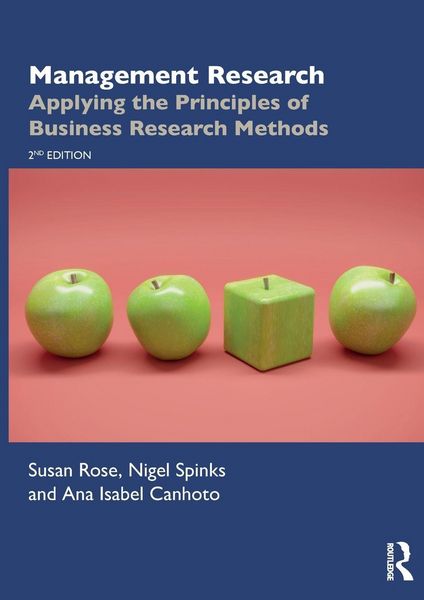
  • Produktbild: Management Research
  • Produktbild: Management Research

Management Research Applying the Principles of Business Research Methods

76,99 €

inkl. gesetzl. MwSt., Versandkostenfrei


Beschreibung

Produktdetails

Einband

Taschenbuch

Erscheinungsdatum

05.12.2023

Abbildungen

schwarz-weiss Illustrationen, Zeichnungen, schwarz-weiss, Tabellen, schwarz-weiss

Verlag

Taylor & Francis

Seitenzahl

482

Maße (L/B/H)

24,6/17,4/2,6 cm

Gewicht

853 g

Auflage

2. Auflage

Sprache

Englisch

ISBN

978-1-03-246295-0

Beschreibung

Rezension

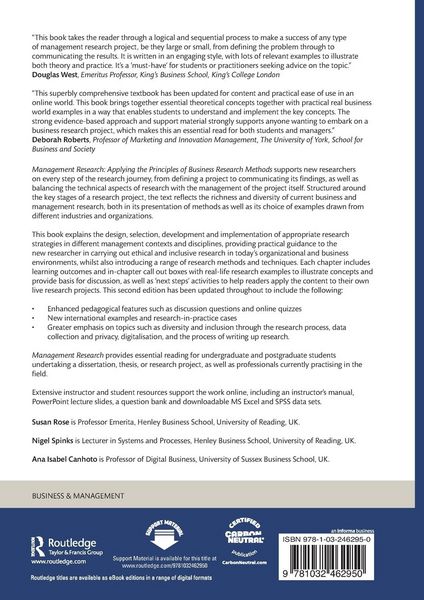
"This book takes the reader through a logical and sequential process to make a success of any type of management research project, be they large or small, from defining the problem through to communicating the results. It is written in an engaging style, with lots of relevant examples to illustrate both theory and practice. It's a 'must-have' for students or practitioners seeking advice on the topic." Douglas West, Emeritus Professor, King's Business School, King's College London.

"This superbly comprehensive textbook has been updated for content and practical ease of use in an online world. This book brings together essential theoretical concepts together with practical real business world examples in a way that enables students to understand and implement the key concepts. The strong evidence-based approach and support material strongly supports anyone wanting to embark on a business research project, which makes this an essential read for both students and managers." Deborah Roberts, Professor of Marketing and Innovation Management, The University of York, School for Business and Society

Produktdetails

Einband

Taschenbuch

Erscheinungsdatum

05.12.2023

Abbildungen

schwarz-weiss Illustrationen, Zeichnungen, schwarz-weiss, Tabellen, schwarz-weiss

Verlag

Taylor & Francis

Seitenzahl

482

Maße (L/B/H)

24,6/17,4/2,6 cm

Gewicht

853 g

Auflage

2. Auflage

Sprache

Englisch

ISBN

978-1-03-246295-0

Herstelleradresse

Libri GmbH
Europaallee 1
36244 Bad Hersfeld
DE

Email: gpsr@libri.de

Noch keine Bewertungen vorhanden

Verfassen Sie die erste Bewertung zu diesem Artikel

Helfen Sie anderen Kundinnen und Kunden durch Ihre Meinung.

Kundinnen und Kunden meinen

Bewertungen (0)

Die Leseprobe wird geladen.
  • Produktbild: Management Research
  • Produktbild: Management Research
  • List of figures

    List of tables

    Preface

    Acknowledgements

    Glossary

    PART I Define

    1 Researching in business and management

    1.1 Introduction

    1.2 Defining management research

    1.3 The relationship between research and practice

    1.4 The relationship between research and theory

    1.5 Research and philosophy

    1.6 Reflexivity and the researcher

    2 Formulating your research problem

    2.1 Introduction

    2.2 A problem-solving view of research

    2.3 Choosing a research problem

    2.4 Developing your research questions

    3 Reviewing the Literature

    3.1 Introduction

    3.2 Undertaking a critical review

    3.3 Search

    3.4 Capture

    3.5 Synthesize

    3.6 Present

    PART II Design

    4 Designing your research

    4.1 Introduction

    4.2 Integrating theory into your research

    4.3 What are quantitative, qualitative or mixed methods?

    4.4 Linking research design to your research questions

    4.5 Time horizon

    4.6 Primary and secondary data

    4.7 Quality in Research

    5 Conducting research ethically and inclusively

    5.1 Introduction

    5.2 Ethics in research

    5.3 Avoidance of harm or loss of dignity

    5.4 Transparency and honesty

    5.5 Right to privacy

    5.6 Inclusivity in research

    5.7 Ethics in online research

    5.8 The role of codes of ethics and gaining ethical approval

    5.9 Researcher integrity

    5.10 Identifying the ethical dimensions of your own research project

    6 Quantitative Research Designs

    6.1 Introduction

    6.2 Experimental and quasi-experimental designs

    6.3 Natural experiments and correlational studies

    6.4 Survey studies

    6.5 Content analysis

    6.6 Data-driven quantitative research

    6.7 Choosing a quantitative research design

    7 Qualitative and Mixed Methods Research Designs

    7.1 Introduction

    7.2 Ethnography

    7.3 Grounded theory

    7.4 Case study research design

    7.5 Action research

    7.6 Interview studies

    7.7 Qualitative approaches to language analysis

    7.8 Choosing a qualitative research design

    7.9 Mixed method research designs

    8 Planning and managing your research project

    8.1 Introduction

    8.2 Selecting a research design

    8.3 Planning your research project

    8.4 Managing your research project

    8.5 Keeping a research diary

    8.6 Preparing a research proposal

    PART III Collect

    9 Sampling

    9.1 Introduction

    9.2 What is a sample?

    9.3 Sampling methods

    9.4 Sampling in quantitative, qualitative, and mixed-methods research

    9.5 Sample size

    9.6 Accessing and recruiting your sample

    10 Collecting data using questionnaires

    10.1 Introduction

    10.2 Why and when to use a questionnaire

    10.3 The questionnaire design process

    10.4 Identify relevant concepts/variables

    10.5 Formulate your questions and decide the level of measurement

    10.6 Structure and lay out the questionnaire

    10.7 Pre-test and pilot the questionnaire

    10.8 Administer and distribute the questionnaire

    11 Collecting data using in-depth interviews

    11.1 Introduction

    11.2 Individual interviews

    11.3 Group interviews

    11.4 Capturing and storing your interview data

    12 Collecting data using diaries and naturally occurring data

    12.1 Introduction

    12.2 Diaries and other researcher-instigated documents

    12.3 Collecting data by observation

    12.4 Collecting data through social media

    12.5 Collecting documents and other records

    12.6 Big data

    12.7 Artefacts

    PART IV Analyse

    13 Analysing quantitative data

    13.1 Introduction

    13.2 Entering your data

    13.3 Preparing your data for analysis

    13.4 Exploring and describing your data

    13.5 Answering your research questions

    13.6 Presenting your findings

    13.7 Summary of chart types used in this chapter

    13.8 Summary of statistical tests used in this chapter

    14 Analysing qualitative data

    14.1 Introduction

    14.2 Preparing and organizing your data

    14.3 Coding your data

    14.4 Using computers in qualitative data analysis

    14.5 Using visualization to make connections

    14.6 Answering your research question

    14.7 Drawing and verifying conclusions

    14.8 Reporting qualitative data analysis

    PART V Communicate

    15 Reporting your research

    15.1 Introduction

    15.2 Writing for an academic qualification

    15.3 Writing for an academic journal

    15.4 Writing for a practitioner audience

    15.5 The process of writing

    15.6 Presenting your research project

    15.7 Other ways of disseminating your research