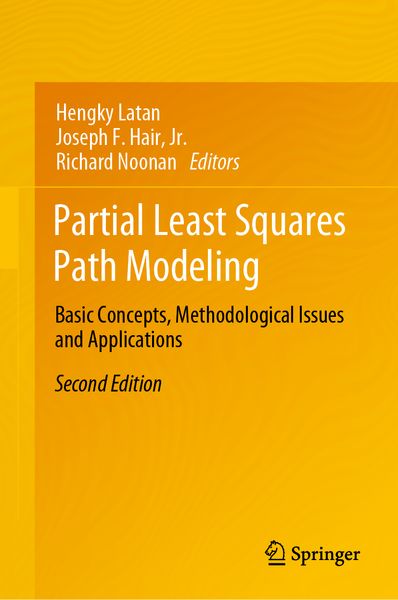
Partial Least Squares Path Modeling Basic Concepts, Methodological Issues and Applications
-
- Hardcover ausgewählt
- Taschenbuch
- eBook
-
Sprache:Englisch
-
Auflage:Second Edition 2023
209,99 €
UVP
241,99 €
inkl. gesetzl. MwSt.,
Beschreibung
Produktdetails
Einband
Gebundene Ausgabe
Erscheinungsdatum
15.11.2023
Abbildungen
XXXVI, 472 p. 90 illus., 28 illus. in color.
Herausgeber
Hengky Latan + weitereVerlag
SpringerSeitenzahl
472
Maße (L/B/H)
24,1/16/3,3 cm
Gewicht
922 g
Auflage
Second Edition 2023
Sprache
Englisch
ISBN
978-3-031-37771-6
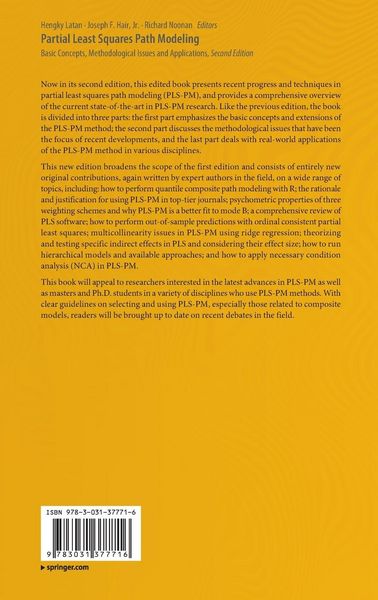
Now in its second edition, this edited book presents recent progress and techniques in partial least squares path modeling (PLS-PM), and provides a comprehensive overview of the current state-of-the-art in PLS-PM research. Like the previous edition, the book is divided into three parts: the first part emphasizes the basic concepts and extensions of the PLS-PM method; the second part discusses the methodological issues that have been the focus of recent developments, and the last part deals with real-world applications of the PLS-PM method in various disciplines.
This new edition broadens the scope of the first edition and consists of entirely new original contributions, again written by expert authors in the field, on a wide range of topics, including: how to perform quantile composite path modeling with R; the rationale and justification for using PLS-PM in top-tier journals; psychometric properties of three weighting schemes and why PLS-PM is a better fit to mode B; a comprehensive review of PLS software; how to perform out-of-sample predictions with ordinal consistent partial least squares; multicollinearity issues in PLS-PM using ridge regression; theorizing and testing specific indirect effects in PLS and considering their effect size; how to run hierarchical models and available approaches; and how to apply necessary condition analysis (NCA) in PLS-PM.
This book will appeal to researchers interested in the latest advances in PLS-PM as well as masters and Ph.D. students in a variety of disciplines who use PLS-PM methods. With clear guidelines on selecting and using PLS-PM, especially those related to composite models, readers will be brought up to date on recent debates in the field.
Noch keine Bewertungen vorhanden
Verfassen Sie die erste Bewertung zu diesem Artikel
Helfen Sie anderen Kundinnen und Kunden durch Ihre Meinung.
Kurze Frage zu unserer Seite
Vielen Dank für Ihr Feedback
Wir nutzen Ihr Feedback, um unsere Produktseiten zu verbessern. Bitte haben Sie Verständnis, dass wir Ihnen keine Rückmeldung geben können. Falls Sie Kontakt mit uns aufnehmen möchten, können Sie sich aber gerne an unseren Kund*innenservice wenden.
zum Kundenservice