• Produktbild: Issues in Science and Theology: Creative Pluralism?
  • Produktbild: Issues in Science and Theology: Creative Pluralism?
- 13%

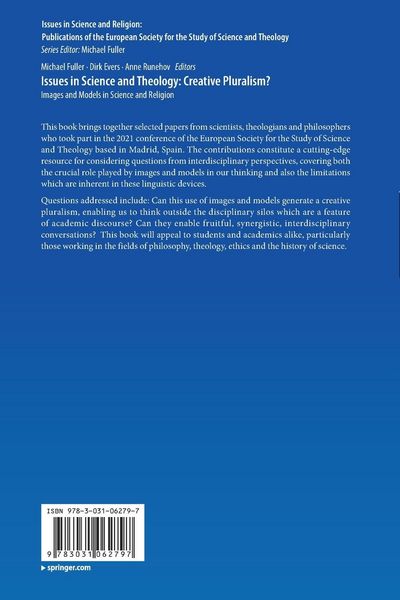
Issues in Science and Theology: Creative Pluralism? Images and Models in Science and Religion

13% sparen

123,99 € UVP 142,99 €

inkl. gesetzl. MwSt., Versandkostenfrei


Beschreibung

Produktdetails

Einband

Taschenbuch

Erscheinungsdatum

30.06.2023

Herausgeber

Michael Fuller + weitere

Verlag

Springer

Seitenzahl

222

Maße (L/B/H)

23,5/15,5/1,4 cm

Gewicht

371 g

Auflage

1st ed. 2022

Sprache

Englisch

ISBN

978-3-031-06279-7

Beschreibung

Portrait

Michael Fuller is a lecturer in science and religion at the University of Edinburgh. He is the author of a monograph and numerous articles dealing with the interface of science and religion, and he has edited numerous symposia relating to this subject. He is a former Chair of the UK Science and Religion Forum, and Vice-President for Publications of the European Society for the Study of Science and Theology. He is an Anglican Priest, a Canon of St Mary’s Cathedral, Edinburgh, and for 15 years he was Pantonian Professor at the Theological Institute of the Scottish Episcopal Church. His research interests include ethical issues raised by new and emerging sciences.

Dirk Evers is Professor of Dogmatics and Philosophy of Religion at Martin-Luther-University Halle-Wittenberg, Germany. Before joining Halle University in 2010 as a faculty member, he worked as assistant professor at Tübingen University under Eberhard Jüngel. Since his doctoral thesis on cosmologyand doctrine of creation in 2000 he has been doing interdisciplinary work at the intersection of science and theology. Since 2014 he has been president of ESSSAT (European Society for the Study of Science and Theology), and he is managing editor of the journal Philosophy, Theology, and the Sciences .

Anne L.C. Runehov is retired Assoc. Professor of Philosophy of Religion, Uppsala University. She works as a freelance writer for the section of Philosophy, National Encyclopedia (NE), Malmö, since 2019, and is an independent researcher, editor and writer. She was a guest-researcher at the Dept. Systematic Theology, Faculty of Theology, Copenhagen University, Nov. 1, 2010 – Oct. 2014. There she also was director of the Copenhagen University Network of Science and Religion (CUNCR) 2008-2013. She was a Post-doctoral fellow: Centre for Naturalism and Christian Semantics, Faculty of Theology, Copenhagen University, Sept. 1, 2008 to October 30, 2010, and at the Dept. Systematic Theology, Copenhagen University, Faculty of Theology, June 2006 – August 2008.

Produktdetails

Einband

Taschenbuch

Erscheinungsdatum

30.06.2023

Herausgeber

Verlag

Springer

Seitenzahl

222

Maße (L/B/H)

23,5/15,5/1,4 cm

Gewicht

371 g

Auflage

1st ed. 2022

Sprache

Englisch

ISBN

978-3-031-06279-7

Herstelleradresse

Springer-Verlag KG
Sachsenplatz 4-6
1201 Wien
AT

Email: GPSR Kontakt

Noch keine Bewertungen vorhanden

Verfassen Sie die erste Bewertung zu diesem Artikel

Helfen Sie anderen Kundinnen und Kunden durch Ihre Meinung.

Kundinnen und Kunden meinen

Bewertungen (0)

  • Produktbild: Issues in Science and Theology: Creative Pluralism?
  • Produktbild: Issues in Science and Theology: Creative Pluralism?
  • Preface.- Introduction (Michael Fuller and Anne Runehov).- Part 1: Philosophical and methodological perspectives.- Chapter 1. Unavoidable pluralism in theology and transitory pluralism in science? Mapping the diversity (Lluis Oviedo).- Chapter 2. Image, Metaphor, and Understanding in Science and Theology (Andrew Pinsent).- Chapter 3. Science and religion complement each other, not compete with one another (Rana Dajani).- Chapter 4. The Role of Images in the Social Construction of (Un-)Availability: Theoretical Considerations and Empirical Illustrations (Silke Gülker).- Chapter 5. Telling Stories in the Pluriverse: Decolonial Options for Creative Pluralism (Lisa L. Stenmark).- Chapter 6. On the Importance of Reaching a ‘Maturation Point’ Before Science and Religion can Interact (Emily Qureshi-Hurst).- Part 2: Scientific perspectives.- Chapter 7. The holism of the new physics, and its form of opening to the modern sense of the religious (Javier Monserrat).- Chapter 8. Shifts in the Scientific Mind: Mapping Einstein’s views on imagination (Eduardo Gutierrez Gonzales).- Chapter 9. Models, Muddles, and Metaphors of the Transcendent (Alfred Kracher).- Chapter 10. On the Hard Problem of Consciousness: How a naturalist (representational) epistemological understanding can be easily harmonized with developments in neuroscience, and post-modern critique (Luis Amaral).- Chapter 11. Imagining the Infinite: Transcendent Models as a Fundamental Nexus between Science and Religion (Buki Fatona).- Chapter 12. The Selective Awareness Experiment: An Argument for Causal Pluralism (Bruno Petrušić and Niels Henrik Gregersen).- Part 3: Religious perspectives.- Chapter 13. Models for intertwining God’s story and the universe story (Ernst M. Conradie).- Chapter 14. Nescience: a contrast in the uses of models within science and theology (Michael Fuller).- Chapter 15. Christology, Psychology, and Participation: A Model for Relating Psychological and Theological Understandings of Humanity (James Thieke).- Chapter 16. Dynamic Systems Theory Meets Theological Anthropology: A Case Study on the Use of Scientific Models in Theological Inquiry (Janna Gonwa).- Chapter 17. Does pluralism itself need to be plural? (Philippe Gagnon).- Chapter 18. Images, metaphors, and models in the Quest for Sustainability: The overlapping geography of scientific and religious insights (Jaime Tatay).- Chapter 19. Towards a New Understanding of Embodiment: Alternative Models to the Western Mind-Body Relationship (Sara Lumbreras).- Index.