Gutscheinbedingungen

**Gültig nur für Bestellungen an die Wunsch-Poststation bis 10.06.2026 auf Spielzeug, Schreibwaren, Filme, Geschenke & Trends, Musik, tolino eReader & Zubehör, Hörbücher und Hörbuch-Downloads (außer Abo), nicht preisgebundene Bücher und Kalender online auf thalia.at und in der Thalia App. Einzelne Artikel können ausgeschlossen sein. Aufgrund der Buchpreisbindung sind deutschsprachige Bücher und eBooks ausgenommen. Zusätzlich ausgenommen sind preisgebundene Artikel, Abos & Flatrates, eBooks, Games, Geschenkkarten/-boxen, Shelfies, Software, Zeitschriften sowie einzelne Artikel von tonies®. Pro Einkauf einmal einlösbar. Kein Click & Collect möglich. Keine Barauszahlung. Nicht kombinierbar mit anderen Aktionen und Gutscheinen. Gutschein wird auf max. 500€ Bestellwert angerechnet. Nicht gültig für Versandkosten und Services.

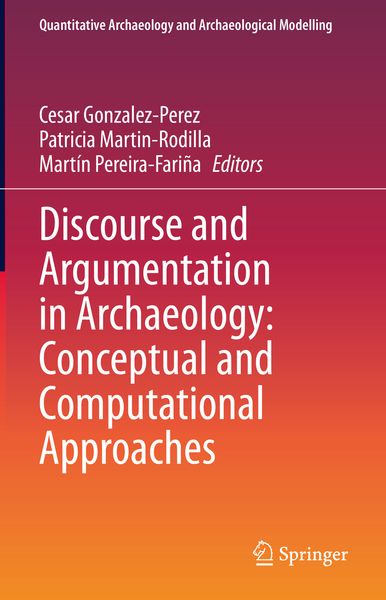
Produktbild: Discourse and Argumentation in Archaeology: Conceptual and Computational Approaches
- 12%

Discourse and Argumentation in Archaeology: Conceptual and Computational Approaches

12% sparen

133,99 € UVP 153,99 €

inkl. gesetzl. MwSt., Versandkostenfrei


Beschreibung

Produktdetails

Einband

Gebundene Ausgabe

Erscheinungsdatum

04.11.2023

Herausgeber

Cesar Gonzalez-Perez + weitere

Verlag

Springer

Seitenzahl

322

Maße (L/B/H)

24,1/16/2,3 cm

Gewicht

744 g

Sprache

Englisch

ISBN

978-3-031-37155-4

Beschreibung

Portrait

Cesar Gonzalez-Perez is a Staff Scientist at Incipit CSIC, where he leads research in software and cultural heritage. His main interests are knowledge generation and communication. Cesar has edited an ISO standard, evaluates research in 6 countries, has started 3 technology-based companies, is an honorary member of Computer Applications and Quantitative Methods in Archaeology, and has authored over 100 publications.

Patricia Martín-Rodilla is currently a lecturer at the Information Retrieval Lab of the University of A Coruña. She was a postdoctoral researcher at the University of Santiago de Compostela and Incipit-CSIC, with stays in Australia, France, Chile and Portugal. She has worked on multiple archaeology and software engineering projects and has authored over 40 publications. Her main interests are areas of intersection between language, software engineering, and humanities (i.e. computational linguistics, information modelling, social networks, etc.) with a particular focus on Digital Humanities research questions and approaches.

Martín Pereira-Fariña is a lecturer at the Department of Philosophy and Anthropology of the University of Santiago de Compostela. His main interests are argumentation theory, philosophy of language and computational models for knowledge representation and reasoning. Martin has been a postdoc researcher at the Centre of Argument Technology (University of Dundee, Scotland) and at Incipit CSIC, and he has authored over 30 publications.

Produktdetails

Einband

Gebundene Ausgabe

Erscheinungsdatum

04.11.2023

Herausgeber

Verlag

Springer

Seitenzahl

322

Maße (L/B/H)

24,1/16/2,3 cm

Gewicht

744 g

Sprache

Englisch

ISBN

978-3-031-37155-4

Herstelleradresse

Springer-Verlag KG
Sachsenplatz 4-6
1201 Wien
AT

Email: ProductSafety@springernature.com

Kundinnen und Kunden meinen

0 Bewertungen

Informationen zu Bewertungen

Zur Abgabe einer Bewertung ist eine Anmeldung im Konto notwendig. Die Authentizität der Bewertungen wird von uns nicht überprüft. Wir behalten uns vor, Bewertungstexte, die unseren Richtlinien widersprechen, entsprechend zu kürzen oder zu löschen.

Die Bewertungen sind nach Format, Anzahl Sterne und Datum sortiert.

Verfassen Sie die erste Bewertung zu diesem Artikel

Helfen Sie anderen Kund*innen durch Ihre Meinung

Kundinnen und Kunden meinen

0 Bewertungen filtern

  • Produktbild: Discourse and Argumentation in Archaeology: Conceptual and Computational Approaches
  • Chapter 1. Introduction to Discourse Analysis and Argumentation Theory (Martín Pereira-Fariña).- Part 1. Conceptual Approaches.- Chapter 2. A New Approach to Interoperable Argumentation Documentation (Stephen Stead).- Chapter 3. Making Good Arguments in Archaeology (Michael E. Smith).- Chapter 4. A Causal Model Application to a Cultural Heritage Sentence Analysis (Alejandro Sobrino).- Chapter 5. What Archaeological Texts Argue About: Denotations and Ontological Proxies (Cesar Gonzalez-Perez).- Chapter 6. The Social Production of Discourse in Archaeology (Isto Huvila).- Chapter 7. Dealing with Vagueness in Archaeological Discourses (Cesar Gonzalez-Perez).- Chapter 8. Extending Discourse Analysis in Archaeology: A Multimodal Approach (Jeremy Huggett).- Part 2. Computational Techniques.- Chapter 9. Computer Processing of Language: Where Archaeological Discourse and Computers Meet (Patricia Martín-Rodilla).- Chapter 10. NLP and Archaeology: A View from a Digital Archive (Holly Wright)- Chapter 11. Information Extraction and Machine Learning for Archaeological Texts (Alex Brandsen).- Chapter 12. Argument Mining and Analytics in Archaeology (John Lawrence).- Chapter 13. Computational Processing of Language Vagueness for Archaeological Site Modelling (Maria Elena Castiello).- Part 3. The Future.- Chapter 14. Future Directions (Cesar Gonzalez-Perez).