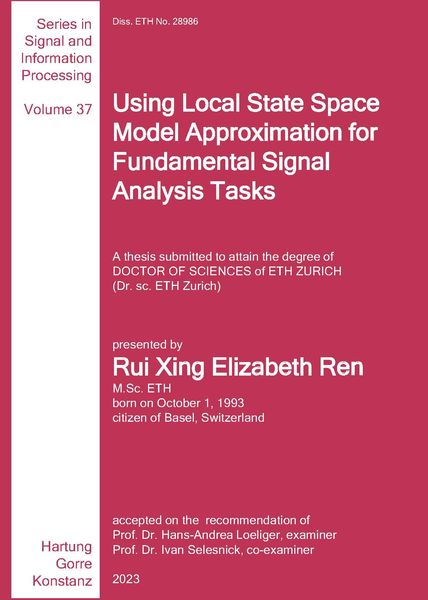

Using Local State Space Model Approximation for Fundamental Signal Analysis Tasks
-
- Englisch ausgewählt
65,80 €
inkl. gesetzl. MwSt.,
Beschreibung
Produktdetails
Einband
Paperback
Erscheinungsdatum
01.05.2023
Herausgeber
Hans-Andrea LoeligerVerlag
Hartung-GorreSeitenzahl
268
Maße (L/B/H)
21/14,8/1,8 cm
Gewicht
418 g
Auflage
2023
Sprache
Englisch
ISBN
978-3-86628-792-1
First, we complete the existing framework. The ALSSM parameterization and RLS recursions are provided for a general function. The solution of the fit parameters for different constraint problems are reviewed. Moreover, feature extraction from both the fit parameters and the cost is detailed as well as examples of their use. In particular, we introduce terminology to analyze the fitting problem from the perspective of projection to a local Hilbert space and as a linear filter. Analytical rules are given for computation of the equivalent filter response and the steady-state precision matrix of the cost.
After establishing the local approximation framework, we further discuss two classes of signal models in particular, namely polynomial and sinusoidal functions. The signal models are complementary, as by nature, polynomials are suited for time-domain description of signals while sinusoids are suited for the frequency-domain.
For local approximation of polynomials, we derive analytical expressions for the steady-state covariance matrix and the linear filter of the coefficients based on the theory of orthogonal polynomial bases. We then discuss the fundamental application of smoothing filters based on local polynomial approximation. We generalize standard SG filters to any ALSSM window and introduce a novel class of smoothing filters based on polynomial fitting to running sums. The properties of the smoothing filters are derived and compared.
Finally, we discuss local sinusoidal approximation. A versatile set of tools is introduced which can be combined to extend the local fitting to signal analysis of locally periodic signals. The tools comprise time-frequency representations of the signals, novel spectrograms based on goodness of fit measures, as well as basic methods for detection of onsets after periods of noise, time shift computation from the model fits and phase and frequency tracking. Our time-frequency representations can be understood as the generalization of the standard STFT to any ALSSM window. The use of the toolbox is demonstrated via several real-world applications. We discuss the estimation of the interaural time delay with a method inspired by the psychoacoustical precedence effect. Furthermore, we propose a scheme for clock synchronization based on our frequency tracking tool. Finally, all the tools are combined for acoustic scene analysis in recordings of killer whale vocalizations.
Noch keine Bewertungen vorhanden
Verfassen Sie die erste Bewertung zu diesem Artikel
Helfen Sie anderen Kundinnen und Kunden durch Ihre Meinung.
Kurze Frage zu unserer Seite
Vielen Dank für Ihr Feedback
Wir nutzen Ihr Feedback, um unsere Produktseiten zu verbessern. Bitte haben Sie Verständnis, dass wir Ihnen keine Rückmeldung geben können. Falls Sie Kontakt mit uns aufnehmen möchten, können Sie sich aber gerne an unseren Kund*innenservice wenden.
zum Kundenservice