Gutscheinbedingungen

**Gültig bis 06.07.2026 auf fremdsprachige Bücher online auf thalia.at, in der Thalia App ab einem Mindestbestellwert von 30€ und in allen Thalia Buchhandlungen in Österreich. In den Buchhandlungen nur gültig auf lagernde Ware. Einzelne Artikel können ausgeschlossen sein. Ausgenommen sind preisgebundene Artikel & eBooks. Pro Einkauf einmal einlösbar. Nur gültig gegen Vorlage oder im Onlineshop hinterlegter Bonuscard. Infos zur Einlösung in der Buchhandlung sind auf der Bonuscard-Vorteilspreisseite zu finden. Click & Collect nur bei Onlinevorabzahlung möglich. Keine Einlösung bei Scan & Go-Bezahlung. Keine Barauszahlung. Nicht kombinierbar mit anderen Aktionen und Gutscheinen. Gutschein wird auf max. 500€ Bestellwert angerechnet. Nicht gültig für Versandkosten und Services.

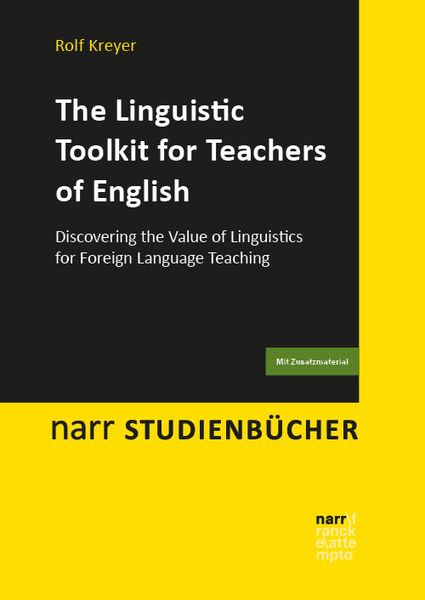
Produktbild: The Linguistic Toolkit for Teachers of English

The Linguistic Toolkit for Teachers of English Discovering the Value of Linguistics for Foreign Language Teaching

Aus der Reihe Narr Studienbücher

27,80 €

inkl. gesetzl. MwSt., zzgl. Versandkosten


  • Kostenlose Lieferung ab 30 € Einkaufswert
  • Versandkostenfrei für Bonuscard-Kund*innen

Beschreibung

Produktdetails

Einband

Taschenbuch

Erscheinungsdatum

23.10.2023

Verlag

Narr Francke Attempto

Seitenzahl

305

Maße (L/B/H)

24,1/17,2/2,5 cm

Gewicht

584 g

Auflage

1. Auflage

Sprache

Englisch

ISBN

978-3-8233-8611-7

Beschreibung

Produktdetails

Einband

Taschenbuch

Erscheinungsdatum

23.10.2023

Verlag

Narr Francke Attempto

Seitenzahl

305

Maße (L/B/H)

24,1/17,2/2,5 cm

Gewicht

584 g

Auflage

1. Auflage

Sprache

Englisch

ISBN

978-3-8233-8611-7

Herstelleradresse

Narr Dr. Gunter
Dischingerweg 5
72070 Tübingen
DE

Email: GPSR Kontakt

Noch keine Bewertungen vorhanden

Verfassen Sie die erste Bewertung zu diesem Artikel

Helfen Sie anderen Kundinnen und Kunden durch Ihre Meinung.

Kundinnen und Kunden meinen

Bewertungen (0)

Weitere Artikel finden Sie in

  • Produktbild: The Linguistic Toolkit for Teachers of English
  • INTRODUCTION
    1 "I just want to be a teacher"
    2 A toolkit and what's in it
    2.1 What tools are good for
    2.2 The art of repairing
    2.2.1 Errors and why they are a good thing
    2.2.2 Interlanguage
    2.2.3 What is an error
    SOUNDS
    3 "What are you sinking about?" - sounds in isolation
    3.1 The description of sounds
    3.2 A comparison of English and German consonants
    3.3 A comparison of English and German vowels
    4 "France is bacon" - Sounds in speech
    4.1 Phonemes, phones and allophones
    4.2 When Alastor Moody has a mat eye - allophonic contrasts
    4.3 "France is bacon" - sounds in speech
    4.3.1 Assimilation
    4.3.2 Weak forms
    4.3.3 Linking
    WORDS AND BEYOND
    5 Nodes and links - the mental lexicon
    5.1 Webs of words, not lists
    5.2 The mental lexicon - some basics
    5.3 Stay connected - links in the mental lexicon
    5.3.1 Defining features
    5.3.2 Encyclopaedic relations
    5.3.3 (Mostly) sense relations
    5.3.4 Collocation and other relations in language use
    5.4 What Taboo can teach us about teaching words
    6 Think big! More than words
    6.1 Why tea can be powerful ... and why it shouldn't
    6.2 Lexical phrases
    6.3 Patterns and their relevance for the classroom
    6.4 Teaching patterns
    THE CORPUS IN THE CLASSROOM
    7 The theory of practical corpus analysis
    7.1 The corpus as a collection of authentic language
    7.2 Words and their contexts
    7.3 More than words - annotation provided in corpora
    8 A more practical introduction to corpus analysis
    8.1 Wild cards, regular expressions and corpus queries
    8.2 Corpus queries - exploiting lemmatization and tagging
    8.3 Corpus queries - collocations
    8.4 Corpora in the classroom
    8.4.1 Benefits and opportunities
    8.4.2 Poblems and pitfalls
    TEXTS
    9 What makes a text a (good) text
    9.1 What makes a text a text - Standards of textuality
    9.2 The relevance of text structure
    9.2.1 Themes and rhemes
    9.2.2 Rhetorical Structure Theory
    10 Texts and the relevance of sentence structure
    10.1 Principles of text processing
    10.1.1 The Given-before-new Principle
    10.1.2 The Principle of End-focus
    10.1.3 The Principle of End-Weight
    10.2 Helpful sentence structures
    10.2.1 Non-canonical clause patterns
    10.2.2 Secondary clause patterns
    10.3 From text to good text - an example
    11 Texts and the relevance of the situation
    11.1 Spoken and written English
    11.2 The interpersonal dimension - politeness
    THE POWER OF LANGUAGE
    12 The recipient
    12.1 Humans - the not so rational animals
    12.2 Communication and the unpacking of information
    12.2.1 Exploiting the Co-operative Principle
    12.2.2 Background knowledge
    12.2.3 Don't think of an elephant!
    13 The producer
    13.1 Packaging information
    13.1.1 The right word at the right time
    13.1.2 Beyond the word level
    13.1.3 Of swarms and floods - the power of metaphor
    13.1.4 Framing
    13.1.5 (Faulty) logic and argumentation
    13.2 Walking uphill