Gutscheinbedingungen

**Gültig bis 06.07.2026 auf fremdsprachige Bücher online auf thalia.at, in der Thalia App ab einem Mindestbestellwert von 30€ und in allen Thalia Buchhandlungen in Österreich. In den Buchhandlungen nur gültig auf lagernde Ware. Einzelne Artikel können ausgeschlossen sein. Ausgenommen sind preisgebundene Artikel & eBooks. Pro Einkauf einmal einlösbar. Nur gültig gegen Vorlage oder im Onlineshop hinterlegter Bonuscard. Infos zur Einlösung in der Buchhandlung sind auf der Bonuscard-Vorteilspreisseite zu finden. Click & Collect nur bei Onlinevorabzahlung möglich. Keine Einlösung bei Scan & Go-Bezahlung. Keine Barauszahlung. Nicht kombinierbar mit anderen Aktionen und Gutscheinen. Gutschein wird auf max. 500€ Bestellwert angerechnet. Nicht gültig für Versandkosten und Services.

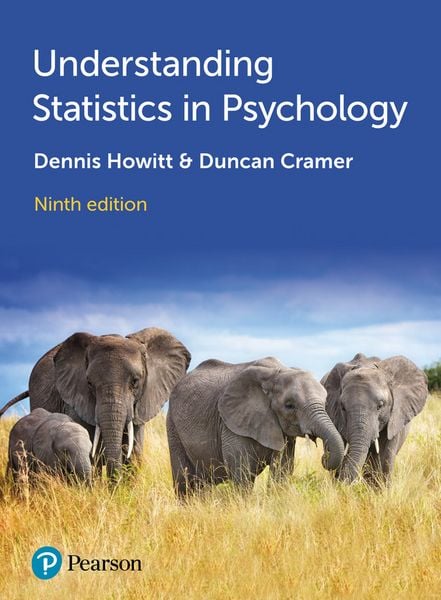
Produktbild: Understanding Statistics in Psychology

Understanding Statistics in Psychology

86,99 €

inkl. gesetzl. MwSt., Versandkostenfrei


Beschreibung

Produktdetails

Einband

Taschenbuch

Erscheinungsdatum

05.11.2024

Verlag

Pearson Studium

Seitenzahl

680

Maße (L/B/H)

26,5/19,5/3,7 cm

Gewicht

1242 g

Auflage

9

Sprache

Englisch

ISBN

978-1-292-46518-0

Beschreibung

Produktdetails

Einband

Taschenbuch

Erscheinungsdatum

05.11.2024

Verlag

Pearson Studium

Seitenzahl

680

Maße (L/B/H)

26,5/19,5/3,7 cm

Gewicht

1242 g

Auflage

9

Sprache

Englisch

ISBN

978-1-292-46518-0

Herstelleradresse

Libri GmbH
Europaallee 1
36244 Bad Hersfeld
DE

Email: GPSR Kontakt

Noch keine Bewertungen vorhanden

Verfassen Sie die erste Bewertung zu diesem Artikel

Helfen Sie anderen Kundinnen und Kunden durch Ihre Meinung.

Kundinnen und Kunden meinen

Bewertungen (0)

Die Leseprobe wird geladen.
  • Produktbild: Understanding Statistics in Psychology
  • Preface

    1. Why statistics?
    Part 1 Descriptive statistics
    1. Some basics: Variability and measurement
    2. Describing variables: Tables and diagrams
    3. Describing variables numerically: Averages, variation and spread
    4. Shapes of distributions of scores
    5. Standard deviation and z-scores: Standard unit of measurement in statistics
    6. Relationships between two or more variables: Diagrams and tables
    7. Correlation coefficients: Pearsons correlation and Spearman's rho
    8. Regression: Prediction with precision
    Part 2 Significance testing
    1. Samples from populations
    2. Statistical significance for the correlation coefficient: Practical introduction to statistical inference
    3. Standard error: Standard deviation of the means of samples
    4. Related or paired-samples t-test: Comparing two samples of related/correlated/paired scores
    5. Unrelated or independent-samples t-test: Comparing two samples of unrelated/uncorrelated/independent scores
    6. What you need to write about your statistical analysis
    7. Confidence intervals
    8. Effect size in statistical analysis: Do my findings matter?
    9. Chi-square: Differences between samples of frequency data
    10. Probability
    11. One- versus two-tailed or -sided significance testing
    12. Ranking tests: Nonparametric statistics
    Part 3 Introduction to analysis of variance
    1. Variance ratio test: F-ratio to compare two variances
    2. Analysis of variance (ANOVA): One-way unrelated or uncorrelated ANOVA
    3. ANOVA for correlated scores or repeated measures
    4. Two-way or factorial ANOVA for unrelated/uncorrelated scores: Two studies for the price of one?
    5. Multiple comparisons in ANOVA: A priori and post hoc tests
    6. Mixed-design ANOVA: Related and unrelated variables together
    7. Analysis of covariance (ANCOVA): Controlling for additional variables
    8. Multivariate analysis of variance (MANOVA)
    9. Discriminant (function) analysis especially in MANOVA
    10. Statistics and analysis of experiments
    Part 4 More advanced correlational statistics
    1. Partial correlation: Spurious correlation, third or confounding variables, suppressor variables
    2. Factor analysis: Simplifying complex data
    3. Multiple regression and multiple correlation
    4. Path analysis
    5. Analysis of a questionnaire/survey project
    Part 5 Assorted advanced techniques
    1. Meta-analysis: Combining and exploring statistical findings from previous research
    2. Reliability in scales and measurement: Consistency and agreement
    3. Influence of moderator variables on relationships between two variables
    4. Statistical power analysis: Getting the sample size right
    Part 6 Advanced qualitative or nominal techniques
    1. Log-linear methods: Analysis of complex contingency tables
    2. Multinomial logistic regression: Distinguishing between several different categories or groups
    3. Binomial logistic regression
    Part 7 Bringing things together
    1. Data mining and Big Data
    2. Towards a masterplan

    Appendices

    Glossary

    References

    Index