KI-Beratung Beta

Gutscheinbedingungen

**Gültig am 27.11.2026 auf Spielzeug, Schreibwaren, Filme, Geschenke & Trends, Musik, tolino eReader & Zubehör, Hörbücher und Hörbuch-Downloads, nicht preisgebundene Bücher und Kalender online auf thalia.at und in der Thalia App. Einzelne Artikel können ausgeschlossen sein. Aufgrund der Buchpreisbindung sind deutschsprachige Bücher und eBooks ausgenommen. Zusätzlich ausgenommen sind Abos & Flatrates, Games, Geschenkkarten/-boxen, Shelfies, Software, Zeitschriften sowie einzelne Artikel von tonies®. Pro Einkauf einmal einlösbar. Click & Collect nur bei Onlinevorabzahlung möglich. Keine Barauszahlung. Nicht kombinierbar mit anderen Aktionen und Gutscheinen. Gutschein wird auf max. 500€ Bestellwert angerechnet. Nicht gültig für Versandkosten und Services.

  • Produktbild: Constructing Postdigital Research
  • Produktbild: Constructing Postdigital Research
- 13%

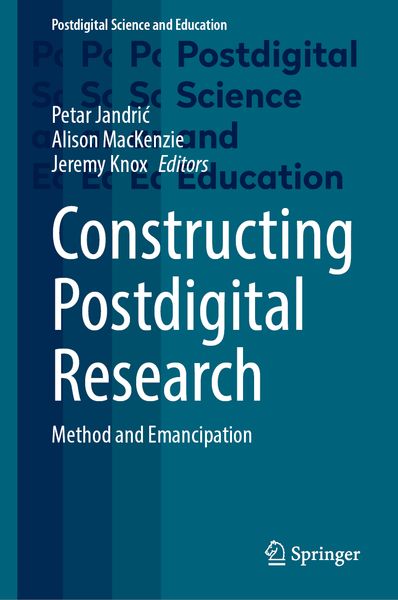
Constructing Postdigital Research Method and Emancipation

13% sparen

161,99 € UVP 186,99 €

inkl. gesetzl. MwSt., Versandkostenfrei


Beschreibung

This book delves into the various methods of constructing postdigital research, with a particular focus on the postdigital dynamic of inclusion and exclusion, as well as the interplay between method and emancipation. By answering three fundamental questions - the relationship between postdigital theory...

Beschreibung

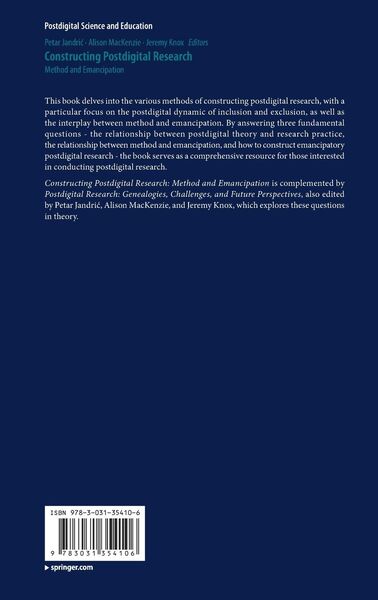
This book delves into the various methods of constructing postdigital research, with a particular focus on the postdigital dynamic of inclusion and exclusion, as well as the interplay between method and emancipation. By answering three fundamental questions - the relationship between postdigital theory and research practice, the relationship between method and emancipation, and how to construct emancipatory postdigital research - the book serves as a comprehensive resource for those interested in conducting postdigital research.

Constructing Postdigital Research: Method and Emancipation is complemented by Postdigital Research: Genealogies, Challenges, and Future Perspectives, also edited by Petar Jandrić, Alison MacKenzie, and Jeremy Knox, which explores these questions in theory.


Rezension

“This book helped me to grasp the multifaceted and boundary blurring nature of postdigital research and perceive the ambiguity and fluidity inherent in postdigital practices. While these issues are especially relevant for emerging researchers and those new to the postdigital perspective, I imagine that the book will also be useful for advanced scholars seeking to improve and critically reflect on their research practice.” (Katharina Poltze, Postdigital Science and Education, Vol. 6 (2), 2024)

Portrait

Petar Jandrić is Professor at the Zagreb University of Applied Sciences, Croatia. Petar’s research interests are at the postdisciplinary intersections between technologies, pedagogies, and the society, and research methodologies of his choice are inter-, trans-, and antidisciplinarity. His recent books include The Methodology and Philosophy of Collective Writing (2021), Bioinformational Philosophy and Postdigital Knowledge Ecologies (2022), Postdigital Ecopedagogies: Genealogies, Contradictions, and Possible Futures (2022), and Postdigital Research: Genealogies, Challenges, and Future Perspectives (2023).

Alison MacKenzie is a Reader at Queen’s University, Belfast. Alison’s research interests are in applied philosophy, particularly feminist and postdigital philosophy, epistemic injustice, and the related fields of epistemologies of ignorance and deceit. Alison has written on critical disability, the Capabilities Approach, and Bourdieusian analytical sociology. Alison is an Associate Editor of the International Journal of Educational Research and is on the editorial board of a number of journals, including Postdigital Science and Education. Her recent edited books are Epistemology of Deceit in a Postdigital Era (2021) and Postdigital Research: Genealogies, Challenges, and Future Perspectives (2023).

Jeremy Knox is Senior Lecturer and Co-director of the Centre for Research in Digital Education at the University of Edinburgh. His research interests include the relationships between education, data-driven technologies, and wider society, and he has led projects funded by the ESRC and the British Council in the UK. Jeremy’s published work includes Posthumanism and the MOOC (2016), Artificial Intelligence and Inclusive Education (2019), The Manifesto for Teaching Online (2020), Data Justice and the Right to the City (2022), AI and Education in China (2023), and Postdigital Research: Genealogies, Challenges, and Future Perspectives (2023).

Produktdetails

Einband

Gebundene Ausgabe

Erscheinungsdatum

02.08.2023

Abbildungen

XXXVI, 387 p. 1 illus.

Herausgeber Petar Jandrić + weitere

Produktdetails

Einband

Gebundene Ausgabe

Erscheinungsdatum

02.08.2023

Abbildungen

XXXVI, 387 p. 1 illus.

Herausgeber
Verlag Springer
Seitenzahl

387

Maße (L/B/H)

24,1/16/2,9 cm

Gewicht

747 g

Auflage

2023

Sprache

Englisch

ISBN

978-3-031-35410-6

Herstelleradresse

Springer-Verlag KG
Sachsenplatz 4-6
1201 Wien
AT

Email: ProductSafety@springernature.com

Noch keine Bewertungen vorhanden

Verfassen Sie die erste Bewertung zu diesem Artikel

Helfen Sie anderen Kundinnen und Kunden durch Ihre Meinung.

Kundinnen und Kunden meinen

Bewertungen (0)

Weitere Artikel finden Sie in

  • Produktbild: Constructing Postdigital Research
  • Produktbild: Constructing Postdigital Research
  • Part 1: Constructing Postdigital Research.- 1.Artificial intelligence in education research: a critical analysis and case study.- 2.Algorithmic systems claim education - and (re)production of societies.- 3.Constructing design knowledge for postdigital science and education.- 4.Collaborative Immersive Qualitative Analysis – A scenographic turn in postdigital research.- 5.Post-qualitative approaches in and for the postdigital age: towards speculative empirical methodologies.- 6.Discovering postdigital contexts using Actor Network Theory. A methodological toolkit and guide.- Part 2: Exclusions and Inclusions.- 7.International Human Rights in The Posthuman Era.- 8.Understanding children’s civil, political and social rights through a postdigital epistemology of silence.- 9.Digital Online Code of Practice and Human Rights Conventions to Protect Women Against Violence: Feminist Philosophy as Postdigital Method.- 10.Caring cuts into the postdigital – exploring postdigital methodologies withfeminist STS approaches.- 11.Vā and post–simultaneities: indigenising posthumanism and the postdigital research relatings.- Part 3: Method and Emancipation.- 12.What’s not to learn? A critical evaluation of the potential impact of Postdigital arts-based research as Resistance.- 13.Postdigital soundscape research.- 14.Maps as method in critical applied linguistics.- 15.Epistemological implications of digital messaging platforms: a case study in Lebanon.- 16.Vestigial Research for Postdigital Pataphysics.