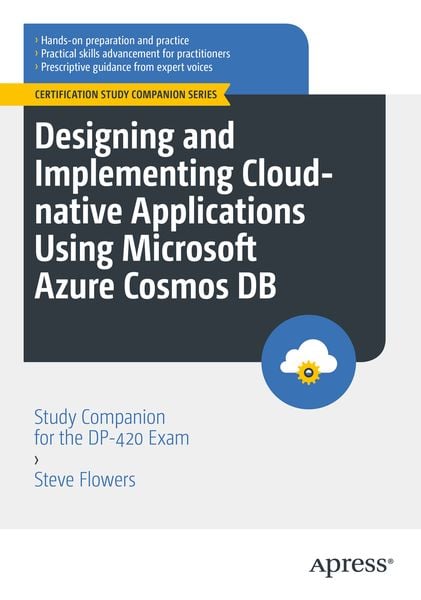
Designing and Implementing Cloud-native Applications Using Microsoft Azure Cosmos DB Study Companion for the DP-420 Exam
-
- Taschenbuch ausgewählt
- eBook
-
Sprache:Englisch
35,99 €
UVP
41,79 €
inkl. gesetzl. MwSt.,
Beschreibung
Produktdetails
Einband
Taschenbuch
Erscheinungsdatum
16.09.2023
Abbildungen
XIX, 199 p. 58 illus.
Verlag
ApressSeitenzahl
199
Maße (L/B/H)
25,4/17,8/1,3 cm
Gewicht
424 g
Auflage
23001 Auflage 1st ed
Sprache
Englisch
ISBN
978-1-4842-9546-5
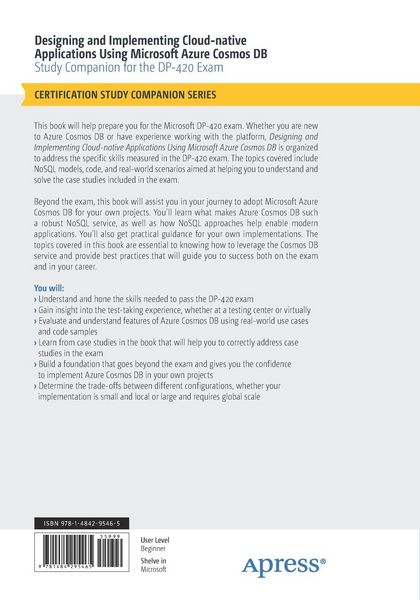
This book will help prepare you for the Microsoft DP-420 exam. Whether you are new to Azure Cosmos DB or have experience working with the platform,
Designing and Implementing Cloud-Native Applications Using Microsoft Azure Cosmos DB
is organized to address the specific skills measured in the DP-420 exam. The topics covered include NoSQL models, code, and real-world scenarios aimed at helping you to understand and solve the case studies included in the exam.
Beyond the exam, this book will assist you in your journey to adopt Microsoft Azure Cosmos DB for your own projects. You’ll learn what makes Azure Cosmos DB such a robust NoSQL service, as well as how NoSQL approaches help enable modern applications. You’ll also get practical guidance for your own implementations. The topics covered in this book are essential to knowing how to leverage the Cosmos DB service and provide best practices that will guide you to success both on the exam and in your career.
What You Will Learn
- Understand and hone the skills needed to pass the DP-420 exam
- Gain insight into the test-taking experience, whether at a testing center or virtually
- Evaluate and understand features of Azure Cosmos DB using real-world use cases and code samples
- Learn from case studies in the book that will help you to correctly address case studies in the exam
- Build a foundation that goes beyond the exam and gives you the confidence to implement Azure Cosmos DB in your own projects
- Determine the trade-offs between different configurations, whether your implementation is small and local or large and requires global scale
Who This Book Is For
Noch keine Bewertungen vorhanden
Verfassen Sie die erste Bewertung zu diesem Artikel
Helfen Sie anderen Kundinnen und Kunden durch Ihre Meinung.
Kurze Frage zu unserer Seite
Vielen Dank für Ihr Feedback
Wir nutzen Ihr Feedback, um unsere Produktseiten zu verbessern. Bitte haben Sie Verständnis, dass wir Ihnen keine Rückmeldung geben können. Falls Sie Kontakt mit uns aufnehmen möchten, können Sie sich aber gerne an unseren Kund*innenservice wenden.
zum Kundenservice