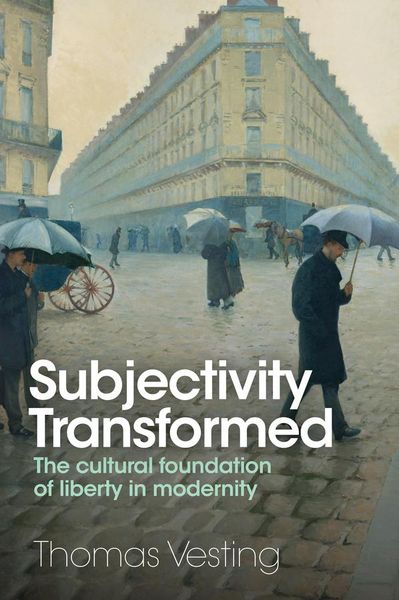
Subjectivity Transformed The Cultural Foundation of Liberty in Modernity
-
- Hardcover
- Taschenbuch ausgewählt
-
Sprache:Englisch
22,99 €
inkl. gesetzl. MwSt.,
- Kostenlose Lieferung ab 30 € Einkaufswert
- Versandkostenfrei für Bonuscard-Kund*innen
Beschreibung
Produktdetails
Einband
Taschenbuch
Erscheinungsdatum
21.02.2024
Verlag
John Wiley & SonsSeitenzahl
288
Maße (L/B/H)
22,8/15,4/2,7 cm
Gewicht
425 g
Auflage
1. Auflage
Übersetzt von
Neil Solomon
Sprache
Englisch
ISBN
978-1-5095-5336-5
This book provides an historically informed reconstruction of the social practices that have shaped the formation of the modern subject from the early modern period to the present. The formal legal protections accorded to subjects are, and always have been, latent in social practices, norms and language before they are articulated in formal legal orders. Vesting argues that, in Western societies, legal personhood is closely tied to three ideal types of social personhood - what he calls the gentleman, the manager, and Homo Digitalis. By examining these three ideal types and their emergence in society, we can see that Western formal law does not bring these ideal types into being but, on the contrary, arises from the social and cultural conditions that these ideal types generate and reflect. Correspondingly, Western legal personhood, or 'legal subjectivity', arises from the history and culture of Western nations, not the other way around. Therefore, signature features of Western formal law, particularly its valorization of the rights of persons (whether natural or non-natural), come from particular socio-historical cultural developments that had already generated the strong ideas of social personhood inherent in the ideal types of the gentleman, the manager, and Homo Digitalis. Subjectivity Transformed is a major contribution to legal and social theory and, with its original analysis of the formation of modern subjectivity, it will be of interest to students and scholars throughout the social sciences and humanities.
Noch keine Bewertungen vorhanden
Verfassen Sie die erste Bewertung zu diesem Artikel
Helfen Sie anderen Kundinnen und Kunden durch Ihre Meinung.
Kurze Frage zu unserer Seite
Vielen Dank für Ihr Feedback
Wir nutzen Ihr Feedback, um unsere Produktseiten zu verbessern. Bitte haben Sie Verständnis, dass wir Ihnen keine Rückmeldung geben können. Falls Sie Kontakt mit uns aufnehmen möchten, können Sie sich aber gerne an unseren Kund*innenservice wenden.
zum Kundenservice