Gutscheinbedingungen

**Gültig bis 14.09.2026 auf Spielzeug, Schreibwaren, Filme, Geschenke & Trends, Musik, tolino eReader & Zubehör, Hörbücher, nicht preisgebundene Bücher und Kalender in der Thalia App. Einzelne Artikel können ausgeschlossen sein. Aufgrund der Buchpreisbindung sind deutschsprachige Bücher und eBooks ausgenommen. Zusätzlich ausgenommen sind Abos & Flatrates, Games, Geschenkkarten/-boxen, Shelfies, Software, Zeitschriften sowie einzelne Artikel von tonies®. Pro Einkauf einmal einlösbar. Nur gültig mit im Onlineshop hinterlegter Bonuscard. Click & Collect nur bei Onlinevorabzahlung möglich. Keine Barauszahlung. Nicht kombinierbar mit anderen Aktionen und Gutscheinen. Gutschein wird auf max. 500€ Bestellwert angerechnet. Nicht gültig für Versandkosten und Services.

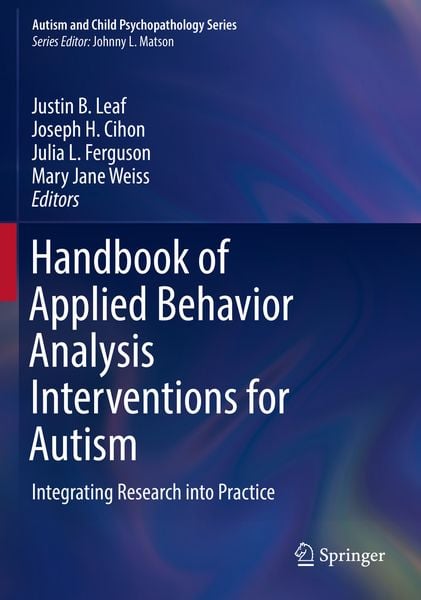
  • Produktbild: Handbook of Applied Behavior Analysis Interventions for Autism
  • Produktbild: Handbook of Applied Behavior Analysis Interventions for Autism
- 13%

Handbook of Applied Behavior Analysis Interventions for Autism Integrating Research into Practice

13% sparen

361,99 € UVP 417,99 €

inkl. gesetzl. MwSt., Versandkostenfrei


Beschreibung

Produktdetails

Einband

Taschenbuch

Erscheinungsdatum

08.05.2023

Abbildungen

XI, 634 p. 20 illus.

Herausgeber

Justin B. Leaf + weitere

Verlag

Springer

Seitenzahl

634

Maße (L/B/H)

25,4/17,8/3,5 cm

Gewicht

1199 g

Auflage

23001 Auflage 1st edition 2022

Sprache

Englisch

ISBN

978-3-030-96480-1

Beschreibung

Portrait


Justin B. Leaf, Ph.D.,
 
BCBA-D
, is the Co-director of Research for the Autism Partnership Foundation and the Associate Director of Doctoral Programs in ABA at Endicott College. Dr. Leaf received his doctorate degree in behavioral psychology from the Department of Applied Behavioral Science at the University of Kansas. He worked directly under the mentorship of Dr. James Sherman and Dr. Jan Sheldon. Currently, Dr. Leaf leads the research team at Autism Partnership Foundation, which conducts research projects both nationally and internationally. His research interests include examining methods to improve social behaviors for children and adolescents with autism and develop friendships, comparing different teaching methodologies, evaluating parameters of reinforcement, and evaluating long term outcomes for individuals diagnosed with autism. Dr. Leaf has more than 100 publications in peer-reviewed journals or book chapters and has presented at both national and international professional conferences and invited events. He serves or has served on several editorial boards f for prominent behavior analytic and autism journals.


Joseph H. Cihon, Ph.D., BCBA-D,
 is the Co-Director of Research for the Autism Partnership Foundation. Dr. Cihon received his bachelor’s degree in special education from Fontbonne University; master’s degree in behavior analysis at the University of North Texas under the mentorship of Dr. Shahla Alai-Rosales, Dr. Jesus Rosales-Ruiz, and Dr. Manish Vaidya; and his doctoral degree at Endicott College under the mentorship of Dr. Mary Jane Weiss. He has more than 15 years of experience working with children, adolescents, and adults diagnosed with autism spectrum disorder and other developmental disabilities in home, school, and community settings. His research interests include evaluating approach-based interventions, shaping, increasing favorable interactions among children, their families, and interventionists, developing contingencies to promote generalization and maintenance, and improving mealtimes for selective eaters. Dr. Cihon has published in and served as a reviewer for several prominent journals and presented research at national and international conferences.


Julia L. Ferguson, M.S., 
is the Research and Assessment Coordinator for the Autism Partnership Foundation. Dr. Ferguson received her bachelor’s degree in applied behavior analysis and her master’s degree in behavior analysis from the University of North Texas under the mentorship of Dr. Shahla Ala’i. She is currently pursuing her doctoral degree in applied behavior analysis at Endicott College under the mentorship of Dr. Mary Jane Weiss. Dr. Ferguson has more than eight years of experience working with children diagnosed with autism spectrum disorder in home, school, community, and clinical settings. Her research interests include evaluating social skills interventions for individuals diagnosed with ASD,staff training, evaluating best practice interventions, and comparing different teaching methodologies for individuals diagnosed with ASD. Dr. Ferguson has published many articles in peer-reviewed journals, authored book chapters, and has presented at national and international conferences.


Mary Jane Weiss, Ph.D., BCBA-D, LABA,
 is Associate Dean of Applied Behavior Analysis, Director of the Ph.D. in ABA, and Professor at Endicott College, where she has been for ten years. Dr. Weiss also does research with the team at Melmark. She has worked in the field of ABA and autism for more than 35 years. She received her doctorate in clinical psychology from Rutgers University in 1990 and became a Board Certified Behavior Analyst in 2000. Dr. Weiss previously worked for 16 years at the Douglass Developmental Disabilities Center at Rutgers University. Her clinical and research interests center on defining best practice ABA techniques, exploring ways to enhance the ethical conduct of practitioners, teaching practitioners  to integrate compassionate care and cultural humility into their work, training staff to be optimally effective at instruction and at collaboration, and maximizing family members’ expertise and adaptation. She serves on the Scientific Council of the Organization for Autism Research, is on the board of Association for Science in Autism Treatment, is a regular contributor to the ABA Ethics Hotline, and is an adviser to the Cambridge Center for Behavioral Studies. She is a regular reviewer for several professional journals and is a frequent member of service committees for various organizations.
 

Produktdetails

Einband

Taschenbuch

Erscheinungsdatum

08.05.2023

Abbildungen

XI, 634 p. 20 illus.

Herausgeber

Verlag

Springer

Seitenzahl

634

Maße (L/B/H)

25,4/17,8/3,5 cm

Gewicht

1199 g

Auflage

23001 Auflage 1st edition 2022

Sprache

Englisch

ISBN

978-3-030-96480-1

Herstelleradresse

Springer-Verlag KG
Sachsenplatz 4-6
1201 Wien
AT

Email: ProductSafety@springernature.com

Noch keine Bewertungen vorhanden

Verfassen Sie die erste Bewertung zu diesem Artikel

Helfen Sie anderen Kundinnen und Kunden durch Ihre Meinung.

Kundinnen und Kunden meinen

Bewertungen (0)

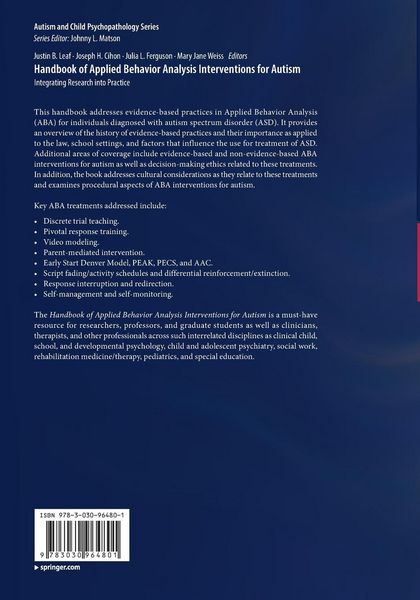
  • Produktbild: Handbook of Applied Behavior Analysis Interventions for Autism
  • Produktbild: Handbook of Applied Behavior Analysis Interventions for Autism

  • Part 1. General Overview
    .- Chapter 1. Introduction to ABA Treatments for Autism Spectrum Disorder.- Chapter 2. What Are Evidence-Based Practices in ABA.- Chapter 3. A History of Non-Evidence-Based Procedures for Individuals Diagnosed with ASD.- Chapter 4. Ethical Decision Making and Evidence Based Practices.- Chapter 5. Evidence Based Practices and the Law.- Chapter 6. Evidence-Based Practices in Schools.- Chapter 7. Factors Influencing to Implement or Not Implement Evidence-Based Procedures.- Chapter 8. A Collaborative Approach to Using ABA Interventions for Autism.- Chapter 9. Evidence-Based Practices as They Relates to Culture.-
    Part 2. The Procedures of ABA Interventions for Autism
    .- Chapter 10. Discrete Trial Teaching.- Chapter 11. Incidental Teaching.- Chapter 12. Pivotal Response Treatment.- Chapter 13. Video Modeling.- Chapter 14. The Teaching Interaction Procedure and Behavioral Skills Training.- Chapter 15. Social Skills Groups.- Chapter 16. Parent-Mediated Interventions.- Chapter 17. Early Start Denver Model.- Chapter 18. PEAK Relational Training System.- Chapter 19. The Picture Exchange Communication System.- Chapter 20. Augmentative and Alternative Communication.- Chapter 21. Shaping.- Chapter 22. Traditional Functional Behavior Assessment and Functional Analysis.- Chapter 23. Practical Functional Assessment.- Chapter 24. Functional Communication Training.- Chapter 25. Time-Out and Response Cost.- Chapter 26. Token Economies.- Chapter 27. Script Fading and Activity Schedules.- Chapter 28. Differential Reinforcement and Extinction.- Chapter 29. Response Interruption and Redirection.- Chapter 30. Self-Management and Self-Monitoring.- Chapter 31. Future Directions in Research and Clinical Practice.