KI-Beratung Beta

Gutscheinbedingungen

**Gültig bis 30.11.2026 auf Spielzeug, Schreibwaren, Filme, Geschenke & Trends, Musik, tolino eReader & Zubehör, Hörbücher und Hörbuch-Downloads, nicht preisgebundene Bücher und Kalender online auf thalia.at und in der Thalia App. Einzelne Artikel können ausgeschlossen sein. Aufgrund der Buchpreisbindung sind deutschsprachige Bücher und eBooks ausgenommen. Zusätzlich ausgenommen sind Abos & Flatrates, Games, Geschenkkarten/-boxen, Shelfies, Software, Zeitschriften sowie einzelne Artikel von tonies®. Pro Einkauf einmal einlösbar. Nur gültig mit im Onlineshop hinterlegter Bonuscard. Click & Collect nur bei Onlinevorabzahlung möglich. Keine Barauszahlung. Nicht kombinierbar mit anderen Aktionen und Gutscheinen. Gutschein wird auf max. 500€ Bestellwert angerechnet. Nicht gültig für Versandkosten und Services.

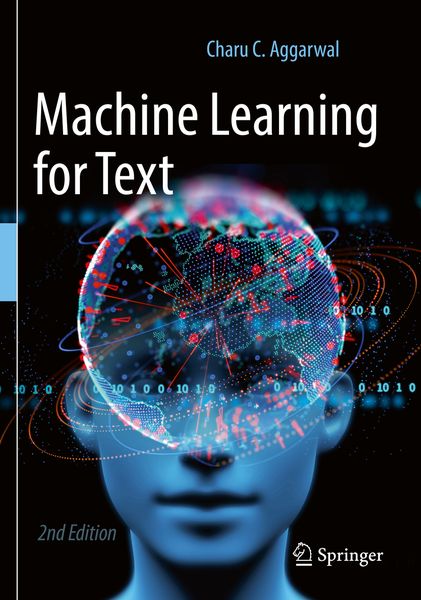
  • Produktbild: Machine Learning for Text
  • Produktbild: Machine Learning for Text

Machine Learning for Text

56,99 €

inkl. gesetzl. MwSt., Versandkostenfrei


Beschreibung

This second edition textbook covers a coherently organized framework for text analytics, which integrates material drawn from the intersecting topics of information retrieval, machine learning, and natural language processing. Particular importance is placed on deep learning methods. The chapters of...

Beschreibung

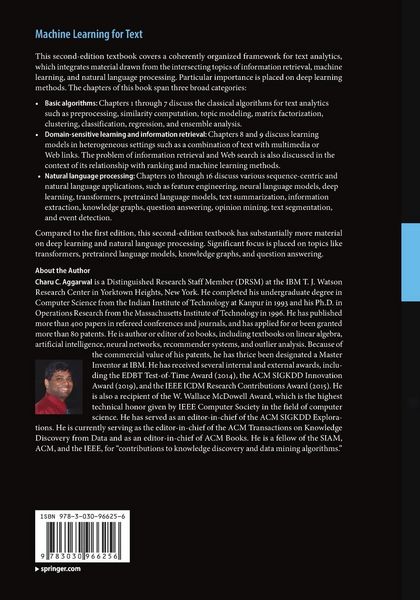
This second edition textbook covers a coherently organized framework for text analytics, which integrates material drawn from the intersecting topics of information retrieval, machine learning, and natural language processing. Particular importance is placed on deep learning methods. The chapters of this book span three broad categories:1. Basic algorithms: Chapters 1 through 7 discuss the classical algorithms for text analytics such as preprocessing, similarity computation, topic modeling, matrix factorization, clustering, classification, regression, and ensemble analysis.

2. Domain-sensitive learning and information retrieval: Chapters 8 and 9 discuss learning models in heterogeneous settings such as a combination of text with multimedia or Web links. The problem of information retrieval and Web search is also discussed in the context of its relationship with ranking and machine learning methods. 

3. Natural language processing: Chapters 10 through 16 discuss various sequence-centric and natural language applications, such as feature engineering, neural language models, deep learning, transformers, pre-trained language models, text summarization, information extraction, knowledge graphs, question answering, opinion mining, text segmentation, and event detection. 

Compared to the first edition, this second edition textbook (which targets mostly advanced level students majoring in computer science and math) has substantially more material on deep learning and natural language processing. Significant focus is placed on topics like transformers, pre-trained language models, knowledge graphs, and question answering.

Produktdetails

Einband

Taschenbuch

Erscheinungsdatum

06.05.2023

Abbildungen

XXIII, 565 p. 92 illus., 5 illus. in color.

Verlag Springer

Produktdetails

Einband

Taschenbuch

Erscheinungsdatum

06.05.2023

Abbildungen

XXIII, 565 p. 92 illus., 5 illus. in color.

Verlag Springer
Seitenzahl

565

Maße (L/B/H)

25,4/17,8/3,2 cm

Gewicht

1098 g

Auflage

Second Edition 2022

Sprache

Englisch

ISBN

978-3-030-96625-6

Herstelleradresse

Springer-Verlag KG
Sachsenplatz 4-6
1201 Wien
AT

Email: ProductSafety@springernature.com

Noch keine Bewertungen vorhanden

Verfassen Sie die erste Bewertung zu diesem Artikel

Helfen Sie anderen Kundinnen und Kunden durch Ihre Meinung.

Kundinnen und Kunden meinen

Bewertungen (0)

  • Produktbild: Machine Learning for Text
  • Produktbild: Machine Learning for Text
  • 1 An Introduction to Text Analytics.- 2 Text Preparation and Similarity Computation.- 3 Matrix Factorization and Topic Modeling.- 4 Text Clustering.- 5 Text Classification: Basic Models.- 6 Linear Models for Classification and Regression.- 7 Classifier Performance and Evaluation.- 8 Joint Text Mining with Heterogeneous Data.- 9 Information Retrieval and Search Engines.- 10 Language Modeling and Deep Learning.- 11 Attention Mechanisms and Transformers.- 12 Text Summarization.- 13 Information Extraction and Knowledge Graphs.- 14 Question Answering.- 15 Opinion Mining and Sentiment Analysis.- 16 Text Segmentation and Event Detection.