Gutscheinbedingungen

**Gültig bis 06.07.2026 auf fremdsprachige Bücher online auf thalia.at, in der Thalia App ab einem Mindestbestellwert von 30€ und in allen Thalia Buchhandlungen in Österreich. In den Buchhandlungen nur gültig auf lagernde Ware. Einzelne Artikel können ausgeschlossen sein. Ausgenommen sind preisgebundene Artikel & eBooks. Pro Einkauf einmal einlösbar. Nur gültig gegen Vorlage oder im Onlineshop hinterlegter Bonuscard. Infos zur Einlösung in der Buchhandlung sind auf der Bonuscard-Vorteilspreisseite zu finden. Click & Collect nur bei Onlinevorabzahlung möglich. Keine Einlösung bei Scan & Go-Bezahlung. Keine Barauszahlung. Nicht kombinierbar mit anderen Aktionen und Gutscheinen. Gutschein wird auf max. 500€ Bestellwert angerechnet. Nicht gültig für Versandkosten und Services.

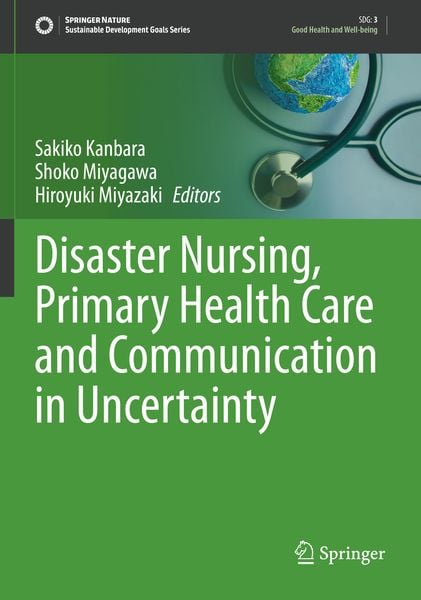
Produktbild: Disaster Nursing, Primary Health Care and Communication in Uncertainty

Disaster Nursing, Primary Health Care and Communication in Uncertainty

65,99 €

inkl. gesetzl. MwSt., Versandkostenfrei


Beschreibung

Produktdetails

Einband

Taschenbuch

Erscheinungsdatum

25.04.2023

Herausgeber

Sakiko Kanbara + weitere

Verlag

Springer

Seitenzahl

346

Maße (L/B/H)

25,4/17,8/1,9 cm

Gewicht

834 g

Auflage

1st ed. 2022

Sprache

Englisch

ISBN

978-3-030-98299-7

Beschreibung

Portrait

Sakiko Kanbara; Founder of EpiNurse Incorporated, which won the Risk Award the 2017 Global Platform for Disaster Risk Reduction, and professor at University of Kochi, mandated as a board member of the Japan Society of Disaster Nursing, member of Science Council of Japan. She received her BS and MS in Health Science from Kobe University and her Ph.D. from the Department of Public Health and International Health, Okayama University.

She earned her place as a researcher at the Research Institute of Nursing Care for People and Community, WHO Collaboration Center for Nursing in Disasters and Health Emergency, University of Hyogo. She has developed new courses for Doctoral Degree Course for Disaster Nursing Global Leadership Program at the University of Kochi, Japan since 2012.

Research interests include disaster nursing, primary healthcare, and health informatics. She received a Special Innovation Award from the Ash Center for Democratic Governance and Innovation, Harvard Kennedy School as a designer of Participatory Caring Map After Flooding in West Japan 2018.


Shoko Miyagawa received her B.A. in Economics and Master of Business Administration and Accounting from Hitotsubashi University and Ph.D. in Media and Governance from Keio University. She also received her Master of Science in Health Informatics from School of Biomedical Informatics, The University of Texas in 2013. Since 2006 she has been an Associate Professor in Faculty of Nursing and Medical Care, Keio University. Her research interest includes health informatics and disaster informatics. She drives the FabNurse Project, a research project to develop and deliver 3D printed care tools. She is the representative of IT DART, a disaster response team of IT professionals and provides various kind of IT support in the event of disaster.


Hiroyuki Miyazaki received a B.A. in environmental information from Keio University, Kanagawa, Japan, in 2006, and M.E.S. and Ph.D. degrees in environmental studies from The University of Tokyo, Japan, in 2008 and 2011, respectively. From 2011 to 2012, he was a JSPS Postdoctoral Fellow with the Center for Spatial Information Science, The University of Tokyo. Since 2012, he had been a researcher with the Earth Observation Data Integration and Fusion Research Initiative, The University of Tokyo, as well as a secondee at the Asian Development Bank, Philippines. Since 2016, he has been the Project Assistant Professor with the Center for Spatial Information Science, The University of Tokyo, and was seconded to the Asian Institute of Technology, Thailand. Since August 2020, he was appointed as a technical advisor in GLODAL, Inc. and since June 2021 as the President to serve for R&D and human resource development in space utilization, AI, and IoT. His research interests include geospatial information science, satellite remote sensing for socioeconomics, and applications to sustainable development.

Produktdetails

Einband

Taschenbuch

Erscheinungsdatum

25.04.2023

Herausgeber

Verlag

Springer

Seitenzahl

346

Maße (L/B/H)

25,4/17,8/1,9 cm

Gewicht

834 g

Auflage

1st ed. 2022

Sprache

Englisch

ISBN

978-3-030-98299-7

Herstelleradresse

Springer-Verlag KG
Sachsenplatz 4-6
1201 Wien
AT

Email: GPSR Kontakt

Noch keine Bewertungen vorhanden

Verfassen Sie die erste Bewertung zu diesem Artikel

Helfen Sie anderen Kundinnen und Kunden durch Ihre Meinung.

Kundinnen und Kunden meinen

Bewertungen (0)

  • Produktbild: Disaster Nursing, Primary Health Care and Communication in Uncertainty
  • Part 1: Global health and Care for Disaster Risk Reduction.- 1. Disaster Nursing for Sustainable Community.- 2. Disaster and global health issues.- 3. Challenges of Global Health with Nursing.- 4. Care for Disaster Risk Reduction.- 5. Disaster health in shelters in Japan.- 6. Research of Disaster Nursing in Japan 2005-2020.- 7. Nursing Experience on disaster and health emergency.- 8. The Sendai Framework and the Bangkok Principles for Nurses.- 9. History of the Development of Competencies for Disaster Nursing.- 10. Capacity Development and the Instructional Design for Achievement Goal.- 11. Nursing Research on Disaster.- Part 3: Fostering Care in Sustainable Community.- 12. Needs of Cultivating Seamless and Individual Care.- 13. Primary Health Care (PHC), Disaster Risk Reduction (DRR) and Role of a local nurse.- 14. Key Players of Cross-Sectoral Collaboration in DRR.- 15. Roles, Rules, and Tools for National Humanitarian Networks on H-EDRM.- 16. Community resilience, disaster nursing and the UN Sustainable Development Goals.- 17. Caring Ecosystems for Area-Capability.- 18. Big challenge for SDGs: Case Study: COVID-19.- Part 4: Assesing Care for DIsasser RIsk Reduction.- 19. Quantative approach for Assesment Health in Disaster .- 20. Qualitative Approaches to Investigating Health in Disaster: Cases from Nepal and Japan.- 21. Chronological Approach for Disaster Response and Monitoring.- 22. Introduction to EpiNurse.- Part 5:Decision making for people centered H-EDRM.- 23. Risk-based / System-based approach for people centered H-EDRM.- 24. Personal Life Records for Health Decision-Making in Disaster Situations.- 25. Management of Health and Disaster-related Data.- 26. Geographic Information System.- 27. Designing decision support systems in DRR.- 28. Case studies of ICT/ GIS Application for DRR - Way to Forward : Challenges,Ethics.- 29. Locality and Caring in Uncertainty.- 30. Care for Disaster Risk Reduction and Communication: Lessons Learned and Way to Forward.