KI-Beratung Beta

Gutscheinbedingungen

**Gültig bis 18.11.2026 auf englischsprachige Klassiker (klassiker-32728) online auf thalia.at und in der Thalia App. Einzelne Artikel können ausgeschlossen sein. Ausgenommen sind preisgebundene Artikel & eBooks. Pro Einkauf einmal einlösbar. Click & Collect nur bei Onlinevorabzahlung möglich. Keine Barauszahlung. Nicht kombinierbar mit anderen Aktionen und Gutscheinen. Gutschein wird auf max. 500€ Bestellwert angerechnet. Nicht gültig für Geschenkkarten, Versandkosten und Services.

  • Produktbild: Machine Learning for Embedded System Security
  • Produktbild: Machine Learning for Embedded System Security
- 11%

Machine Learning for Embedded System Security

11% sparen

96,99 € UVP 109,99 €

inkl. gesetzl. MwSt., Versandkostenfrei


Beschreibung

This book comprehensively covers the state-of-the-art security applications of machine learning techniques.  The first part explains the emerging solutions for anti-tamper design, IC Counterfeits detection and hardware Trojan identification. It also explains the latest development of deep-learning-based...

Beschreibung

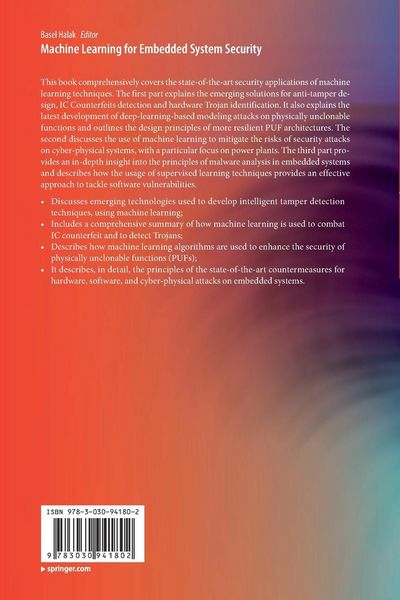
This book comprehensively covers the state-of-the-art security applications of machine learning techniques.  The first part explains the emerging solutions for anti-tamper design, IC Counterfeits detection and hardware Trojan identification. It also explains the latest development of deep-learning-based modeling attacks on physically unclonable functions and outlines the design principles of more resilient PUF architectures. The second discusses the use of machine learning to mitigate the risks of security attacks on cyber-physical systems, with a particular focus on power plants. The third part provides an in-depth insight into the principles of malware analysis in embedded systems and describes how the usage of supervised learning techniques provides an effective approach to tackle software vulnerabilities. 

Portrait


Dr. Basel Halak is the director of the embedded systems and IoT program at the University of Southampton, a visiting scholar at the Technical University of Kaiserslautern, a visiting professor at the Kazakh-British Technical University, an industrial fellow of the royal academy of engineering, and a national teaching fellow of the Advance Higher Education(HE) Academy. Dr. Halak's publications include over 80-refereed conference and journal papers and authored four books, including the first textbook on Physically Unclonable Functions. His research expertise includes evaluation of the security of hardware devices, development of countermeasures, mathematical formalism of reliability issues in CMOS circuits (e.g. crosstalk, radiation, aging), and the use of fault tolerance techniques to improve the robustness of electronics systems against such issues. Dr. Halak lectures on digital design, Secure Hardware, and Cryptography.  Dr. Halak serves on several technical program committees such as HOST, IEEE DATE, IVSW, and DAC. He is an associate editor of IEEE access and an editor of the IET circuit devices and system journal. He is also a member of the hardware security-working group of the World Wide Web Consortium (W3C).


Produktdetails

Einband

Taschenbuch

Erscheinungsdatum

23.04.2023

Abbildungen

XV, 160 p. 66 illus., 39 illus. in color.

Herausgeber Basel Halak

Produktdetails

Einband

Taschenbuch

Erscheinungsdatum

23.04.2023

Abbildungen

XV, 160 p. 66 illus., 39 illus. in color.

Herausgeber Basel Halak
Verlag Springer
Seitenzahl

160

Maße (L/B/H)

23,5/15,5/1 cm

Gewicht

277 g

Auflage

23001 Auflage 1st ed. 2022

Sprache

Englisch

ISBN

978-3-030-94180-2

Herstelleradresse

Springer-Verlag KG
Sachsenplatz 4-6
1201 Wien
AT

Email: ProductSafety@springernature.com

Noch keine Bewertungen vorhanden

Verfassen Sie die erste Bewertung zu diesem Artikel

Helfen Sie anderen Kundinnen und Kunden durch Ihre Meinung.

Kundinnen und Kunden meinen

Bewertungen (0)

  • Produktbild: Machine Learning for Embedded System Security
  • Produktbild: Machine Learning for Embedded System Security

  • Introduction.- Machine Learning for Tamper Detection.- Machine Learning for IC Counterfeit Detection and Prevention.- Machine Learning for Secure PUF Design.- Machine Learning for Malware Analysis.- Machine Learning for Detection of Software Attacks.- Conclusions and Future Opportunities.