Beschreibung
Produktdetails
Einband
Taschenbuch
Erscheinungsdatum
15.03.2023
Verlag
IsletSeitenzahl
512
Maße (L/B/H)
24,4/17/2,8 cm
Gewicht
874 g
Sprache
Englisch
ISBN
978-3-949546-12-9
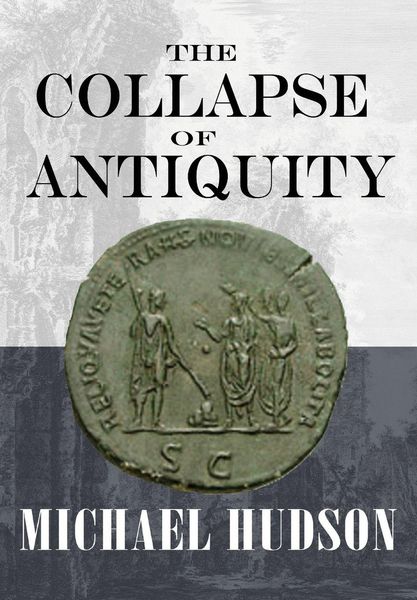
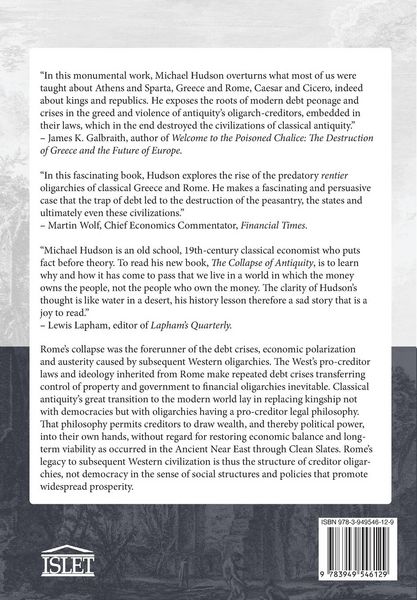
The Collapse of Antiquity: Greece and Rome as Civilization's Oligarchic Turning Point The Collapse of Antiquity, the sequel to Michael's "...and forgive them their debts," is the second and latest book in his trilogy on the history of debt. It describes how the dynamics of interest-bearing debt led to the rise of rentier oligarchies in classical Greece and Rome, causing economic polarization, widespread austerity, revolts, wars and ultimately the collapse of Rome into serfdom and feudalism. That collapse bequeathed to subsequent Western civilization a pro-creditor legal philosophy that has led to today's creditor oligarchies. In telling this story, The Collapse of Antiquity reveals the eerie parallels between the collapsing Roman world and today's debt-burdened Western economies. Endorsements Scope The Collapse of Antiquity is vast in its sweep, covering: the transmission of interest-bearing debt from the Ancient Near East to the Mediterranean world, but without the "safety valve" of periodic royal Clean Slate debt cancellations to restore economic balance and prevent the emergence of creditor oligarchies; the rise of creditor and landholding oligarchies in classical Greece and Rome; classical antiquity's debt crises and revolts, and the suppression, assassination and ultimately failure of reformers; the role played by greed, money-lust (wealth-addiction) and hubris, as analysed by Socrates, Plato, Aristotle and other ancient writers; Rome's "End Time" collapse into serfdom and pro-creditor oligarchic legacy that continues to shape the West; the transformation of Christianity as it became Rome's state religion, supporting the oligarchy, dropping the revolutionary early Christian calls for debt cancellation and changing the meaning of the Lord's Prayer and "sin," from a focus on the economic sphere to the personal sphere of individual egotism; how pro-creditor ideology distorts recent economic interpretations of antiquity, showing increasing sympathy with Rome's oligarchic policies.
Noch keine Bewertungen vorhanden
Verfassen Sie die erste Bewertung zu diesem Artikel
Helfen Sie anderen Kundinnen und Kunden durch Ihre Meinung.
Kurze Frage zu unserer Seite
Vielen Dank für Ihr Feedback
Wir nutzen Ihr Feedback, um unsere Produktseiten zu verbessern. Bitte haben Sie Verständnis, dass wir Ihnen keine Rückmeldung geben können. Falls Sie Kontakt mit uns aufnehmen möchten, können Sie sich aber gerne an unseren Kund*innenservice wenden.
zum Kundenservice