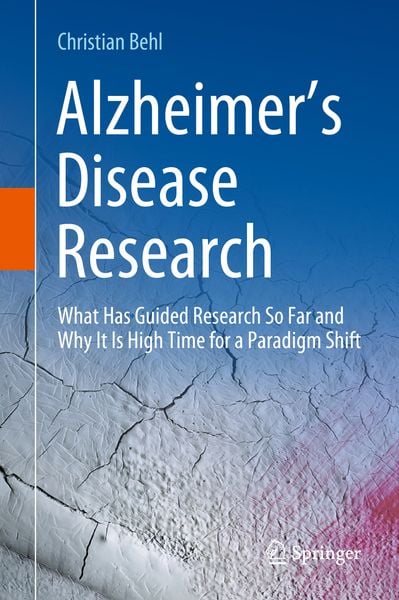
Alzheimer’s Disease Research What Has Guided Research So Far and Why It Is High Time for a Paradigm Shift
-
- Hardcover ausgewählt
- Taschenbuch
- eBook
-
Sprache:Englisch
37,99 €
UVP
43,99 €
inkl. gesetzl. MwSt.,
Beschreibung
Produktdetails
Einband
Gebundene Ausgabe
Erscheinungsdatum
14.07.2023
Abbildungen
XXV, 652 p. 116 illus., 107 illus. in color.
Verlag
SpringerSeitenzahl
652
Maße (L/B/H)
24,1/16/3,2 cm
Gewicht
1296 g
Auflage
2023
Sprache
Englisch
ISBN
978-3-031-31569-5
This book highlights the key phases and central findings of Alzheimer’s Disease research since the introduction of the label ‘Alzheimer’s Disease’ in 1910. The author, Christian Behl, puts dementia research in the context of the respective zeitgeist and summarizes the paths that have led to the currently available Alzheimer’s drugs. As the reader is taken through the major developments in Alzheimer's Disease research, particularly over the past thirty years, Behl poses critical questions: Why are the exact causes of Alzheimer's Disease still in the dark, despite all the immense, worldwide research efforts in academia as well as in the pharmaceutical industry? Why has the majority of an entire research field kept focusing on a single hypothesis that establishes the deposition of the amyloid beta peptide in the brain as the key trigger of Alzheimer's pathology, even though this concept has still not been convincingly proven in the clinics? Are there other hypotheses that might explainthe pathogenesis of this complex brain disease, and if so, why were these perspectives not adequately followed?
In this book, Behl tries to answer these questions. Starting with the historical background, the author illustrates the long and arduous research journey, its numerous setbacks, and the many alternative explanations for the disease, which have started gaining increasing attention and acceptance in the Alzheimer’s research community only more recently.
With his deep dive into the history and progression of this research, including the most recent developments, Behl explains why he believes that it is high time to promote a paradigm shift in Alzheimer’s Disease research.
Noch keine Bewertungen vorhanden
Verfassen Sie die erste Bewertung zu diesem Artikel
Helfen Sie anderen Kundinnen und Kunden durch Ihre Meinung.
Kurze Frage zu unserer Seite
Vielen Dank für Ihr Feedback
Wir nutzen Ihr Feedback, um unsere Produktseiten zu verbessern. Bitte haben Sie Verständnis, dass wir Ihnen keine Rückmeldung geben können. Falls Sie Kontakt mit uns aufnehmen möchten, können Sie sich aber gerne an unseren Kund*innenservice wenden.
zum Kundenservice