KI-Beratung Beta

Gutscheinbedingungen

**Gültig am 01.10.2026 ab einem Mindestbestellwert von 30€ auf Spielzeug, Schreibwaren, Filme, Geschenke & Trends, Musik, tolino eReader & Zubehör, Hörbücher und Hörbuch-Downloads, nicht preisgebundene Bücher und Kalender online auf thalia.at und in der Thalia App. Einzelne Artikel können ausgeschlossen sein. Aufgrund der Buchpreisbindung sind deutschsprachige Bücher und eBooks ausgenommen. Zusätzlich ausgenommen sind Abos & Flatrates, Games, Geschenkkarten/-boxen, Shelfies, Software, Zeitschriften sowie einzelne Artikel von tonies®. Pro Einkauf einmal einlösbar. Click & Collect nur bei Onlinevorabzahlung möglich. Keine Barauszahlung. Nicht kombinierbar mit anderen Aktionen und Gutscheinen. Gutschein wird auf max. 500€ Bestellwert angerechnet. Nicht gültig für Versandkosten und Services. Preisgebundene Artikel sind vom Mindestbestellwert ausgeschlossen.

  • Produktbild: Modern Nanotechnology
  • Produktbild: Modern Nanotechnology
- 12%

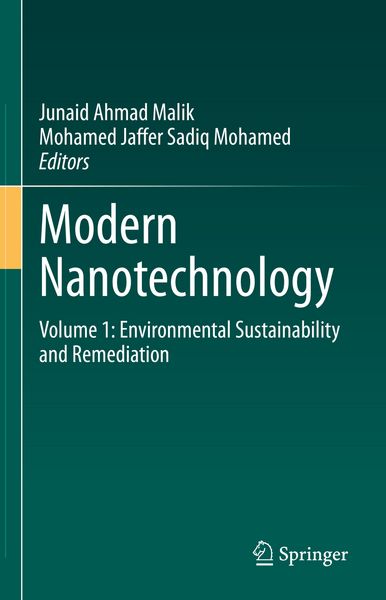
Modern Nanotechnology Volume 1: Environmental Sustainability and Remediation

12% sparen

134,99 € UVP 153,99 €

inkl. gesetzl. MwSt., Versandkostenfrei


Beschreibung

Produktdetails

Einband

Gebundene Ausgabe

Erscheinungsdatum

19.07.2023

Abbildungen

XII, 687 p. 92 illus., 80 illus. in color.

Herausgeber

Junaid Ahmad Malik + weitere

Verlag

Springer

Seitenzahl

687

Maße (L/B/H)

24,1/16/4,3 cm

Gewicht

1207 g

Auflage

2023

Sprache

Englisch

ISBN

978-3-031-31110-9

Beschreibung

Portrait

Dr. Malik received B.Sc. (2008) Science from the University of Kashmir, Srinagar, J&K; M.Sc. (2010) in Zoology from Barkatullah University, Bhopal, Madhya Pradesh; and PhD (2015) in Zoology from the same university. He completed his B.Ed program in 2017 from the University of Kashmir, Srinagar, J&K. He started his career as Lecturer in School Education Department, Govt. of J&K for 2 years. Dr. Malik is now working as a Lecturer in Department of Zoology, Govt. Degree College, Bijbehara, Kashmir (J&K) and actively involved in teaching and research activities. He has more than 8 years of research experience. His areas of interest are ecology, soil macrofauna, wildlife biology, conservation biology etc. Dr. Malik has published more than 20 research papers in various national and international peer-reviewed journals. He has published 24 books, 36 book chapters and more than 10 popular editorial articles with various publishers like Springer Nature, Elsevier Inc., Taylor and Francis Group and IGI Global. Dr. Malik is acting as the Editor-in-Chief of Inventum Biologicum (An International Journal of Biological Research) published by World Biologica, India. He is also serving as editor and reviewer of several journals with a reasonable repute. He has participated in several State, National, and International conferences, seminars, workshops, and symposia and more than 20 conference papers are to his credit. Mohamed Jaffer Sadiq Mohamed, PhD, is working as a Postdoctoral Researcher in the King Fahd University of Petroleum and Minerals, Dhahran, Saudi Arabia. Dr. Sadiq received BSc (2006) in Chemistry from Bharathiyar University, Coimbatore, Tamil Nadu; MSc (2008) in Applied Chemistry from National Institute of Technology (NIT), Tiruchirappalli, Tamil Nadu; MTech (2014) in Nanotechnology from Karunya University, Coimbatore, Tamil Nadu; and PhD (2017) in Chemistry from National Institute of Technology Karnataka (NITK), Surathkal, Mangalore, Karnataka. He started his career as Chemist in Hindustan Zinc Limited, Rajasthan, for four years. He worked as a Postdoctoral Researcher in the Yunnan University, Kunming, China for two years. Dr. Sadiq is now working as a Postdoctoral Researcher in the King Fahd University of Petroleum and Minerals, Dhahran, Saudi Arabia, and is actively involved in teaching and research activities. He has more than 10 years of industrial and research experience. His areas of interest are Nanomaterials/Nanocomposites/Nanocrystals/Perovskites based photocatalysis, water splitting, fenton’s like catalysts, electrocatalysis (HER, OER, ORR), heterogeneous catalysis, supercapacitors, fuel cell catalysis, and solar cells. He has authored 2 book chapters, edited 2 books, published 30 research articles and technical papers in international peer-reviewed journals like Springer, Elsevier, RSC, ACS, etc. He is also serving as editor and reviewer of several journals with a reasonable reputation. He has participated in several State, National, and International Conferences, seminars, workshops, and symposia, and more than 20 conference papers are to his credit.

Produktdetails

Einband

Gebundene Ausgabe

Erscheinungsdatum

19.07.2023

Abbildungen

XII, 687 p. 92 illus., 80 illus. in color.

Herausgeber

Verlag

Springer

Seitenzahl

687

Maße (L/B/H)

24,1/16/4,3 cm

Gewicht

1207 g

Auflage

2023

Sprache

Englisch

ISBN

978-3-031-31110-9

Herstelleradresse

Springer-Verlag KG
Sachsenplatz 4-6
1201 Wien
AT

Email: ProductSafety@springernature.com

Noch keine Bewertungen vorhanden

Verfassen Sie die erste Bewertung zu diesem Artikel

Helfen Sie anderen Kundinnen und Kunden durch Ihre Meinung.

Kundinnen und Kunden meinen

Bewertungen (0)

  • Produktbild: Modern Nanotechnology
  • Produktbild: Modern Nanotechnology
  • Chapter1. Fundamentals of Nanotechnology for Environmental Engineering.- Chapter2. Fundamental Aspects of Nanocomposite Materials for Environmental Protection and Remediation.- Chapter3. Nanotechnology for Sustainable Agriculture: Current Trends and Future Prospects.- Chapter4. Nanomaterials in Soil Health Management and Crop Production.- Chapter5. Nanomaterials for Water Purification and Reclamation.- Chapter6. Role of Nanomaterials in the Treatment of Wastewater.- Chapter7. Applications of Nanomaterials for Water Treatment: Current Trends and Future Scope.- Chapter8. Engineered Nanomaterials for Water Treatment Applications.- Chapter9. Research Trends in Photocatalytic Water Purification: Current Perspectives and Future Prospects – A Review.- Chapter10. Nanotechnology for Water Splitting: A Sustainable Way to Generate Hydrogen.- Chapter11. Carbon Nanomaterials for Wastewater Treatment.- Chapter12. Nanosorbents – A Nanotechnological Approach for the Treatment of Heavy Metal Contamination in Wastewater.- Chapter13. Nanofiltration Membrane Techniques for Heavy Metal Separation.- Chapter14. Carbon Dots as Nanoprobes for Heavy Metal Detection.- Chapter15. Nanotechnology for Plastic Degradation.- Chapter16. Role of Nanomodification and Nanofertilizers in Crop Production and Soil Health.- Chapter17. Microbes Induced Biofabrication of Gold Nanoparticles and its Exploitation in Biosensing of Phytopathogens.- Chapter18. Removal of Radioactive Wastes Using Nanomaterial.- Chapter19. Nanotechnology-based Photocatalytic Degradation of Pharmaceuticals.- Chapter20. Nanotechnological Interventions in the Degradation of Pharmaceutical Compounds.- Chapter21. Nanocomposites for Removal and Degradation of Organic Pollutants.- Chapter22. Nanotechnological Approaches against Fungal Pathogens of Economically Important Crop Plants.- Chapter23. Advanced Approaches in Micro- and Nano-sensors for Harsh Environmental Applications: A Review.- Chapter24. Cellulose Based Gels: Synthesis, Properties and Applications.- Chapter25. Artificial Photosynthesis Using Nanotechnology.- Chapter26. Artificial Photosynthesis with Gold Nanostructures Incorporation in Non-photosynthetic Bacteria.