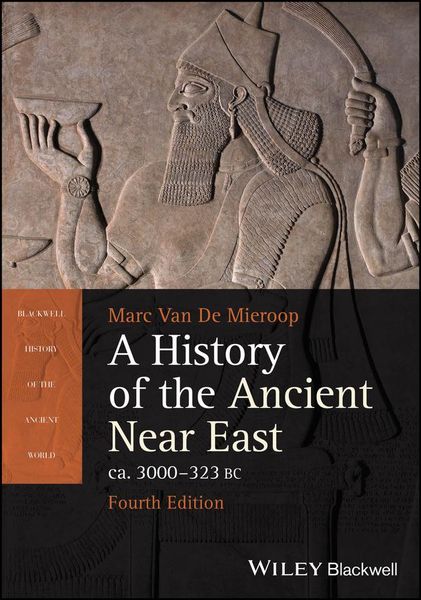
A History of the Ancient Near East Ca. 3000 - 323 BC
-
- Englisch ausgewählt
56,99 €
inkl. gesetzl. MwSt.,
Beschreibung
Produktdetails
Einband
Taschenbuch
Erscheinungsdatum
08.10.2024
Verlag
WileySeitenzahl
400
Maße (L/B/H)
25,5/18,3/3 cm
Gewicht
766 g
Auflage
4th edition
Sprache
Englisch
ISBN
978-1-394-21022-0
BLACKWELL HISTORY OF THE ANCIENT WORLD
A History of the Ancient Near East
ca. 3000-323 BC
Fourth Edition
"This marvelous book is a classic, and deservedly so. This new edition brings the history up to date with revelations from newly published cuneiform tablets and recent archaeological excavations."
-Amanda H. Podany, Professor of History, Cal Poly Pomona
"An outstanding resource for studying the history of the ANE... It is remarkable to find a volume with this subject matter that is as clear and as engaging as what Van De Mieroop has offered here."
-Kurtis Peters, RBECS
Now in its fourth edition, A History of the Ancient Near East remains one of the most accessible introductions to the rich and complex history of the region available. Integrating original sources, up-to-date scholarship, and extensive supplementary materials, this popular textbook provides student-friendly coverage of the origins of the first cities in Mesopotamia, the growth of the Babylonian and Hittite kingdoms, and the rise of the Assyrian and Persian empires.
With an easy-to-understand narrative style, noted historian and lecturer Marc Van De Mieroop guides students through the extraordinary multicultural civilizations of the ancient Near Eastern world. Clear and straightforward chapters describe a wide variety of political, social, and cultural developments, beginning from the invention of writing circa 3000 BC and ending with the conquests of Alexander the Great.
This new edition is fully revised to reflect the latest developments in the field, including entirely new sections on recent archaeological discoveries and textual findings. Streamlined and improved chapters are complemented with detailed maps, historical timelines, images and illustrations, and an extensive and up-to-date bibliography.
A History of the Ancient Near East ca. 3000-323 BC, Fourth Edition, is an ideal textbook for undergraduate and introductory graduate courses on archaeology or ancient Near Eastern history, as well as a valuable resource for general readers with an interest in the ancient world and the Bible.
Noch keine Bewertungen vorhanden
Verfassen Sie die erste Bewertung zu diesem Artikel
Helfen Sie anderen Kundinnen und Kunden durch Ihre Meinung.
Kurze Frage zu unserer Seite
Vielen Dank für Ihr Feedback
Wir nutzen Ihr Feedback, um unsere Produktseiten zu verbessern. Bitte haben Sie Verständnis, dass wir Ihnen keine Rückmeldung geben können. Falls Sie Kontakt mit uns aufnehmen möchten, können Sie sich aber gerne an unseren Kund*innenservice wenden.
zum Kundenservice