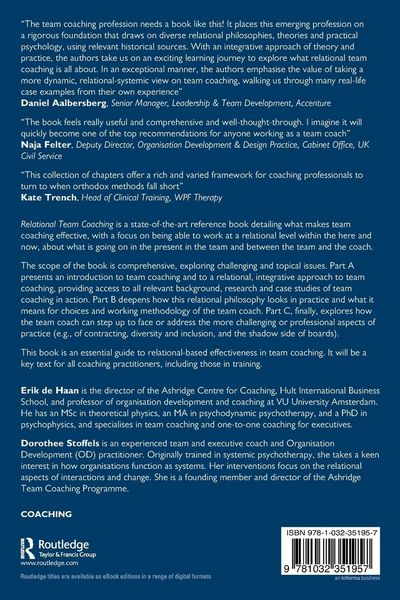
"The team coaching profession needs a book like this! It places this emerging profession on a rigorous foundation that draws on diverse relational philosophies, theories and practical psychology, using relevant historical sources. With an integrative approach of theory and practice, the authors take us on an exciting learning journey to explore what relational team coaching is all about. In an exceptional manner, the authors emphasise the value of taking a more dynamic, relational-systemic view on team coaching, walking us through many real-life case examples from their own experience. Instead of prescribing certain tools and techniques as 'best practice', the authors invite us to grow our relational courage by gently exploring the complex dynamics of human interaction in the moment, helping teams to progress.By practising what they preach, the authors learned me to be more comfortable with 'not knowing'. As a team coach myself, they helped me reflect and appreciate more who I am and to be curious in the emerging moment. Ultimately, this handbook significantly helps to further continue my self-discovery in helping teams deal with complex challenges and anxieties."
Daniel Aalbersberg, Senior Manager Leadership & Team Development, Accenture
"What I really enjoyed and connected with in this book was the encouragement to bring one's whole self into group coaching practice - embracing the resulting uncertainty and unpredictability and engaging with the deeper and more relational outcomes that can emerge. In chapter 3 I enjoyed the offering of a 'hunch' as a coaching tool (or hypothesis in chapter 4). In chapter 4 I appreciated the encouragement to actively engage and utilize your own experience in a group as well as their response to your presence and interventions. In chapter 5 I connected strongly with the long term impact of founders on organizational culture - and the importance of taking account of the context in which an organization works. In chapters 3 and 4 I found the grids offering 'types' of questions/what to look out for and consider extremely useful - providing guides to shaping responses rather than offering a linear process. Overall the content resonated with - and shone a mirror on practices of eco-psychology, non-heirachical governance and consensual decision making which I have experienced in my working and voluntary fields."
Hilary Jennings, Independent Consultant and Director, Happy Museum
"It is a very important topic and a timely piece of work - and one that in our Executive Development practice we are seeking to deepen our experience and expertise. Which is to say, I come at this from a practitioner but in no way an expert perspective. I fully support the premise of relational team coaching and I think your introduction and Chapter 1 describe your rationale very clearly. I am particularly struck by the nature of power dynamics in any process & relationship where one party may be perceived to be more 'expert' than another, and am drawn to how the nature of relational coaching can bring a different tenor to this work. In some ways, as you articulate later in the book (e.g. in Chapter 4, pg64, such as the notion that 'The coach will...encounter resistance to the work.'), this power dynamic is inevitable and mirrors what goes on between team members. It is an interesting paradox for a coach to hold i.e. to bring a presence and skillset that is by definition missing from the team (an expertise), whilst also sitting alongside the team as an 'equal' or peer. A theme that felt very figural, to deploy a Gestalt term, through my reading was the challenge you are posing to us as team coaches to raise our game and develop an elevated presence, mindset and awareness to do this work well"
Senior leader, Head of Executive Development (anonymous)
"I really like this book! The book feels really useful and comprehensive and well-thought-through. I imagine it will quickly become one of the top recommendations for anyone working with team coaching."
Naja Felter, Deputy Director, Organisation, Development & Design Practice, Cabinet Office, UK Civil Service
"In terms of readability, I found the book pretty easy to read and the content easy to digest. It's not a book that can be skim-read though and for me, required a degree of focus and concentration to ensure that I understood the key hypotheses and messages. Perhaps understandably, I found the tone of the book to be on the academic side, but this was nicely balanced by the inclusion of case examples and vignettes and the very practical nature of the book. It did strike me that the book would appeal largely to more experienced and academically/ professionally qualified coaches and I assume that this is the target audience you had in mind during the drafting of the book. From a structural perspective, the book lends itself well to dipping in and out of depending on the topic of interest/immediate challenge and I could imagine that professional coaches would find this particularly valuable. The Brief Abstracts and the detailed introductions to Parts A, B and C were a helpful orientation and a simple way of directing the reader towards the most relevant section of the book. Part C - for me, this was the most valuable section of the book and the easiest section to digest and relate to. For those with a practical bias, the importance of landing the hypotheses and constructs in practical ways with examples to illustrate the points and with the inclusion of some insightful questions and prompts for the reader, cannot be emphasised enough. I felt that these chapters covered the content with sufficient depth and would be easy to draw from and adopt in real life situations. I was particularly attracted to the Talik team coaching model for reasons of simplicity and practicality."
Jo Easton, Senior role in HR in De La Rue PLC
"I love the super comprehensive collection of material and perspectives that you have captured in this book. This is a topic I am quite passionate about and I felt totally spoilt for choice. I also adore that people can read the chapter(s) that they are most interested in at that time. Brilliantly done!!"
Talia Nikpalj, Head of Executive Development, Associated British Foods plc
"I have to say I have really enjoyed reading your book. I haven't read it all yet, but all the Chapters I have read or dipped into have been a great, and very accessible summary of their theme. And I have really liked how they have been bought together and illuminated by case studies. And when it comes out in hard copy, I will definitely be wanting to add it to my library, and for my co-coaches and collaborators to read it and discuss themes with me. I've picked up lots of insights, reminders, and new ideas from it so far to build into my work."
Liz Hill-Smith, Associate Director of Organisation Development, Arup UKIMEA
"Working relationally is complex and demanding in its unpredictability; this collection offers a rich and varied framework for coaching professionals to turn to when orthodox methods fall short."
Kate Trench, Head of Clinical Training, WPF Therapy