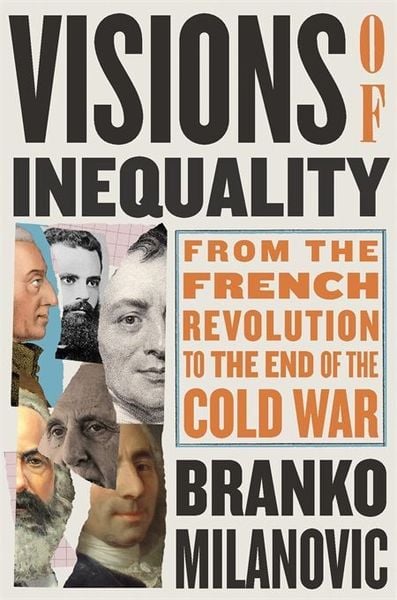
Visions of Inequality From the French Revolution to the End of the Cold War
-
- Englisch ausgewählt
32,99 €
inkl. gesetzl. MwSt.,
Beschreibung
Produktdetails
Einband
Gebundene Ausgabe
Erscheinungsdatum
10.10.2023
Abbildungen
26 illus.
Verlag
Harvard University PressSeitenzahl
359
Maße (L/B/H)
15,6/23,8/3,8 cm
Gewicht
624 g
Farbe
Lichtgrau / Anthrazit
Sprache
Englisch
ISBN
978-0-674-26414-4
A Financial Times Best Book of the Year.
A sweeping and original history of how economists across two centuries have thought about inequality, told through portraits of six key figures.
"How do you see income distribution in your time, and how and why do you expect it to change?" That is the question Branko Milanovic imagines posing to six of history's most influential economists: François Quesnay, Adam Smith, David Ricardo, Karl Marx, Vilfredo Pareto, and Simon Kuznets. Probing their works in the context of their lives, he charts the evolution of thinking about inequality, showing just how much views have varied among ages and societies. Indeed, Milanovic argues, we cannot speak of "inequality" as a general concept: any analysis of it is inextricably linked to a particular time and place.
Visions of Inequality takes us from Quesnay and the physiocrats, for whom social classes were prescribed by law, through the classic nineteenth-century treatises of Smith, Ricardo, and Marx, who saw class as a purely economic category driven by means of production. It shows how Pareto reconceived class as a matter of elites versus the rest of the population, while Kuznets saw inequality arising from the urban-rural divide. And it explains why inequality studies were eclipsed during the Cold War, before their remarkable resurgence as a central preoccupation in economics today.
Meticulously extracting each author's view of income distribution from their often voluminous writings, Milanovic offers an invaluable genealogy of the discourse surrounding inequality. These intellectual portraits are infused not only with a deep understanding of economic theory but also with psychological nuance, reconstructing each thinker's outlook given what was knowable to them within their historical contexts and methodologies.
Noch keine Bewertungen vorhanden
Verfassen Sie die erste Bewertung zu diesem Artikel
Helfen Sie anderen Kundinnen und Kunden durch Ihre Meinung.
Kurze Frage zu unserer Seite
Vielen Dank für Ihr Feedback
Wir nutzen Ihr Feedback, um unsere Produktseiten zu verbessern. Bitte haben Sie Verständnis, dass wir Ihnen keine Rückmeldung geben können. Falls Sie Kontakt mit uns aufnehmen möchten, können Sie sich aber gerne an unseren Kund*innenservice wenden.
zum Kundenservice