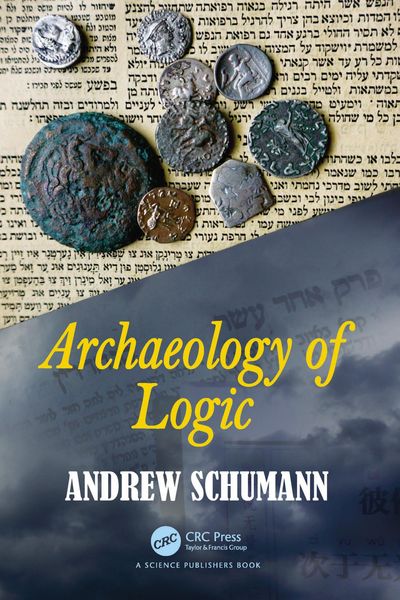
Archaeology of Logic
-
- Taschenbuch
- eBook ausgewählt
-
Form:Einzelkauf Download
-
Sprache:Englisch
-
eBook Format:PDF
- PDF 99,80 € ausgewählt
- ePUB 99,80 €
99,80 €
inkl. gesetzl. MwSt.Beschreibung
Produktdetails
Format
Kopierschutz
Ja
Family Sharing
Nein
Text-to-Speech
Nein
Erscheinungsdatum
27.04.2023
Verlag
Taylor & Francis eBooksSeitenzahl
440 (Printausgabe)
Auflage
1. Auflage
Sprache
Englisch
EAN
9781000871074
The question arises whether logic was given to us by God or whether it is the result of human evolution. I believe that at least the modus ponens rule ( A and if A then B implies B) is inherent in humans, but probably many other modern systems (e.g., resource logic, non - monotonic logic etc.) are the result of humans adapating to the environment. It is therefore of interest to study and compare the way logic is used in ancient cultures as well as the way logic is going to be used in our 21st century. This welcome book studies and compares the way formation of logic in three cultures: Ancient Greek (4th century B.C.), Judaic (1st century B.C. - 1st century A.D.) and Indo-Buddhist (2nd century A.D.) The book notes that logic became especially popular during the period of late antiquity in countries covered by the international trade of the Silk Road. This study makes a valuable contribution to the history of logic and to the very understanding of the origions and nature of logical thinking. -Prof. Dov Gabbay, King's College London, UK
Andrew Schumann in his book demonsrates that logic step-by-step arose in different places and cultural circles. He argues that if we apply a structural-genealogical method, as well as turn to various sources, particularly, religious, philosophical, linguistic, etc., then we can obtain a more general and more adequate picture of emengence and development of logic. This book is a new and very valuable contribution to the history of logic as a manifestation of the human mind. - Prof. Jan Wolenski, Jagiellonian University, Poland
The author of the Archaeology of Logic defends the claim, calling it "logic is aftter all", which sees logical competence as a practical skill that people began to learn in antiquity, as soom as they realized that avoiding cognitive biases in their reasoning would make their daily activities more successful. The in-depth reading of the book with its diving into the comparative quotations in the long dead or hardly known to most of us languages like Sumerian-Akkadian, Aramatic, Hebrew and etc, will be rewarded by the response that the logical competence is diverse and it can be trained, despite the inevitabilitiy of the reasoning fallacies; and that critical discussions and agaonal character of the social lide are the necessary tools for that. - Prof. Elena Lisanyuk
Noch keine Bewertungen vorhanden
Verfassen Sie die erste Bewertung zu diesem Artikel
Helfen Sie anderen Kundinnen und Kunden durch Ihre Meinung.
Kurze Frage zu unserer Seite
Vielen Dank für Ihr Feedback
Wir nutzen Ihr Feedback, um unsere Produktseiten zu verbessern. Bitte haben Sie Verständnis, dass wir Ihnen keine Rückmeldung geben können. Falls Sie Kontakt mit uns aufnehmen möchten, können Sie sich aber gerne an unseren Kund*innenservice wenden.
zum Kundenservice