
The Soils of Oregon
-
- Hardcover
- Taschenbuch ausgewählt
- eBook
-
Sprache:Englisch
161,99 €
UVP
186,99 €
inkl. gesetzl. MwSt.,
Beschreibung
Produktdetails
Einband
Taschenbuch
Erscheinungsdatum
08.04.2023
Abbildungen
XIX, 545 p. 229 illus., 197 illus. in color.
Verlag
SpringerSeitenzahl
545
Maße (L/B/H)
27,9/21/3,1 cm
Gewicht
1366 g
Auflage
23001 Auflage 1st edition 2022
Sprache
Englisch
ISBN
978-3-030-90093-9
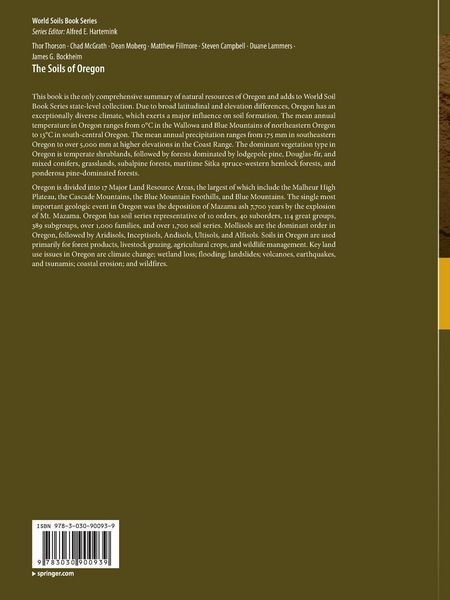
This book is the only comprehensive summary of natural resources of Oregon and adds to World Soil Book Series state-level collection. Due to broad latitudinal and elevation differences, Oregon has an exceptionally diverse climate, which exerts a major influence on soil formation. The mean annual temperature in Oregon ranges from 0°C in the Wallowa and Blue Mountains of northeastern Oregon to 13 °C in south-central Oregon. The mean annual precipitation ranges from 175 mm in southeastern Oregon to over 5,000 mm at higher elevations in the Coast Range. The dominant vegetation type in Oregon is temperate shrublands, followed by forests dominated by lodgepole pine, Douglas-fir, and mixed conifers, grasslands, subalpine forests, maritime Sitka spruce-western hemlock forests, and ponderosa pine-dominated forests.
Oregon is divided into 17 Major Land Resource Areas, the largest of which include the Malheur High Plateau, the Cascade Mountains, the Blue Mountain Foothills, and Blue Mountains. The single most important geologic event in Oregon was the deposition of Mazama ash 7,700 years by the explosion of Mt. Mazama. Oregon has soil series representative of 10 orders, 40 suborders, 114 great groups, 389 subgroups, over 1,000 families, and over 1,700 soil series. Mollisols are the dominant order in Oregon, followed by Aridisols, Inceptisols, Andisols, Ultisols, and Alfisols. Soils in Oregon are used primarily for forest products, livestock grazing, agricultural crops, and wildlife management. Key land use issues in Oregon are climate change; wetland loss; flooding; landslides; volcanoes, earthquakes, and tsunamis; coastal erosion; and wildfires.
Noch keine Bewertungen vorhanden
Verfassen Sie die erste Bewertung zu diesem Artikel
Helfen Sie anderen Kundinnen und Kunden durch Ihre Meinung.
Kurze Frage zu unserer Seite
Vielen Dank für Ihr Feedback
Wir nutzen Ihr Feedback, um unsere Produktseiten zu verbessern. Bitte haben Sie Verständnis, dass wir Ihnen keine Rückmeldung geben können. Falls Sie Kontakt mit uns aufnehmen möchten, können Sie sich aber gerne an unseren Kund*innenservice wenden.
zum Kundenservice