KI-Beratung Beta

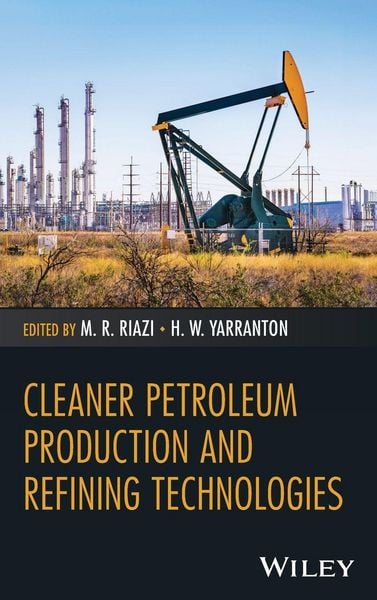
Produktbild: Cleaner Petroleum Production and Refining Technologies

Cleaner Petroleum Production and Refining Technologies

235,99 €

inkl. gesetzl. MwSt., Versandkostenfrei


Beschreibung

Produktdetails

Einband

Gebundene Ausgabe

Erscheinungsdatum

27.04.2026

Herausgeber

M. R. Riazi + weitere

Verlag

Wiley

Seitenzahl

560

Maße (L/B/H)

22,9/15,2/3,2 cm

Gewicht

916 g

Sprache

Englisch

ISBN

978-1-394-20923-1

Beschreibung

Produktdetails

Einband

Gebundene Ausgabe

Erscheinungsdatum

27.04.2026

Herausgeber

Verlag

Wiley

Seitenzahl

560

Maße (L/B/H)

22,9/15,2/3,2 cm

Gewicht

916 g

Sprache

Englisch

ISBN

978-1-394-20923-1

Herstelleradresse

Libri GmbH
Europaallee 1
36244 Bad Hersfeld
DE

Email: gpsr@libri.de

Noch keine Bewertungen vorhanden

Verfassen Sie die erste Bewertung zu diesem Artikel

Helfen Sie anderen Kundinnen und Kunden durch Ihre Meinung.

Kundinnen und Kunden meinen

Bewertungen (0)

Die Leseprobe wird geladen.
  • Produktbild: Cleaner Petroleum Production and Refining Technologies
  • List of Contributors xvii
    Preface xix

    1 Introduction 1
    M. R. Riazi and Harvey W. Yarranton

    1.1 Historical Perspective on Petroleum 2
    1.2 Future Demand for Petroleum and Its Products 5
    1.3 Petroleum Production 9
    1.4 Petroleum Refining 12

    Part I Cleaner Petroleum Production 23

    2 Carbon Capture, Storage, and Enhanced Oil Recovery 25
    Eduardo Manrique

    2.1 Introduction 25
    2.2 CCUS: Main Steps 26
    2.3 Geologic CO2 Storage 28
    2.4 Enhanced Oil Recovery 30
    2.5 CCUS: Challenges and General Economics 38
    2.6 Closing Remarks 55

    3 Fugitive Methane Emissions 77
    Stuart Riddick

    3.1 Methane Oil and Gas Emission Sources 77
    3.2 Methane 79
    3.3 Micrometeorology 81
    3.4 Methane Emission Quantification Methodologies 86
    3.5 Measuring Methane Concentrations 95
    3.6 Full System Solutions 101
    3.7 Challenges and Needs for Future Work 101

    4 Technologies to Reduce GHG Emissions from Heavy Oil Production 117
    Dr. Bruce S. Carey

    4.1 Introduction 117
    4.2 Current Commercial Thermal Methods 122
    4.3 New Solvent-based Recovery Processes with Improved Environmental Metrics 133
    4.4 Other Recovery and Associated GHG Intensity Reduction Technologies 163
    4.5 Summary of GHG Reduction Estimates 177
    4.6 Key Takeaways and Concluding Comments 177

    5 Energy Intensity in Mineable Oil Sands 189
    Danuta M. Sztukowski and Elco D. Hollander

    5.1 Introduction to Mineable Oil Sands 189
    5.2 Evolution of Process Flowsheets 196
    5.3 Continuous Improvement Opportunities 212
    5.4 Step-out Technologies 221
    5.5 Concluding Remarks 225

    6 Tailings and Waste Management in Mineable Oil Sands 233
    Elco D. Hollander and Danuta M. Sztukowski

    6.1 Introduction to Tailings and Waste Management 233
    6.2 Tailings Mass Balance and Waste Material Types 236
    6.3 The Tailings Management Challenge 243
    6.4 Tailings Technology Trade-offs 253
    6.5 Technologies Deployed 257
    6.6 Concluding Remarks 267

    Part II Cleaner Petroleum Refining 275

    7 Refining of Unconventional and Heavy Oil 277
    M. R. Riazi and Dicho Stratiev

    7.1 Introduction 277
    7.2 Heavy and Extra Heavy Oil Refining Technologies 277
    7.3 Shale Oil Production and Processing 309

    8 Petroleum Refining with Deep Conversion and Deep Desulfurization 333
    George Hoekstra, Marcio Wagner da Silva, and Thomas Murphy

    8.1 Heavy Oil Process Overview 333
    8.2 A Closer Look at Heavy Oil Upgrading Reactors and Catalysts 338
    8.3 Economic Analysis of Gasoline Sulfur Reduction Investment 349

    9 Hydrogen Production Using Renewable Feedstock 363
    Gabriela Nascimento da Silva, Clarissa Bergman-Fonte, Pedro R. R. Rochedo, Frédéric Lantz, and Alexandre Szklo

    9.1 Introduction 363
    9.2 Hydrogen Production in Oil Refineries 367
    9.3 Hydrogen Produced from Water Electrolysis 370
    9.4 Conclusion 375

    10 Closer Integration Between Refining and Petrochemical Assets and Their Role in the Future of the Downstream Industry 383
    Marcio Wagner da Silva, George Hoekstra, and Thomas Murphy

    10.1 Introduction and Context 383
    10.2 What Is the Petrochemical Integration Concept? 385
    10.3 The Crude Oil to Chemicals - Maximum Added Value to the Processed Crude 387
    10.4 Available Crude-to-chemicals Routes 400
    10.5 Refining Technologies and Relatively Low-cost Alternatives to Integration 402
    10.6 Closing the Sustainability Cycle - Plastics Recycling Technologies 406
    10.7 Conclusion 407

    11 Greening Existing Petroleum Refineries via Biomass Processing 411
    Clarissa Bergman-Fonte, Aline T. Carvalho, Gabriela Nascimento da Silva, Pedro R. R. Rochedo, Frédéric Lantz, and Alexandre Szklo

    11.1 Introduction 411
    11.2 General Concepts 412
    11.3 Oily Crops, Used Cooking Oils, Residual Fats 414
    11.4 Lignocellulosic Biomass 420
    11.5 Sugary and Starchy Biomass 427
    11.6 Opportunities and Challenges for Biomass Co-processing - A Case Study Application 428
    11.7 Conclusion 434

    12 Liquid Fuels from Syngas and CO2 443
    Chike George Okoye-Chine and B. Frank Gupton

    12.1 Introduction 443
    12.2 Syngas Production 444
    12.3 Liquid Fuel Production from Syngas via FT Synthesis 456
    12.4 Conversion of CO2 into Liquid Fuels 459
    12.5 Conclusion 466

    13 Syngas Production Beyond Petroleum Feedstock Toward LCA 481
    Amol A. Inamdar, Francisco O. Aguirre, Olubayo O. Oginni, Heidi A. Taboada, and Lucy Mar Camacho

    13.1 Introduction 481
    13.2 Other Syngas Production Pathways 482
    13.3 Valuable Syngas Subproducts and Their Environmental Footprint 483
    13.4 Feedstock Alternatives for Syngas Production 485
    13.5 Process Optimizations to Improve Environmental Performance 488
    13.6 Environmental Impact of Syngas Production 490
    13.7 Life Cycle Assessment of Syngas Production 494
    13.8 Final Considerations from Syngas LCA 498

    14 Investment Required for Upgrading Petroleum Refineries - Simplified Approach 507
    Thomas Murphy, George Hoekstra, and Marcio Wagner da Silva

    14.1 Introduction 508
    14.2 Derivatives 510
    14.3 Model Risk 513
    14.4 Quantitative Models 515
    14.5 Model Audits and Critique 516
    14.6 Systems Thinking 517
    14.7 Assessment of Model Risk Fits into a DSM Framework 520
    14.8 Real Option Strategy Assessment Example - Evaluating CTL Technology 521
    14.9 Environmental Compliance: Environmental Credits and Offsets 526
    14.10 Conclusion 527

    Index 529