
KI-Beratung Beta

  • Produktbild: The Palgrave Handbook of the Anthropology of Technology
  • Produktbild: The Palgrave Handbook of the Anthropology of Technology
- 13%

The Palgrave Handbook of the Anthropology of Technology

13% sparen

171,99 € UVP 197,99 €

inkl. gesetzl. MwSt., Versandkostenfrei


Beschreibung

This Handbook offers an overview of the thriving and diverse field of anthropological studies of technology. It features 39 original chapters, each reviewing the state of the art of current research and enlivening the field of study through ethnographic analysis of human-technology interfaces, forms...

Beschreibung

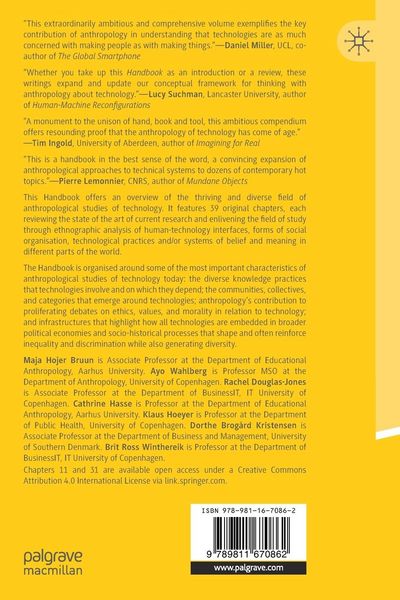
This Handbook offers an overview of the thriving and diverse field of anthropological studies of technology. It features 39 original chapters, each reviewing the state of the art of current research and enlivening the field of study through ethnographic analysis of human-technology interfaces, forms of social organisation, technological practices and/or systems of belief and meaning in different parts of the world.

The Handbook is organised around some of the most important characteristics of anthropological studies of technology today: the diverse knowledge practices that technologies involve and on which they depend; the communities, collectives, and categories that emerge around technologies; anthropology’s contribution to proliferating debates on ethics, values, and morality in relation to technology; and infrastructures that highlight how all technologies are embedded in broader political economies and socio-historical processes that shape and often reinforce inequality and discrimination while also generating diversity. All chapters share a commitment to human experiences, embodiments, practices, and materialities in the daily lives of those people and institutions involved in the development, manufacturing, deployment, and/or use of particular technologies.

Portrait


Maja Hojer Bruun is Associate Professor at the Department of Educational Anthropology, Aarhus University.


Ayo Wahlberg is Professor MSO at the Department of Anthropology, University of Copenhagen.


Rachel Douglas-Jones is Associate Professor at the Department of BusinessIT, IT University of Copenhagen.


Cathrine Hasse is Professor at the Department of Educational Anthropology, Aarhus University.


Klaus Hoeyer is Professor at the Department of Public Health, University of Copenhagen.


Dorthe Brogård Kristensen is Associate Professor at the Department of Business and Management, University of Southern Denmark.


Brit Ross Winthereik is Professor at the Department of BusinessIT, IT University of Copenhagen.


Produktdetails

Einband

Taschenbuch

Erscheinungsdatum

25.03.2023

Abbildungen

XXIV, 808 p. 23 illus., 16 illus. in color.

Herausgeber Maja Hojer Bruun + weitere

Produktdetails

Einband

Taschenbuch

Erscheinungsdatum

25.03.2023

Abbildungen

XXIV, 808 p. 23 illus., 16 illus. in color.

Herausgeber
Verlag Springer Singapore
Seitenzahl

808

Maße (L/B/H)

23,5/15,5/4,5 cm

Gewicht

1235 g

Auflage

1st ed. 2022

Sprache

Englisch

ISBN

978-981-16-7086-2

Herstelleradresse

Springer-Verlag GmbH
Tiergartenstr. 17
69121 Heidelberg
DE

Email: ProductSafety@springernature.com

Noch keine Bewertungen vorhanden

Verfassen Sie die erste Bewertung zu diesem Artikel

Helfen Sie anderen Kundinnen und Kunden durch Ihre Meinung.

Kundinnen und Kunden meinen

Bewertungen (0)

  • Produktbild: The Palgrave Handbook of the Anthropology of Technology
  • Produktbild: The Palgrave Handbook of the Anthropology of Technology

  • The Anthropology of Technology: The Formation of a Field.- Section 1: Perspectives, Fields, and Approaches.- Making ‘Technology’ Visible: Technical Activities and the Chaîne Opératoire.- Technology as Skill in Handwork and Craft: Basketwork and Handweaving.- Material Culture Studies: Objectification, Agency, and Intangibility.- Feminist Technoscience and New Imaginaries of Human Reproduction.- Assemblage Ethnography: Configurations Across Scales, Sites, and Practices.- Humanism, Posthumanism, and New Humanism: How Robots Challenge the Anthropological Object.- Structuring Race into the Machine: The Spoiled Promise of Postgenomic Gene Sequencing.- An Interventional Design Anthropology of Emerging Technologies: Working Through an Interdisciplinary Field.- Computational Ethnography: A Case of Covid-19’s Methodological Consequences.- Section 2: Knowing, Unknowing, and Re-knowing.- Knowing, Unknowing, and Re-knowing.- Technology, Environment, and the Ends of Knowledge.- Charting the Unknown: Tracking the Self, Experimenting with the Digital.- Data, Knowledge Practices, and Naturecultural Worlds: Vehicle Emissions in the Anthropocene.- Set, Setting, and Clinical Trials: Colonial Technologies and Psychedelics.- Assembling Population Data in the Field: The Labour, Technologies, and Materialities of Quantification.- Peopled by Data: Statistical Knowledge Practices, Population-Making, and the State.- Data Practices and Sustainable Development Goals: Organising Knowledge for Sustainable Futures.- Section 3: Communities, Collectives, and Categories.- Communities, Collectives, and Categories.- Un/Doing Race: On Technology, Individuals, and Collectives in Forensic Practice.- Learning, Technology, and the Instrumentalisation of Critique.- Technology, Gender, and Nation: Building Modern Citizens in Maoist China.- Imagineerism: Technology, Robots, Kinship. Perspectives from Japan.- Collectivities and Technological Activism: Feminist Hacking.- Inside Technology Organisations: Imaginaries of Digitalisation at Work.- Section 4: Ethics, Values, and Morality.- Ethics, Values, and Morality.- Moral Ambiguities: Fleshy and Digital Substitutes in the Life Sciences.- Enacting Authenticity: Changing Ontologies of Biological Entities.- Technologies of Beauty: The Materiality, Ethics, and Normativity of Cosmetic Citizenship.- The Optimised and Enhanced Self: Experiences of the Self and the Making of Societal Values.- Articulations of Ethics: Energy Worlds and Moral Selves.- Competing Responsibilities and the Ethics of Care in Young People’s Engagements with Digital Mental Health.- Committee Work: Stem Cell Governance in the United States.- Section 5: Infrastructures, Linkages, and Livelihoods.- Infrastructures, Linkages, and Livelihoods.- Accumulation: Exploring the Materiality of Energy Infrastructure.- Food Infrastructures and Technologies of Trust in Contemporary China.- Water Infrastructures: The Making and Maintenance of Material and Organisational Connections.- Electricity as a Field for Anthropological Theorizing and Research.- Circuit Board Money: An Infrastructural Perspective on Digital Payments.