KI-Beratung Beta

Gutscheinbedingungen

**Gültig am 25.11.2026 auf fremdsprachige Bücher online auf thalia.at und in der Thalia App. Einzelne Artikel können ausgeschlossen sein. Ausgenommen sind preisgebundene Artikel & eBooks. Pro Einkauf einmal einlösbar. Click & Collect nur bei Onlinevorabzahlung möglich. Keine Barauszahlung. Nicht kombinierbar mit anderen Aktionen und Gutscheinen. Gutschein wird auf max. 500€ Bestellwert angerechnet. Nicht gültig für Geschenkkarten, Versandkosten und Services.

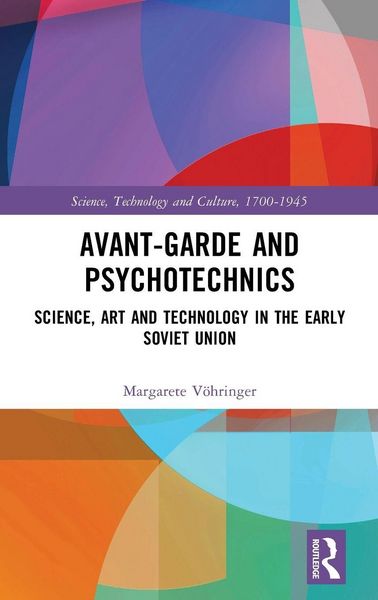
Produktbild: Avant-Garde and Psychotechnics

Avant-Garde and Psychotechnics Science, Art and Technology in the Early Soviet Union

229,99 €

inkl. gesetzl. MwSt., Versandkostenfrei


Beschreibung

Avant-Garde and Psychotechnics presents an innovative look at the Russian avant-garde and its cultural encounters with the sciences in the 1920s. The book examines some of the lesser known entanglements between architects, filmmakers and philosophers, on the one hand, and experimental psychologists and...

Beschreibung

Avant-Garde and Psychotechnics presents an innovative look at the Russian avant-garde and its cultural encounters with the sciences in the 1920s. The book examines some of the lesser known entanglements between architects, filmmakers and philosophers, on the one hand, and experimental psychologists and physiologists on the other. In Russia, famous avant-garde artists, such as El Lissitzky, Vassily Kandinsky and Dziga Vertov, helped propagate a movement referred to as "psychotechnics" that was emerging at the time in Germany and the United States and eventually led to a "psychotechnical boom." At the end of the story told in the book, it becomes clear that this boom continues to the present day. By analyzing concrete projects undertaken by Russian artists and scientists in cooperation with one another, and by drawing on as-yet-unpublished archival material, Avant-Garde and Psychotechnics challenges the established notion of socialist sciences. At the same time, it provides an entirely new picture of what was thought to be modern art, thereby demonstrating that artistic experimentation had much more than a mere metaphorical meaning in Russian arts in the 1920s.

In 2007 Avant-Garde and Psychotechnics was acknowledged with an award for interdisciplinary research by the Wilhelm-Ostwald-Society, Großbothen. In 2011 the book received funding from the VolkswagenStiftung to be translated into English and Russian (the Russian edition was published by NLO books in 2019). The original German edition also received favorable reviews in NZZ, NTM, Derive, Junge Welt and Sehepunkte.

Rezension

Much has been written on the relations between the arts and sciences. Margarete Vöhringer's ambitious book goes further and explores ways, at a particular time and place, in which there were not separable 'related' activities but a common experimental practice with material things, in which all was 'art'. The purpose is not to dissolve differences but to specify, in historical detail, the sharing and modification of material practices and instrumentation as they carry from one cultural setting to another.

Roger Smith, The British Journal for the History of Science, 2023:1-2

Produktdetails

Einband

Gebundene Ausgabe

Erscheinungsdatum

31.07.2023

Abbildungen

50 SW-Abb., 50 SW-Fotos

Verlag Taylor & Francis

Produktdetails

Einband

Gebundene Ausgabe

Erscheinungsdatum

31.07.2023

Abbildungen

50 SW-Abb., 50 SW-Fotos

Verlag Taylor & Francis
Seitenzahl

256

Maße (L/B/H)

24/16,1/1,8 cm

Gewicht

502 g

Sprache

Englisch

ISBN

978-1-03-253264-6

Herstelleradresse

Libri GmbH
Europaallee 1
36244 Bad Hersfeld
DE

Email: gpsr@libri.de

Noch keine Bewertungen vorhanden

Verfassen Sie die erste Bewertung zu diesem Artikel

Helfen Sie anderen Kundinnen und Kunden durch Ihre Meinung.

Kundinnen und Kunden meinen

Bewertungen (0)

Die Leseprobe wird geladen.
  • Produktbild: Avant-Garde and Psychotechnics
  • Introduction. 1. Feed(ing) Back: Nicolai Ladovsky's Psychotechnical Laboratory for Architecture, Moscow 1921-1927 2. Networking: Vsevolod Pudovkin's Mechanics of the Brain - Film as Reflexology, Leningrad/Moscow 1925-1926. 3. Grafting: Alexander Bogdanov's Circular Blood Transfusions, Moscow 1924-1928. Conclusion: Feeding Back, Networking and Grafting as Cultural Techniques.