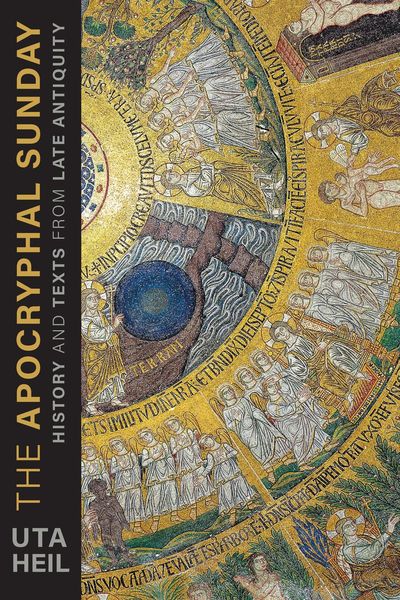
Apocryphal Sunday History and Texts from Late Antiquity
-
- Taschenbuch
- eBook ausgewählt
-
Form:Einzelkauf Download
-
Sprache:Englisch
40,60 €
inkl. gesetzl. MwSt.Beschreibung
Produktdetails
Format
ePUB
Kopierschutz
Ja
Family Sharing
Ja
Text-to-Speech
Ja
Erscheinungsdatum
17.10.2023
Verlag
Fortress PressSeitenzahl
(Printausgabe)
Dateigröße
5014 KB
Sprache
Englisch
EAN
9781506491080
A range of apocryphal and pseudepigraphic texts from Late Antiquity points to the importance of Sunday as a holiday for baptized Christians. First and foremost is the so-called Letter from Heaven, which has experienced a broad and long-lasting reception up to modern times, although it was also criticized as a forgery from its beginning. Unfortunately, these texts have not received sufficient attention so far.
This volume presents various versions of the Letter from Heaven, as well as other texts (the pseudepigraphic Acts of the Synod of Caesarea; pseudepigraphic sermons of Eusebius of Alexandria, John Chrysostom, and Basil of Caesarea; passages from the Didascalia or Diataxis of Jesus Christ; the Second Apocryphal Apocalypse of John; the Visio Pauli; a sermon of Sophronius of Jerusalem; and the Apocalypse of Anastasia), together with a translation and commentary. An introduction tells the story of this letter and integrates it and the other texts into the cultural history of Sunday. It becomes clear that Sunday as a day of rest and a feast day was not in the foreground of the development of an ecclesiastical festival calendar for a long time, although Emperor Constantine enacted a law on holiday rest on Sunday in 321 CE. Sunday, rather, marks the end of the Christianization of time and the calendar, when Easter, Pentecost, Christmas, and martyrs' feasts were already taken for granted. The authors of these texts obviously wanted to accelerate this process, which is why an anonymous person even resorted to presenting Christ himself as the author of this letter. Here, severe punishments are threatened to all who do not observe Sunday, who work as if it were a weekday, and who skip worship. The broad tradition shows that the letter was read and distributed despite all the criticism, and was even turned into an early form of a chain letter.
Noch keine Bewertungen vorhanden
Verfassen Sie die erste Bewertung zu diesem Artikel
Helfen Sie anderen Kundinnen und Kunden durch Ihre Meinung.
Kurze Frage zu unserer Seite
Vielen Dank für Ihr Feedback
Wir nutzen Ihr Feedback, um unsere Produktseiten zu verbessern. Bitte haben Sie Verständnis, dass wir Ihnen keine Rückmeldung geben können. Falls Sie Kontakt mit uns aufnehmen möchten, können Sie sich aber gerne an unseren Kund*innenservice wenden.
zum Kundenservice