KI-Beratung Beta

  • Produktbild: Business and Policy Solutions to Climate Change
  • Produktbild: Business and Policy Solutions to Climate Change
- 13%

Business and Policy Solutions to Climate Change From Mitigation to Adaptation

13% sparen

209,99 € UVP 241,99 €

inkl. gesetzl. MwSt., Versandkostenfrei


Beschreibung

Produktdetails

Einband

Taschenbuch

Erscheinungsdatum

03.03.2023

Abbildungen

XXX, 449 p. 46 illus.

Herausgeber

Thomas Walker + weitere

Verlag

Springer

Seitenzahl

449

Maße (L/B/H)

21/14,8/2,6 cm

Gewicht

615 g

Sprache

Englisch

ISBN

978-3-030-86805-5

Beschreibung

Portrait


Dr. Thomas Walker
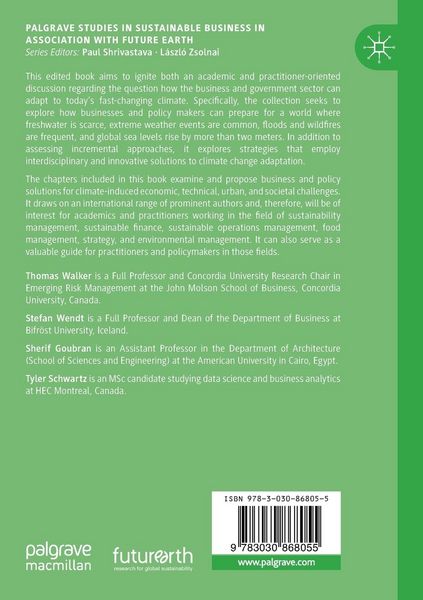
is a Professor of Finance, the Director and Academic Lead of the Emerging Risks Information Center (ERIC), the Director for the Jacques Ménard/BMO Center for Capital Markets Research, and the Concordia University Research Chair in Emerging Risk Management (Tier 1) at Concordia University in Montreal, Canada. He previously served as an Associate Dean, Department Chair, and Director of Concordia’s David O’Brien Centre for Sustainable Enterprise. Before his academic career, he worked for firms such as Mercedes Benz, KPMG, and Utility Consultants International. He has published over 70 journal articles and books.

Dr. Stefan Wendt
is a Professor and Dean of the Department of Business at Bifröst University, Iceland. Previously, he was Associate Professor at Reykjavik University, Iceland, and Research and Teaching Assistant at Bamberg University, Germany. His research covers corporate finance, financial markets, sustainable finance, digital finance, and behavioral finance.

Dr. Sherif Goubran
is an Assistant Professor in the Department of Architecture (School of Sciences and Engineering) at the American University in Cairo. His research focus includes building sustainability and sustainability assessment, sustainability in architectural design, and human approaches in design.

Tyler Schwartz
is an MSc candidate at HEC Montreal studying data science and business analytics. Tyler completed his undergraduate degree at the John Molson School of Business, for which he received honors in finance. His research interests include predictive modeling, bio-statistics, sports analytics, and machine learning.


Produktdetails

Einband

Taschenbuch

Erscheinungsdatum

03.03.2023

Abbildungen

XXX, 449 p. 46 illus.

Herausgeber

Verlag

Springer

Seitenzahl

449

Maße (L/B/H)

21/14,8/2,6 cm

Gewicht

615 g

Sprache

Englisch

ISBN

978-3-030-86805-5

Herstelleradresse

Springer-Verlag GmbH
Tiergartenstr. 17
69121 Heidelberg
DE

Email: ProductSafety@springernature.com

Noch keine Bewertungen vorhanden

Verfassen Sie die erste Bewertung zu diesem Artikel

Helfen Sie anderen Kundinnen und Kunden durch Ihre Meinung.

Kundinnen und Kunden meinen

Bewertungen (0)

  • Produktbild: Business and Policy Solutions to Climate Change
  • Produktbild: Business and Policy Solutions to Climate Change

  • Part 1: Introduction.- Chapter 1: Climate Change Adaptation: An Overview.- Chapter 2: Defining Net-Zero and Climate Recommendations for Carbon Offsetting.- Part 2: Ecology and the Natural Environment.- Chapter 3: Green Infrastructure Mapping for Adaptation, Biodiversity, and Health and Wellbeing: A Tool Development Case Study in Edinburgh.- Chapter 4: Agroecological Approaches for Climatic Change Mitigation and Adaptation: Experiences from the South to Encourage Direct Producer-Consumer Relationships.- Chapter 5: Sustainable Renaturation in Desertification Control: Expediting the Natural Succession of Large-Scale Vegetation in Drylands.- Part 3: Finance and the Economy.- Chapter 6: Weaknesses in Corporate Commitments to Climate Change Adaptation and How to Fix Them: A Systemic Scenario Assessment Approach.- Chapter 7: Climate Finance: A Business-Ethical Analysis.- Chapter 8: Risk-Rating GHG Emissions Offsets based on Climate Requirements.- Chapter 9: An Investigation of Climate Change within the Framework of a Schumpeterian Economic Growth Model.- Chapter 10: Culture, Economics, and Climate Change Adaptation.- Chapter 11: Investors’ Adaptation to Climate Change: A Temporal Portfolio Choice Model with Diminishing Climate Duration Hazard.- Part 4: Cities and Urban Areas.- Chapter 12: Mainstreaming Adaptation into Urban Planning: Projects and Changes in Regulatory Frameworks for Resilient Cities.- Chapter 13: Path-Dependency as a Potential Cause for the Disjunction between Theory and Tools in the Modelled Reality of Sustainable Architecture.- Part 5: Global Perspectives.- Chapter 14: Addressing Climate Change and Waste Management Problems through the Development of the Waste-to-Energy Value Chain for Trinidad and Tobago.- Chapter 15: The Role of Businesses in Climate Change Adaptation in the Arctic.- Chapter 16: Climate Risk on the Rise: Canada’s Approach to Limiting Future Climate Impacts.- Chapter 17: Unlocking Climate Finance to Compensate Caribbean Small IslandDeveloping States for Damages and Losses from Climate Change.- Chapter 18: Integrating Local and Indigenous Knowledge for Climate Change Adaptation in Africa.