Gutscheinbedingungen

**Gültig bis 14.09.2026 auf Spielzeug, Schreibwaren, Filme, Geschenke & Trends, Musik, tolino eReader & Zubehör, Hörbücher, nicht preisgebundene Bücher und Kalender in der Thalia App. Einzelne Artikel können ausgeschlossen sein. Aufgrund der Buchpreisbindung sind deutschsprachige Bücher und eBooks ausgenommen. Zusätzlich ausgenommen sind Abos & Flatrates, Games, Geschenkkarten/-boxen, Shelfies, Software, Zeitschriften sowie einzelne Artikel von tonies®. Pro Einkauf einmal einlösbar. Nur gültig mit im Onlineshop hinterlegter Bonuscard. Click & Collect nur bei Onlinevorabzahlung möglich. Keine Barauszahlung. Nicht kombinierbar mit anderen Aktionen und Gutscheinen. Gutschein wird auf max. 500€ Bestellwert angerechnet. Nicht gültig für Versandkosten und Services.

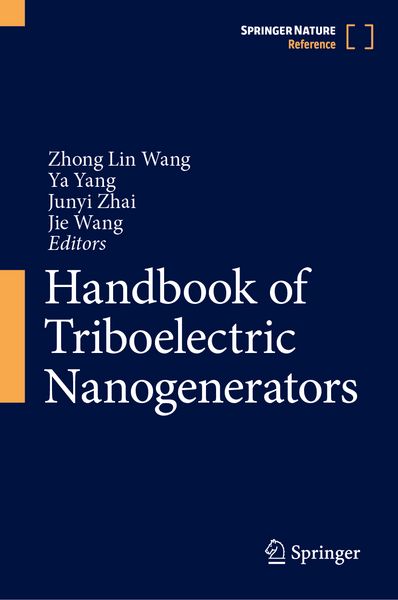
Produktbild: Handbook of Triboelectric Nanogenerators

Handbook of Triboelectric Nanogenerators

992,99 €

inkl. gesetzl. MwSt., Versandkostenfrei


Beschreibung

Produktdetails

Einband

Set mit diversen Artikeln

Erscheinungsdatum

26.08.2023

Abbildungen

XXV, 1954 p. 1030 illus., 1000 illus. in color. In 2 volumes, not available separately.

Herausgeber

Zhong Lin Wang + weitere

Verlag

Springer

Seitenzahl

1954

Maße (L/B/H)

24,1/16/11,1 cm

Gewicht

3661 g

Auflage

1st ed. 2023

Sprache

Englisch

ISBN

978-3-031-28110-5

Beschreibung

Portrait

Zhong Lin Wang is the Director of the Beijing Institute of Nanoenergy and Nanosystems, and Regents Professor and Hightower Chair at Georgia Institute of Technology. Dr. Wang pioneered the nanogenerators field for distributed energy, self-powered sensors, and large-scale blue energy. He coined the fields of piezotronics and piezo-phototronics for the third generation semiconductors. Among 100,000 scientists across all fields worldwide, Wang is ranked #3 in career scientific impact, and #1 in Materials Science. Dr. Wang has received the Celsius Lecture Laureate, Uppsala University, Sweden (2020); The Albert Einstein World Award of Science (2019); Diels-Planck lecture award (2019); ENI award in Energy Frontiers (2018); The James C. McGroddy Prize in New Materials from American Physical Society (2014); and MRS Medal from Materials Research Society (2011). Dr. Wang was elected as a fellow of the US National Academy of Inventors in 2022, foreign member of the Chinese Academy of Sciences in 2009, member of European Academy of Sciences in 2002, academician of Academia of Sinica 2018, and international fellow of Canadian Academy of Engineering 2019. Dr. Wang is the founding editor and chief editor of an international journal Nano Energy. 

Ya Yang is a Professor at the Beijing Institute of Nano energy and Nanosystems, Chinese Academy of Sciences. He has developed various new hybridized and multi-effects coupled nanoenergy-related materials and devices, opening up the new principles of the device design and coupled effects, and the new approaches of improving output performances of nanoenergy-related devices. His main research interests focus on hybridized and coupled nanogenerators, self-powered sensors, other energy-scavenging devices, and some new physical effects. He has published more than 200 SCI academic papers in top journals, which have been cited by more than 19,000 times, and the corresponding H-index is 83 (web of science). He has served as the session chairman of the international academic conferences for six times, and he is the editor-in-chief of Nanoenergy Advances, and the editorial committee member of InfoMat, Nano-Micro Letters, Nanoscale, Nanoscale Advances, iScience, and some other journals. 

Junyi Zhai is a Professor at the Beijing Institute of Nanoenergy and Nanosystems, Chinese Academy of Sciences. His research mainly engaged in the preparation of piezoelectric semiconductor materials, the growth and characterization of epitaxial functional oxides, the design and application of novel multifunctional electronics and optoelectronics devices, self powered sensors, and the Ocean Internet of Things. So far, he has published more than 150 research papers in journals such as Science Advances, Nature Communication, Matter, Chemical Review, and Advanced Materials, with over 10,000 citations. The H-index of these papers is 52, and he has obtained 10 inventionpatents. He has been a PI or Co-Pi for five projects from the National Natural Science Foundation of China and the Ministry of Science and Technology of the People’s Republic of China. 

Jie Wang received his B.Eng. degrees from the Department of Polymer Science and Engineering and the Department of Computer Science and Technology at Xi’an Jiaotong University in 2000. He received his Ph. D. degree from the Department of Electronics Science and Technology at Xi’an Jiaotong University in 2008. Dr. Wang joined the Beijing Institute of Nanoenergy and Nanosystems, Chinese Academy of Sciences as a Professor in 2016. His current research interests mainly focus on triboelectric nanogenerators, high-entropy energy, self-powered sensors, and self-powered system. He has authored over 130 peer-reviewed journal articles (13 in Nature/Science sister journals, H-index 56), and holds over 30 patents. He was honored as the New Century Excellent Talents in University, China

Produktdetails

Einband

Set mit diversen Artikeln

Erscheinungsdatum

26.08.2023

Abbildungen

XXV, 1954 p. 1030 illus., 1000 illus. in color. In 2 volumes, not available separately.

Herausgeber

Verlag

Springer

Seitenzahl

1954

Maße (L/B/H)

24,1/16/11,1 cm

Gewicht

3661 g

Auflage

1st ed. 2023

Sprache

Englisch

ISBN

978-3-031-28110-5

Herstelleradresse

Springer-Verlag KG
Sachsenplatz 4-6
1201 Wien
AT

Email: ProductSafety@springernature.com

Noch keine Bewertungen vorhanden

Verfassen Sie die erste Bewertung zu diesem Artikel

Helfen Sie anderen Kundinnen und Kunden durch Ihre Meinung.

Kundinnen und Kunden meinen

Bewertungen (0)

  • Produktbild: Handbook of Triboelectric Nanogenerators
  • Part I: Fundamentals of triboelectric nanogenerators.- Part II: Triboelectric nanogenerators as micro-nano power sources.- Part III: Triboelectric nanogenerators for blue energy and environment.- Part IV: Triboelectric nanogenerators as sensors and high voltage sources.