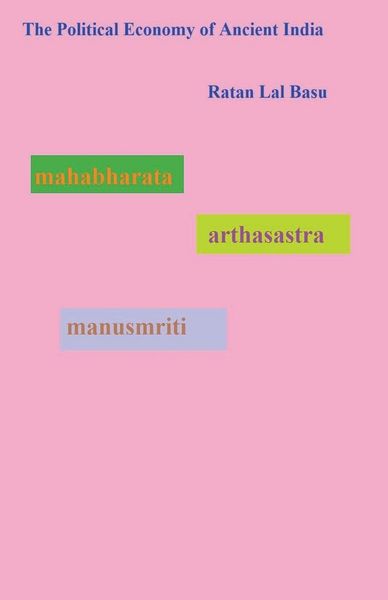
The Political Economy of Ancient India
-
- Taschenbuch ausgewählt
- eBook
-
Sprache:Englisch
21,99 €
inkl. gesetzl. MwSt.,
- Kostenlose Lieferung ab 30 € Einkaufswert
- Versandkostenfrei für Bonuscard-Kund*innen
Beschreibung
Produktdetails
Einband
Taschenbuch
Erscheinungsdatum
22.01.2023
Verlag
KautilyaSeitenzahl
220
Maße (L/B/H)
21,6/14/1,3 cm
Gewicht
317 g
Sprache
Englisch
EAN
9798201835149
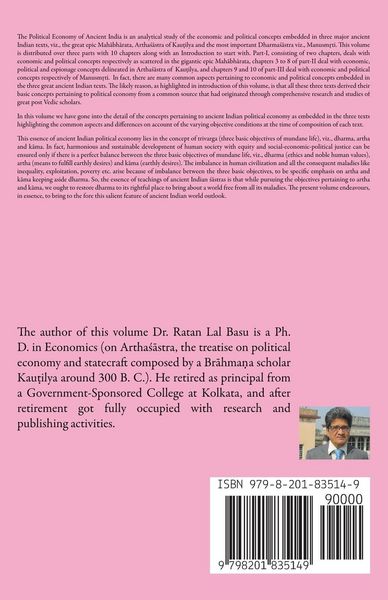
The Political Economy of Ancient India is an analytical study of the economic and political concepts embedded in three major ancient Indian texts, viz., the great epic Mah¿bh¿rata, Arthä¿stra of Kaüilya and the most important Dharmä¿stra viz., Manusm¿ti. This volume is distributed over three parts with 10 chapters along with an Introduction to start with. Part-I, consisting of two chapters, deals with economic and political concepts respectively as scattered in the gigantic epic Mah¿bh¿rata, chapters 3 to 8 of part-II deal with economic, political and espionage concepts delineated in Arthä¿stra of Kaüilya, and chapters 9 and 10 of part-III deal with economic and political concepts respectively of Manusm¿ti. In fact, there are many common aspects pertaining to economic and political concepts embedded in the three great ancient Indian texts. The likely reason, as highlighted in introduction of this volume, is that all these three texts derived their basic concepts pertaining to political economy from a common source that had originated through comprehensive research and studies of great post Vedic scholars. In this volume we have gone into the detail of the concepts pertaining to ancient Indian political economy as embedded in the three texts highlighting the common aspects and differences on account of the varying objective conditions at the time of composition of each text. This essence of ancient Indian political economy lies in the concept of trivarga (three basic objectives of mundane life), viz., dharma, artha and k¿ma. In fact, harmonious and sustainable development of human society with equity and social-economic-political justice can be ensured only if there is a perfect balance between the three basic objectives of mundane life, viz., dharma (ethics and noble human values), artha (means to fulfill earthly desires) and k¿ma (earthly desires). The imbalance in human civilization and all the consequent maladies like inequality, exploitation, poverty etc. arise because of imbalance between the three basic objectives, to be specific emphasis on artha and k¿ma keeping aside dharma. So, the essence of teachings of ancient Indian ¿¿stras is that while pursuing the objectives pertaining to artha and k¿ma, we ought to restore dharma to its rightful place to bring about a world free from all its maladies. The present volume endeavours, in essence, to bring to the fore this salient feature of ancient Indian world outlook.
Noch keine Bewertungen vorhanden
Verfassen Sie die erste Bewertung zu diesem Artikel
Helfen Sie anderen Kundinnen und Kunden durch Ihre Meinung.
Kurze Frage zu unserer Seite
Vielen Dank für Ihr Feedback
Wir nutzen Ihr Feedback, um unsere Produktseiten zu verbessern. Bitte haben Sie Verständnis, dass wir Ihnen keine Rückmeldung geben können. Falls Sie Kontakt mit uns aufnehmen möchten, können Sie sich aber gerne an unseren Kund*innenservice wenden.
zum Kundenservice