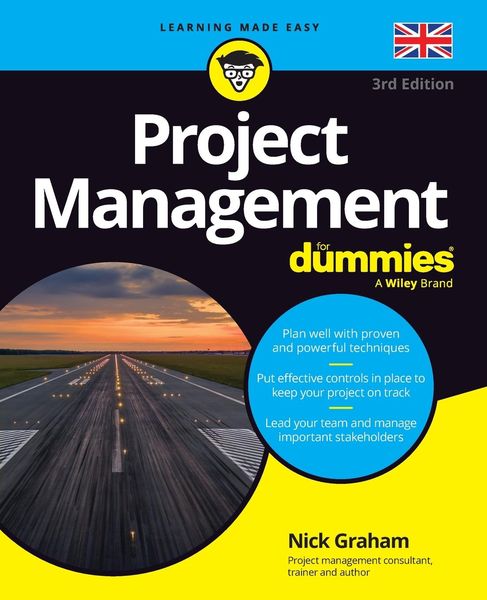
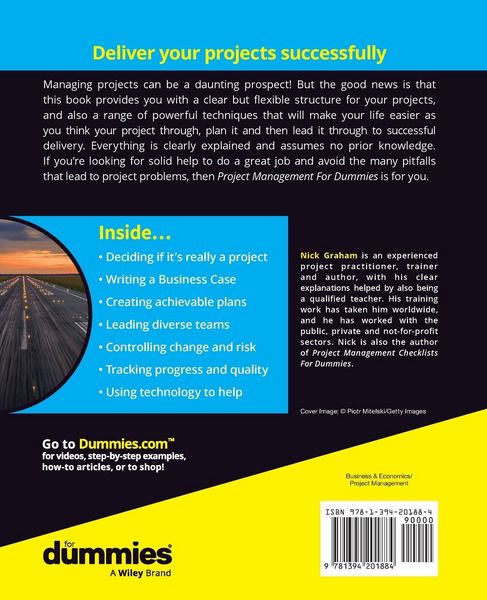
• Produktbild: Project Management For Dummies - UK
  • Produktbild: Project Management For Dummies - UK

Project Management For Dummies - UK UK Edition

25,99 €

inkl. gesetzl. MwSt., zzgl. Versandkosten


  • Kostenlose Lieferung ab 30 € Einkaufswert
  • Versandkostenfrei für Bonuscard-Kund*innen

Beschreibung

Produktdetails

Einband

Taschenbuch

Erscheinungsdatum

31.10.2023

Verlag

John Wiley & Sons Inc

Seitenzahl

448

Maße (L/B/H)

23,5/19,1/2,4 cm

Gewicht

834 g

Auflage

3rd UK Edition

Sprache

Englisch

ISBN

978-1-394-20188-4

Beschreibung

Produktdetails

Einband

Taschenbuch

Erscheinungsdatum

31.10.2023

Verlag

John Wiley & Sons Inc

Seitenzahl

448

Maße (L/B/H)

23,5/19,1/2,4 cm

Gewicht

834 g

Auflage

3rd UK Edition

Sprache

Englisch

ISBN

978-1-394-20188-4

Herstelleradresse

Libri GmbH
Europaallee 1
36244 Bad Hersfeld
DE

Email: gpsr@libri.de

Kundinnen und Kunden meinen

0 Bewertungen

Informationen zu Bewertungen

Zur Abgabe einer Bewertung ist eine Anmeldung im Konto notwendig. Die Authentizität der Bewertungen wird von uns nicht überprüft. Wir behalten uns vor, Bewertungstexte, die unseren Richtlinien widersprechen, entsprechend zu kürzen oder zu löschen.

Die Bewertungen sind nach Format, Anzahl Sterne und Datum sortiert.

Verfassen Sie die erste Bewertung zu diesem Artikel

Helfen Sie anderen Kund*innen durch Ihre Meinung

Kundinnen und Kunden meinen

0 Bewertungen filtern

Die Leseprobe wird geladen.
  • Produktbild: Project Management For Dummies - UK
  • Produktbild: Project Management For Dummies - UK
  • Introduction 1

    About This Book 2

    Foolish Assumptions 2

    Icons Used in This Book 3

    Beyond the Book 4

    Where to Go from Here 4

    Part 1: Understanding Projects and What You Want to Achieve 5

    Chapter 1: Success in Project Management 7

    Taking on a Project 7

    Avoiding the Pitfalls 8

    Deciding Whether the Job is a Project 10

    Understanding the four control areas 10

    Recognising the diversity of projects 12

    Understanding the four stages of a project 13

    Defining the Project Manager's Role 15

    Looking at the Project Manager's tasks 16

    Opposing opposition 17

    Avoiding 'shortcuts' 18

    Deciding On Your Approach 19

    Chapter 2: Thinking Through the Life of Your Project 21

    Using a Set Approach 21

    Breaking the Project Down into Stages 22

    Appreciating the advantages of stages 23

    Deciding on the number of delivery stages 24

    Understanding the Four Main Stages 25

    Starting the project 25

    The planning stage - organising and preparing 28

    The delivery stages - carrying out the work 32

    The closure stage 36

    Chapter 3: Defining the Scope and Producing a Business Case 37

    Defining the Scope 38

    Managing expectations and avoiding disappointment 39

    Challenging the scope 39

    Understanding the dimensions of scope 40

    Being clear 40

    Considering the requirements 41

    Producing a Business Case 41

    Getting to grips with the basic contents 42

    Keeping the Business Case up to date 42

    Figuring out why you're doing the project 43

    Understanding project justification 44

    Understanding benefits 45

    Writing the Business Case 49

    Complying with organisational standards 50

    Going Back to the Scope 50

    Challenging the existing scope 51

    Going the second mile 51

    Getting to Grips with Techniques 52

    Calculating return on investment 52

    Understanding cost-benefit analysis 52

    Chapter 4: Knowing Your Project's Stakeholders 55

    Managing Stakeholders 56

    Identifying stakeholders - the 'who' 57

    Analysing the stakeholders - the 'where' 60

    Understanding positions - the 'why' 62

    Deciding action - the 'what' 63

    Working with stakeholders - the 'how' 65

    Planning the work - the 'when' 66

    Handling Opposition 67

    Solving the problems 67

    Focusing on the common areas 67

    Understanding that you're a threat 67

    Spotting facts and emotions 69

    Overriding the opposition 70

    Handling Multiple-Stakeholder Projects 71

    Getting multiple approvals 71

    Developing management strategies 71

    Part 2: Planning Time: Determining What, When and How Much 73

    Chapter 5: Planning with Deliverables First 75

    Seeing the Logic of Product Planning 76

    Thinking 'product' before thinking 'task' 76

    Understanding the problems of an activity focus 78

    Knowing What a Product Is - and Isn't 79

    Finding Good Product Names 80

    Using a Business Project Example 81

    Identifying the products 81

    Developing a sequence 82

    Defining the products 87

    Using a Structured Product List 88

    Unleashing the Power of the Work Flow Diagram 91

    Using the Work Flow Diagram for risk 92

    Using the Work Flow Diagram for control 92

    Using the Work Flow Diagram to show stages 93

    Using the Work Flow for progress reporting 93

    Getting a picture of the project 95

    Chapter 6: Planning the Activities 97

    Moving From Products to Activities 98

    Having multiple tasks to build a product 98

    Listing the activities or tasks 99

    Drawing Up a First Activity Network 101

    Seeing how you build up an Activity Network 101

    Using the Work Flow Diagram 103

    Putting in the time durations 105

    Calculating the length of the project 107

    Understanding Float and Its Impact 109

    Identifying the Critical Path 111

    Watching the critical path 112

    Finding a split critical path 113

    Being More Precise with Dependencies 114

    Understanding dependency types 114

    Staying in touch with reality 117

    Thinking a bit more about sequences 118

    Working with the Activity Network 120

    Working back to meet end dates 121

    Avoiding backing into your schedule 122

    Going for Gantt 123

    Estimating Activity Durations 125

    Getting the best information 126

    Using estimating techniques 127

    Putting a health warning on estimates 128

    Chapter 7: Looking At Staff Resources 131

    Seeing Why You Need to Plan Staff Use 132

    Dealing with resource conflicts 132

    Making sure that people are available 133

    Monitoring use of staff on the project 135

    Matching People to Tasks 135

    Working out the skill sets and knowledge that you need on the teams 135

    Growing your people 136

    Identifying skills sets 137

    Honing Your Task Duration Estimates 138

    Documenting your estimates 138

    Factors in activity timing and estimates 139

    Estimating required work effort 140

    Factoring in productivity 141

    Taking care with historical data 144

    Accounting for availability 145

    Smoothing the Resource 146

    Checking for resource conflict 146

    Resolving resource conflicts - the steps 147

    Co-ordinating assignments across multiple projects 149

    Chapter 8: Planning for Other Resources and Developing the Budget 151

    Determining Physical Resource Needs 152

    Identifying resource needs 152

    Understanding physical resources 154

    Thinking a bit more about timing 155

    Preparing a Budget 156

    Looking at different types of project costs 157

    Developing a project budget at three levels 159

    Creating a detailed budget estimate 160

    Refining your budget through the stages 162

    Avoiding drowning people in detail 164

    Chapter 9: Planning at Different Times and Levels 165

    Putting the Main Structure in Place 166

    Deciding on the stages 166

    Holding a Stage Gate 168

    Working with Planning Levels 169

    Drawing up new plans 170

    Keeping higher level plans up to date 172

    Planning at more than one level at once 172

    Chapter 10: Dealing with Risk and Uncertainty 175

    Understanding Risks and Risk Management 176

    Seeing why you need risk management 177

    Managing, not necessarily avoiding, risk 177

    Keeping people informed 178

    Keeping risk in focus throughout the project 180

    Working Through the Risk Cycle 180

    Identifying a risk and its trigger event(s) 182

    (Re)analyse the risk and check existing actions 183

    Deciding risk management action(s) 189

    Add/modify risk management in the plans 193

    Take planned action(s) and monitor the risk 194

    Documenting Risk 195

    Risk Plan 195

    Risk Log 196

    Getting Some Help from Techniques 197

    Ishikawa (fishbone) diagram 197

    Work Flow Diagram 198

    Risk Checklist 198

    Decision tree 198

    Chapter 11: Controlling Quality 201

    Understanding the Effects of Getting Quality Wrong 203

    Understanding the impact of poor quality 203

    Avoiding the cost of unnecessarily high quality 204

    Defining Quality 205

    Striking the Quality Balance 205

    Balancing quality against project effort (and more) 205

    Thinking through what quality level you need 206

    Identifying when quality levels are mandatory 208

    Spotting Quality Game-Playing and Working to Prevent It 208

    The quality level game and a guilty conscience 209

    When formality and auditing means nothing 210

    Typical game players 211

    Achieving a Culture of Quality 211

    Communicating quality requirements and procedures 212

    Explaining the attitude to error 212

    Celebrating when errors are found 213

    Getting On Top of Quality in Your Project 214

    Drawing up an effective Quality Plan 214

    Building the foundation with good product definition 216

    Using powerful yet simple logs 217

    Auditing quality effectively 218

    Delivering At the Right Level 218

    Specifying the right sort of testing 219

    Using the right people 219

    Reviewing Products 220

    Using informal review (peer level checking) 220

    Using formal review 221

    Part 3: Putting Your Management Team Together 225

    Chapter 12: Organising the Project 227

    Designing the Project Organisation 227

    Understanding it's about roles, not jobs 229

    Getting to grips with project roles 230

    Looking at the roles 230

    Influencing the selection of PSG roles 239

    Defining Organisational Structures 239

    The projectised structure 239

    The matrix structure 240

    Taking note of the structure 241

    Chapter 13: Working With Teams and Specialists 243

    Looking At the Team in Context 245

    Working with Team Leaders 246

    Accepting That People Are Different 248

    Using the Controller-Analyst Matrix 248

    Building in or avoiding team conflict 249

    Using the model on the fly 250

    Thinking About Suitable Team Members 251

    Considering Performance 252

    Identifying the performance progression 252

    Monitoring performance 253

    Maximising performance 253

    Working with Senior Staff 254

    Being secure in your role 255

    Calling in the heavy guns 255

    Working with Technical Specialists 256

    Finding a translator 256

    Admitting your ignorance 257

    Being on-side 257

    Working with Supplier Teams 258

    Supporting supplier staff 258

    Choosing suppliers carefully 259

    Thinking 'time', not just 'initial cost' 259

    Dealing With Discipline 259

    Maintaining some distance 260

    Owning the problem 260

    Avoiding jumping to conclusions 261

    Resolving problems - or trying to 261

    Treading the disciplinary trail 262

    Changing Staff 262

    Chapter 14: Being an Effective Leader 263

    Practising Management and Leadership 264

    Understanding what makes a good leader 264

    Developing personal authority 266

    Knowing What Motivates and What Demotivates 268

    Taking a lesson from Fred Herzberg 268

    Understanding points of demotivation 270

    Ensuring that others are on board 271

    Developing Your Teams 272

    Defining your project procedures 272

    Helping your teams to function well 273

    Stoking the Boilers 275

    Letting people know how they're doing 276

    Motivating people when they leave 276

    Keeping your finger on the pulse 277

    Part 4: Steering the Project to Success 279

    Chapter 15: Tracking Progress and Staying in Control 281

    Understanding What Underpins Effective Progress Control 282

    Having a reliable plan 282

    Having clear and frequent milestones 283

    Having an effective reporting mechanism 284

    Harnessing Product Power for Progress Control 284

    Compiling a Work Checklist 285

    Getting visual with the Work Flow Diagram 286

    Monitoring at project, stage and Work Package levels 286

    Taking Action When Things Go Off Track 286

    Finding out why the project is off track 287

    Thinking about what you can do to get back on track 289

    Deciding what you'll do 290

    Taking action 290

    Monitoring the effectiveness of the action 290

    Monitoring Work Effort and Costs 291

    Keeping an eye on work effort 291

    Follow the money: Monitoring expenditure 295

    Dealing with Change and Avoiding Scope Creep 299

    Understanding different types of change 300

    Looking at impacts - the four dogs 302

    Responding to change requests 304

    Eliminating scope creep - well, almost 305

    Handling Bad News 306

    Chapter 16: Keeping Everyone Informed 307

    Looking At Communications Failure 308

    Communications breakdown - the big project killer 308

    Identifying causes of communications problems 309

    Communicating Effectively 311

    Distinguishing between one-way and two-way communication 312

    Can you hear me? Listening actively 312

    Choosing the Appropriate Medium 314

    Writing reports 315

    Meeting up 318

    Setting up a project website 321

    Making a business presentation 321

    Preparing a Communications Plan 323

    Identifying the communications 324

    Writing a Communications Plan 326

    Chapter 17: Closing Your Project 329

    Staying the Course to Completion 330

    Thinking ahead about project closure 330

    Dealing with a crash stop 331

    Planning Closure 332

    Outlining closure activities 333

    Motivating teams to the finish line 334

    Providing a Good Transition for Team Members 334

    Reviewing the Project 336

    Beginning with the end in mind 336

    Recording project information 338

    Learning lessons and passing them on 338

    Measuring benefits 338

    Planning for Things After the Project 340

    Part 5: Taking Your Project Management to the Next Level 343

    Chapter 18: Outlining the Cyclical (Agile) Approach 345

    Understanding the Difference Between Linear and Cyclical Approaches 346

    Seeing Beyond the Hype 347

    Unravelling misnomers 347

    Separating fact from over-enthusiastic fiction 348

    Implementing a Cyclical Approach 349

    Understanding roles and functions 350

    Running development cycles 350

    Choosing The Right Approach for Your Project 352

    Basing your decision on the project's characteristics 352

    Seeing the gaps in cyclical approaches 352

    Getting it right, cyclical or not 353

    Chapter 19: Managing Multiple Projects 357

    Talking the Talk 358

    Defining a programme 358

    Defining a portfolio 360

    Deciding on a Programme 360

    Understanding programme roles 361

    Fitting in with Programme Plans 362

    Mapping interdependencies by product 362

    Controlling a programme 364

    Managing a Portfolio 365

    Understanding the project implications 366

    Maintaining the portfolio 366

    Chapter 20: Using Technology to Up Your Game 369

    Using Computer Software Effectively 370

    Seeing what software you need 371

    Understanding where to use software 371

    Having Your Head in the Cloud 377

    Getting Really Good Stuff for Free 379

    Supporting Virtual Teams with Communication Technology 380

    Saving Time with Software 381

    Being Artificially Intelligent 381

    Chapter 21: Monitoring Project Performance with Earned Value Management 383

    Understanding EVM Terms and Formulas 384

    Looking at a project example (1) 384

    Looking at a project example (2) 385

    Looking at a project example (3) 385

    Getting the three key figures 386

    Working with Ratios and Formulas 388

    Investigating Variances 389

    Deciding What to Measure for EVM 390

    Chapter 22: Project Governance and Why It's Really Important 393

    Seeing Why It's a No-brainer 394

    Looking At Other Guidance 395

    Understanding What's Involved 395

    Understanding the Organisational Level 396

    Standards and approaches 397

    Reviewing governance and standards 397

    Checking an Individual Project 398

    Checking the project's Outline Charter 399

    Checking the Charter and PMP 399

    Checking the project while it's running 400

    Evaluating the project at the end 401

    Maintaining the 'Big Divide' 402

    Coordinating Your Project Training 403

    Part 6: The Part of Tens 405

    Chapter 23: Ten Questions to Ask Yourself as You Plan Your Project 407

    What Are the Objectives of Your Project? 407

    Who Do You Need to Involve? 408

    What Will You Produce? 408

    What Constraints Must You Satisfy? 409

    What Assumptions Are You Making? 409

    What Work Has to Be Done? 410

    When Does Each Activity Start and End? 410

    Who Will Perform the Project Work? 410

    What Other Resources Do You Need? 411

    What Can Go Wrong? 411

    Chapter 24: Ten Tips for Writing a Convincing Business Case 413

    Starting with a Bang 413

    Spelling out the Benefits Clearly 414

    Pointing Out the Non-quantifiables 414

    Being Prudent 415

    Considering Three-point Estimating 415

    Making Sure Benefits Aren't Features 415

    Avoiding Benefits Contamination 416

    Making Sure You Can Deliver Benefits 416

    Supplying Evidence or Referencing It 416

    Using Appendices 417

    Chapter 25: Ten Tips for Being a Better Project Manager 419

    Being a 'Why' Person 420

    Being a 'Can Do' Person 420

    Thinking about the Big Picture 420

    Thinking in Detail 420

    Assuming Cautiously 421

    Viewing People as Allies Not Adversaries 421

    Saying What You Mean, and Meaning What You Say 421

    Respecting Other People 422

    Acknowledging Good Performance 422

    Being a Manager and a Leader 422

    Index 423