KI-Beratung Beta

  • Produktbild: Games to Play and Games not to Play
  • Produktbild: Games to Play and Games not to Play
Band 469 - 13%

Games to Play and Games not to Play Strategic Decisions via Extensions of Game Theory

13% sparen

171,99 € UVP 197,99 €

inkl. gesetzl. MwSt., Versandkostenfrei


Beschreibung

This book contributes to the theoretical discussions of equilibria that rest on error―in which we include mistaken choices of games to play. Extant game theory recommends diverse strategies (plans of actions) for various given games, particularly those in Nash equilibria, in which no player benefits...

Beschreibung

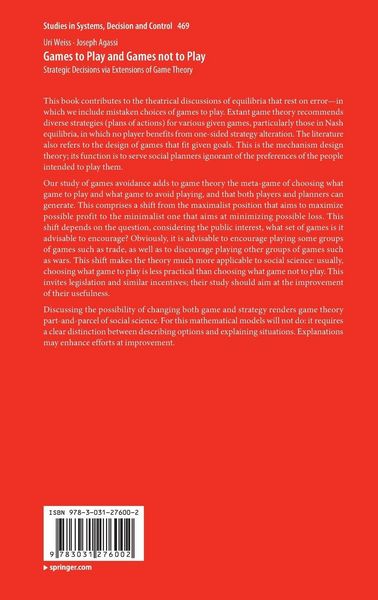
This book contributes to the theoretical discussions of equilibria that rest on error―in which we include mistaken choices of games to play. Extant game theory recommends diverse strategies (plans of actions) for various given games, particularly those in Nash equilibria, in which no player benefits from one-sided strategy alteration. The literature also refers to the design of games that fit given goals. This is the mechanism design theory; its function is to serve social planners ignorant of the preferences of the people intended to play them.

Our study of games avoidance adds to game theory the meta-game of choosing what game to play and what game to avoid playing, and that both players and planners can generate. This comprises a shift from the maximalist position that aims to maximize possible profit to the minimalist one that aims at minimizing possible loss. This shift depends on the question, considering the public interest, what set of games is it advisable to encourage? Obviously, it is advisable to encourage playing some groups of games such as trade, as well as to discourage playing other groups of games such as wars. This shift makes the theory much more applicable to social science: usually, choosing what game to play is less practical than choosing what game not to play. This invites legislation and similar incentives; their study should aim at the improvement of their usefulness.

Discussing the possibility of changing both game and strategy renders game theory part-and-parcel of social science. For this mathematical models will not do: it requires a clear distinction between describing options and explaining situations. Explanations may enhance efforts at improvement.

Rezension

“The book certainly offers a metaphysical and ethical perspective that, if seriously considered, would suggest refreshing ways for tackling this distressing development.” (Nimrod Bar-Am, Philosophy of the Social Sciences, Vol. 56 (3), 2026)

Produktdetails

Einband

Gebundene Ausgabe

Erscheinungsdatum

19.05.2023

Abbildungen

XI, 236 p. 2 illus., 1 illus. in color.

Verlag Springer

Produktdetails

Einband

Gebundene Ausgabe

Erscheinungsdatum

19.05.2023

Abbildungen

XI, 236 p. 2 illus., 1 illus. in color.

Verlag Springer
Seitenzahl

236

Maße (L/B/H)

24,1/16/2 cm

Gewicht

489 g

Auflage

2023

Sprache

Englisch

ISBN

978-3-031-27600-2

Herstelleradresse

Springer-Verlag KG
Sachsenplatz 4-6
1201 Wien
AT

Email: ProductSafety@springernature.com

Noch keine Bewertungen vorhanden

Verfassen Sie die erste Bewertung zu diesem Artikel

Helfen Sie anderen Kundinnen und Kunden durch Ihre Meinung.

Kundinnen und Kunden meinen

Bewertungen (0)

  • Produktbild: Games to Play and Games not to Play
  • Produktbild: Games to Play and Games not to Play
  • Introduction: Game Theory and Peace.- Strategic Decisions: Game and Strategy: Extended Game Theory.- Game Theory Encourages Peace.- International Accords.- Game Theory as Part-and-parcel of Social Science.- The Game Theory of the European Union versus the Pax Romana.- Playing the Game of International Law.- Mutual Threat: The Game of the Cold War.- Equilibria in Games of War and Peace: Options for Cooperation.- The Game not Chosen: Equilibria of Games about Games.