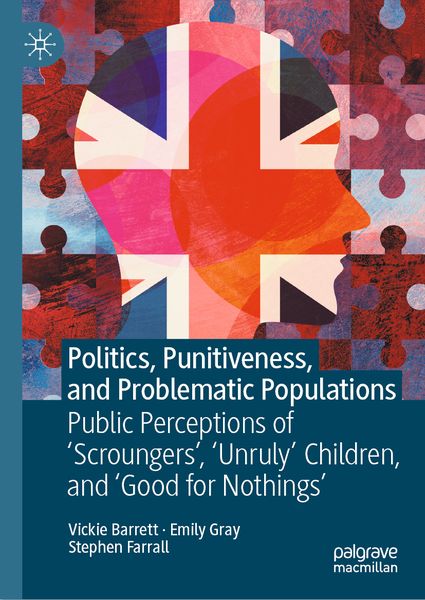

Politics, Punitiveness, and Problematic Populations Public Perceptions of 'Scroungers', 'Unruly' Children, and ‘Good for Nothings’
-
- Hardcover ausgewählt
- Taschenbuch
- eBook
-
Sprache:Englisch
115,99 €
UVP
131,99 €
inkl. gesetzl. MwSt.,
Beschreibung
Produktdetails
Einband
Gebundene Ausgabe
Erscheinungsdatum
02.06.2023
Abbildungen
XV, 379 p. 26 illus., 4 illus. in color.
Verlag
SpringerSeitenzahl
379
Maße (L/B/H)
21,6/15,3/2,6 cm
Gewicht
623 g
Sprache
Englisch
ISBN
978-3-031-27476-3
This book speaks to those interested in topics related to punitiveness and public attitudes to crime and punishment. Punitiveness has been the focus of increasing criminological attention in recent decades. This book extends this focus by taking a multi-disciplinary approach to examining punitiveness in the criminal justice system, the welfare system, and the education system in British society today. In doing so, this study uses new survey data (n=5,781) applying ordinal and linear regression and structural equation modelling to examine the relationship between public punitiveness towards ‘rulebreakers’ and political values. This is explored through assessing punitive attitudes towards the treatment of i) school pupils who break school rules, ii) towards the treatment of benefit recipients who fail to comply with the rules, and iii) towards people who break the law. It examines the relationship between political attitudes (neo-conservative values, neo-liberal values), nostalgic values (social, economic, and political), and public punitive attitudes towards the three rule-breaking groups. This book’s appeal may extend to an interdisciplinary audience including welfare, education, and social policy disciplines.
Noch keine Bewertungen vorhanden
Verfassen Sie die erste Bewertung zu diesem Artikel
Helfen Sie anderen Kundinnen und Kunden durch Ihre Meinung.
Kurze Frage zu unserer Seite
Vielen Dank für Ihr Feedback
Wir nutzen Ihr Feedback, um unsere Produktseiten zu verbessern. Bitte haben Sie Verständnis, dass wir Ihnen keine Rückmeldung geben können. Falls Sie Kontakt mit uns aufnehmen möchten, können Sie sich aber gerne an unseren Kund*innenservice wenden.
zum Kundenservice