KI-Beratung Beta

Gutscheinbedingungen

**Gültig am 27.11.2026 auf Spielzeug, Schreibwaren, Filme, Geschenke & Trends, Musik, tolino eReader & Zubehör, Hörbücher und Hörbuch-Downloads, nicht preisgebundene Bücher und Kalender online auf thalia.at und in der Thalia App. Einzelne Artikel können ausgeschlossen sein. Aufgrund der Buchpreisbindung sind deutschsprachige Bücher und eBooks ausgenommen. Zusätzlich ausgenommen sind Abos & Flatrates, Games, Geschenkkarten/-boxen, Shelfies, Software, Zeitschriften sowie einzelne Artikel von tonies®. Pro Einkauf einmal einlösbar. Click & Collect nur bei Onlinevorabzahlung möglich. Keine Barauszahlung. Nicht kombinierbar mit anderen Aktionen und Gutscheinen. Gutschein wird auf max. 500€ Bestellwert angerechnet. Nicht gültig für Versandkosten und Services.

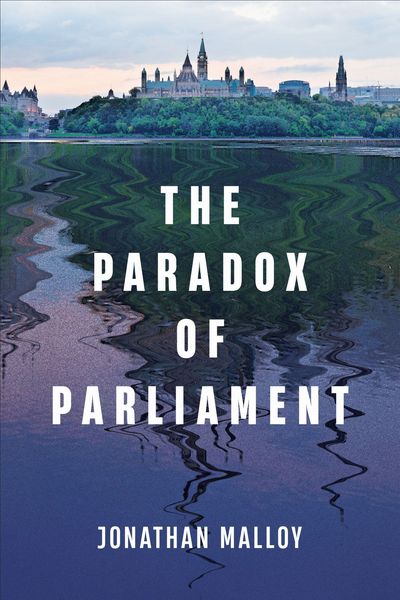
  • Produktbild: The Paradox of Parliament
  • Produktbild: The Paradox of Parliament

The Paradox of Parliament

75,99 €

inkl. gesetzl. MwSt., Versandkostenfrei


Beschreibung

The Paradox of Parliament provides a comprehensive analysis of all aspects of Parliament in order to explain the paradoxical expectations placed on the institution. The book argues that Parliament labours under two different "logics" of its purpose and primary role: one based on governance and decision-making...

Beschreibung

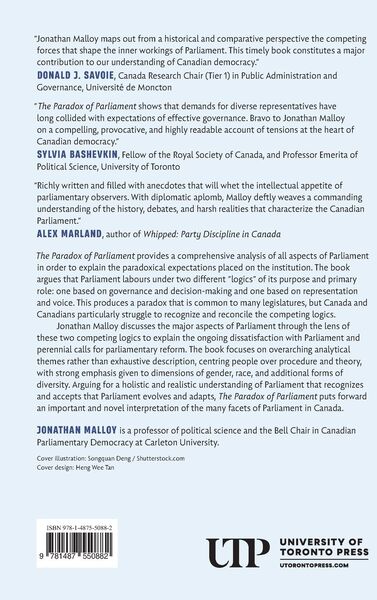
The Paradox of Parliament provides a comprehensive analysis of all aspects of Parliament in order to explain the paradoxical expectations placed on the institution. The book argues that Parliament labours under two different "logics" of its purpose and primary role: one based on governance and decision-making and one based on representation and voice. This produces a paradox that is common to many legislatures, but Canada and Canadians particularly struggle to recognize and reconcile the competing logics.

In The Paradox of Parliament, Jonathan Malloy discusses the major aspects of Parliament through the lens of these two competing logics to explain the ongoing dissatisfaction with Parliament and perennial calls for parliamentary reform. It focuses on overarching analytical themes rather than exhaustive description. It centres people over procedure and theory, with strong emphasis given to dimensions of gender, race, and additional forms of diversity. Arguing for a holistic and realistic understanding of Parliament that recognizes and accepts that Parliament evolves and adapts, The Paradox of Parliament puts forward an important and novel interpretation of the many facets of Parliament in Canada.

Produktdetails

Einband

Gebundene Ausgabe

Erscheinungsdatum

17.03.2023

Abbildungen

1 b&w figure, 1 b&w table

Verlag University of Toronto Press

Produktdetails

Einband

Gebundene Ausgabe

Erscheinungsdatum

17.03.2023

Abbildungen

1 b&w figure, 1 b&w table

Verlag University of Toronto Press
Seitenzahl

304

Maße (L/B/H)

22,9/15,2/1,9 cm

Gewicht

576 g

Sprache

Englisch

ISBN

978-1-4875-5088-2

Herstelleradresse

Libri GmbH
Europaallee 1
36244 Bad Hersfeld
DE

Email: gpsr@libri.de

Noch keine Bewertungen vorhanden

Verfassen Sie die erste Bewertung zu diesem Artikel

Helfen Sie anderen Kundinnen und Kunden durch Ihre Meinung.

Kundinnen und Kunden meinen

Bewertungen (0)

Die Leseprobe wird geladen.
  • Produktbild: The Paradox of Parliament
  • Produktbild: The Paradox of Parliament
  • 1. Introduction
    Explanations for Parliament’s Problems
    Paradox and the Competing Logics
    Conclusion

    2. Historical Foundations and the Competing Logics
    Indigenous Peoples and Legislative Representation
    The Early Development of Canadian Legislatures
    The Logic of Governance
    The Logic of Representation
    Attempting to Reconcile the Logics: "Every Reform Creates A New Problem"
    Reforms of the 1960s-1980s
    The 1990s: The Reform Party and Paul Martin’s "Democratic Deficit"
    The 2004-2011 Minority Era and Beyond
    Consensus Legislatures
    Canada in Comparative Perspective
    Conclusion

    3. Parties
    Canadian Political Parties: An Overview
    The Weakness of Canadian Parties
    Party Discipline: Is Canada Exceptional?
    Party Discipline in Practice
    "Excessive" Discipline
    Party Discipline and the Party System
    Parties in Minority Governments
    Electoral Systems and Parties
    Conclusion

    4. MPs
    Why Do MPs Run?
    Who Gets Elected as an MP?
    Gender and Race
    Socioeconomic and Occupational Backgrounds
    Age
    Learning to Be an MP
    MPs in the House
    MPs in the Constituency
    Life as an MP: The Personal Dimension
    Managing Their Public Roles
    Managing Their Personal Lives
    MP Pay
    Staffing
    An MP’s Day
    Departure, Turnover, and "Amateurism"
    Conclusion

    5. House of Commons Business
    The Roles
    The Speaker
    The Clerk and Procedural Staff
    House Leaders and Whips
    The Setting
    The Chamber and Decorum
    The Parliamentary Day
    The House of Commons at Work: Four Aspects
    Government Bills and Debate
    Question Period
    Private Members Business
    Opposition Days and Confidence/Non-confidence Motions
    Process in Minority Parliaments
    Committees
    Conclusion

    6. Diversity
    Persons with Disabilities
    LGBT Persons
    Women in Parliament
    Women in the Senate
    Women in the House
    Figure 9.1 Women in the House of Commons since 1968 (%)
    Women as Legislators
    Race
    Symbolic
    Descriptive
    Table 9.1 Racialized MPs in the House of Commons Compared to General Population
    Substantive
    Conclusion

    7. The Senate
    Bicameralism
    A Brief Description of the Senate
    History of the Senate
    Senate Reform
    The Senate since 2016

    8. Scrutiny
    Scrutiny in Theory and Practice
    Parliament and Money
    Officers of Parliament
    Parliamentary Scrutiny: How Far Can It Go?
    Parliament’s Access to Documents and People
    Conclusion

    9. The Future of Parliament
    Technological
    Sociological
    Citizen Attitudes
    Conclusion