Gutscheinbedingungen

**Gültig bis 24.09.2026 ab einem Mindestbestellwert von 30€ auf Spielzeug, Schreibwaren, Filme, Geschenke & Trends, Musik, tolino eReader & Zubehör, Hörbücher und Hörbuch-Downloads, nicht preisgebundene Bücher und Kalender online auf thalia.at und in der Thalia App. Einzelne Artikel können ausgeschlossen sein. Aufgrund der Buchpreisbindung sind deutschsprachige Bücher und eBooks ausgenommen. Zusätzlich ausgenommen sind Abos & Flatrates, Games, Geschenkkarten/-boxen, Shelfies, Software, Zeitschriften sowie einzelne Artikel von tonies®. Pro Einkauf einmal einlösbar. Click & Collect nur bei Onlinevorabzahlung möglich. Keine Barauszahlung. Nicht kombinierbar mit anderen Aktionen und Gutscheinen. Gutschein wird auf max. 500€ Bestellwert angerechnet. Nicht gültig für Versandkosten und Services. Preisgebundene Artikel sind vom Mindestbestellwert ausgeschlossen.

Beschreibung

Produktdetails

Einband

Taschenbuch

Erscheinungsdatum

24.03.2023

Herausgeber

Joginder Singh Panwar + weitere

Verlag

Elsevier Science & Technology

Seitenzahl

532

Maße (L/B/H)

22,9/15,2/2,7 cm

Gewicht

705 g

Sprache

Englisch

ISBN

978-0-323-91900-5

Beschreibung

Portrait

Dr. Joginder Singh is a Professor in the Department of Botany at Nagaland University, Lumami, India. His previous positions include a professorship at Lovely Professional University's School of Bioengineering and Biosciences and a Young Scientist role at Jai Narain Vyas University's Microbial Biotechnology and Biofertilizer Laboratory (funded by the Department of Science and Technology, Government of India). He is a member of several scientific societies, including the Association of Microbiologists of India and the European Federation of Biotechnology. Dr. Singh has an extensive publication record, with over 250 research and review articles, 35 edited books (with publishers like Elsevier and Springer), and 125 book chapters. He is a reviewer for numerous prestigious journals. He has actively participated in and presented at numerous national and international scientific events.

Prof. Ashok Pandey is currently Executive Director, Centre for Energy and Environmental Sustainability-India, Lucknow. His major research and technological development interests are industrial and environmental biotechnology and energy biosciences, focusing on biomass to biofuels and chemicals, waste to wealth and energy, etc.

Dr. Simranjeet Singh is presently working as post-doctoral fellow in Interdisciplinary Centre for Water Research, Indian Institute of Science, Bangalore. Previously he was working as Project Scientist at Punjab Biotechnology Incubators, Mohali (India). Dr. Singh has been conferred the "Young Scientist” award by the IOSRD in 2018. He has more than 65 research and review articles and 33 book chapters. He is an active member of various scientific societies and organizations including, Asian Chemical society, Society for the Green Environment and editorial board member of Mini Review in Organic chemistry.

Prof. Vinod Kumar Garg is an environmental scientist and academician currently serving as Professor in the Department of Environmental Science and Technology at the Central University of Punjab, Bathinda, India. With over three decades of experience in teaching, research, and academic administration, he has made significant contributions to the field of environmental sciences, particularly in pollution control, radioecology, and sustainable waste management. Prof. Garg's research interests encompass water and wastewater treatment, solid and hazardous waste management, pesticide pollution, heavy metal contamination, radio-ecology, green chemistry and sustainability. He has published many research papers in reputed national and international journals and contributed to a number of books in the domain of environmental sustainability.

Prof. Praveen C Ramamurthy received M. Sc. in Polymer science in 1995 from University of Mysore and PhD degree from Clemson University in the year 2004. He worked as a R&D Engineer in Therm-O-Disc, Mansfield, OH, USA and Research Scientist in Hoku Scientific, Honolulu, Hawaii, USA. He joined IISc in the year 2007 and currently a Professor in the Department of Materials Engineering. He is also Associate faculty in Centre for Nano Science and Engineering and Inter Disciplinary Centre for Energy Research. His current research focuses on organic electronics including synthesis of conjugated polymer for the application in photovoltaics, and sensors and device package application with focus on stability and large area device fabrication. He has over 190 peer reviewed papers published and 18 patents to his credit.

Produktdetails

Einband

Taschenbuch

Erscheinungsdatum

24.03.2023

Herausgeber

Verlag

Elsevier Science & Technology

Seitenzahl

532

Maße (L/B/H)

22,9/15,2/2,7 cm

Gewicht

705 g

Sprache

Englisch

ISBN

978-0-323-91900-5

Herstelleradresse

Libri GmbH
Europaallee 1
36244 Bad Hersfeld
DE

Email: gpsr@libri.de

Noch keine Bewertungen vorhanden

Verfassen Sie die erste Bewertung zu diesem Artikel

Helfen Sie anderen Kundinnen und Kunden durch Ihre Meinung.

Kundinnen und Kunden meinen

Bewertungen (0)

Die Leseprobe wird geladen.
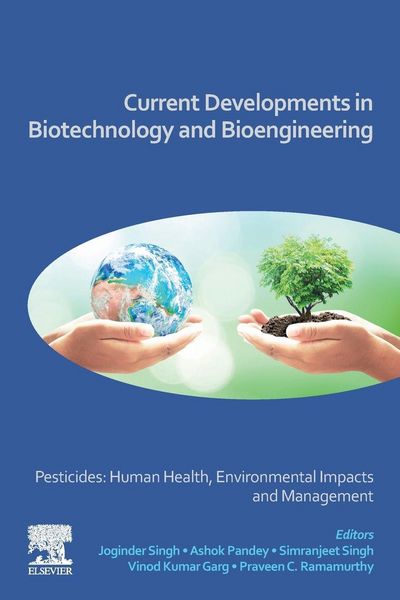
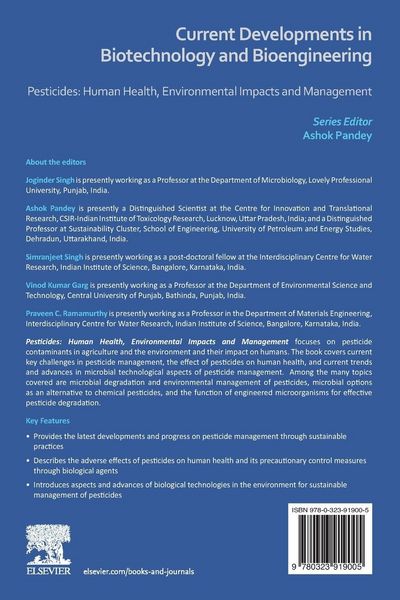
  • Produktbild: Current Developments in Biotechnology and Bioengineering
  • Produktbild: Current Developments in Biotechnology and Bioengineering
  • 1.Impact and prospects of pesticides on human and Environment health
    2.Pesticide pollution in freshwater and its impact on community health
    3.Pesticide Pollution in Freshwater: Occurrence, Distribution, Impact, and Remediation
    4.Persistence of pesticides residues with chemical food preservatives in fruits and vegetables
    5.Dietary intake of pesticide residues through vegetables
    6.Dietary intake of pesticide residues through fruits
    7.Genome editing of microbes for degradation of pesticides
    8.Evolution of biodegradation pathways for efficient microbial based management of pesticides
    9.Plant hormones for the regulation of pesticide metabolism
    10.Depleted mineralization of pesticides on soil microbial diversity
    11.Health impacts of pesticides farm applicators
    12.Impact of pesticides on natural populations of insects in the agricultural field
    13.Microbial enzymes for biodegradation and detoxification of pesticides
    14.Role of cloning and modification of genes pesticide decomposition
    15.Influence of subsoil microbial community across different depths on the biodegradation of pesticides
    16.Use of pesticide and mechanism of resistance development in plants
    17.Impact of pesticides on microbial diversity
    18.Removal pesticides in wastewater by Fenton systems: Enhanced degradation by chelating agents and solar irradiation
    19.Environmental Impacts of Synthetic and Bio Fungicides