KI-Beratung Beta

Gutscheinbedingungen

**Gültig bis 11.11.2026 auf Spielzeug, Schreibwaren, Filme, Geschenke & Trends, Musik, tolino eReader & Zubehör, Hörbücher und Hörbuch-Downloads, nicht preisgebundene Bücher und Kalender online auf thalia.at und in der Thalia App. Einzelne Artikel können ausgeschlossen sein. Aufgrund der Buchpreisbindung sind deutschsprachige Bücher und eBooks ausgenommen. Zusätzlich ausgenommen sind Abos & Flatrates, Games, Geschenkkarten/-boxen, Shelfies, Software, Zeitschriften sowie einzelne Artikel von tonies®. Pro Einkauf einmal einlösbar. Click & Collect nur bei Onlinevorabzahlung möglich. Keine Barauszahlung. Nicht kombinierbar mit anderen Aktionen und Gutscheinen. Gutschein wird auf max. 500€ Bestellwert angerechnet. Nicht gültig für Versandkosten und Services.

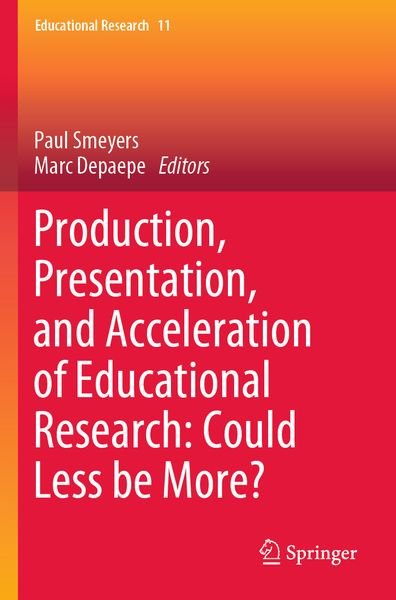
  • Produktbild: Production, Presentation, and Acceleration of Educational Research: Could Less be More?
  • Produktbild: Production, Presentation, and Acceleration of Educational Research: Could Less be More?
Band 11 - 13%

Production, Presentation, and Acceleration of Educational Research: Could Less be More?

Aus der Reihe Educational Research
13% sparen

123,99 € UVP 142,99 €

inkl. gesetzl. MwSt., Versandkostenfrei


Beschreibung

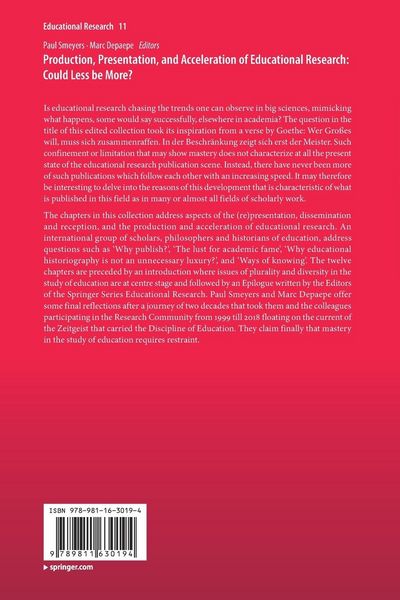
Is educational research chasing the trends one can observe in big sciences, mimicking what happens, some would say successfully, elsewhere in academia? The question in the title of this edited collection took its inspiration from a verse by Goethe: Wer Großes will, muss sich zusammenraffen. In der Beschränkung...

Beschreibung

Is educational research chasing the trends one can observe in big sciences, mimicking what happens, some would say successfully, elsewhere in academia? The question in the title of this edited collection took its inspiration from a verse by Goethe: Wer Großes will, muss sich zusammenraffen. In der Beschränkung zeigt sich erst der Meister. Such confinement or limitation that may show mastery does not characterize at all the present state of the educational research publication scene. Instead, there have never been more of such publications which follow each other with an increasing speed. It may therefore be interesting to delve into the reasons of this development that is characteristic of what is published in this field as in many or almost all fields of scholarly work. 
The chapters in this collection address aspects of the (re)presentation, dissemination and reception, and the production and acceleration of educational research. An international group of scholars, philosophers and historians of education, address questions such as ‘Why publish?’, ‘The lust for academic fame’, ‘Why educational historiography is not an unnecessary luxury?’, and ‘Ways of knowing’. The twelve chapters are preceded by an introduction where issues of plurality and diversity in the study of education are at centre stage and followed by an Epilogue written by the Editors of the Springer Series Educational Research. Paul Smeyers and Marc Depaepe offer some final reflections after a journey of two decades that took them and the colleagues participating in the Research Community from 1999 till 2018 floating on the current of the Zeitgeist that carried the Discipline of Education. They claim finally that mastery in the study of education requires restraint.

Portrait

Paul Smeyers is since 2018 Emeritus Professor of Philosophy of Education, KU Leuven Belgium. He is the Editor of the international journal Ethics and Education . He co-authored and co-edited a number of books in the area of philosophy of education and interpretative research. His journal articles deal with issues of philosophy of educational research, epistemology, postmodernism, and pays attention amongst others to the legacy of Wittgenstein and Winch for philosophy of education and educational research.
Marc Depaepe (1953) was deputy chancellor at the KU Leuven (2013-2017). Since 2005 co-editor-in-chief of Paedagogica Historica . Former president of the International Standing Conference for the History of Education (1991-1994) and member of the International Academy of Education (2012-). In 2015 he was awarded an honorary doctorate at the University of Latvia. Since 2018 Emeritus Professor (“with duties”) of the KU Leuven and since 2019 Leading Researcher at the University of Latvia, in Riga. Published abundantly on various aspects of international educational historiography and the history of education in Belgium and Congo.

Produktdetails

Einband

Taschenbuch

Erscheinungsdatum

15.02.2023

Abbildungen

VIII, 233 p. 32 illus., 23 illus. in color.

Herausgeber Paul Smeyers + weitere

Produktdetails

Einband

Taschenbuch

Erscheinungsdatum

15.02.2023

Abbildungen

VIII, 233 p. 32 illus., 23 illus. in color.

Herausgeber
Verlag Springer Singapore
Seitenzahl

233

Maße (L/B/H)

23,5/15,5/1,4 cm

Gewicht

376 g

Auflage

1st edition 2021

Sprache

Englisch

ISBN

978-981-16-3019-4

Herstelleradresse

Springer-Verlag KG
Sachsenplatz 4-6
1201 Wien
AT

Email: ProductSafety@springernature.com

Noch keine Bewertungen vorhanden

Verfassen Sie die erste Bewertung zu diesem Artikel

Helfen Sie anderen Kundinnen und Kunden durch Ihre Meinung.

Kundinnen und Kunden meinen

Bewertungen (0)

  • Produktbild: Production, Presentation, and Acceleration of Educational Research: Could Less be More?
  • Produktbild: Production, Presentation, and Acceleration of Educational Research: Could Less be More?
  • 1 Incentives to embrace plurality and diversity in the study of education. An Introduction.- 2 Why Publish?.- 3 The Lust for Academic Fame: America’s Engine for Scholarly Production.- 4 ‘Relations of production’ and their impact on the character and pace of research and scholarship.- 5 Evaluating Productivity in Educational Research: Criteria of Rigor and Ethics.- 6 Times of elephants: Foucault-inspired intervals of production, critique, and accelerated configurings.- 7 Lost in Narcissism? An elementary quantitative, but deliberately non-bibliometric approach to my own publication behavior.- 8 Lost in Enthusiasm? An elementary qualitative analysis of forty-four years of research in order to show why even today educational historiography is not an unnecessary luxury.- 9 Understanding without words: visual representations in math, science and art.- 10 The State’s Spectacles: Education Statistics, Representations of Schooling, and the Federal Government’s Educational Sight.- 11 From the global sixties to the global 2010s: communicating about research in the history of education (a perspective from France).- 12 Curiosity and Acquaintance: Ways of Knowing.- 13 Education, fast and slow.- 14 Mastery in the study of education requires restraint. Epilogue.