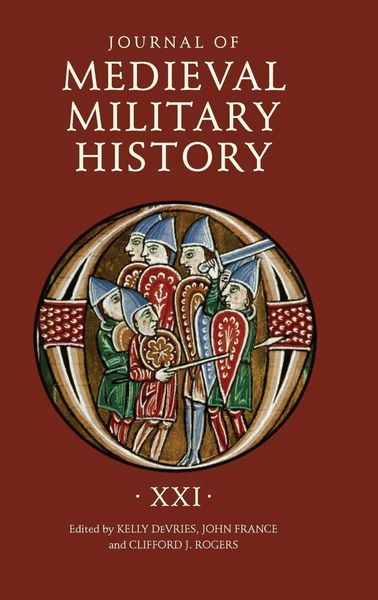
Journal of Medieval Military History Volume XXI
-
- Englisch ausgewählt
-
Verlag:Boydell Press
- Boydell & Brewer Ltd 127,99 €
- Boydell & Brewer Ltd 127,99 €
- Boydell & Brewer Ltd 127,99 €
- Boydell & Brewer Ltd 127,99 €
- Boydell & Brewer Ltd 137,99 €
- Boydell Press 127,99 €
- Boydell Press 127,99 €
- Boydell Press 127,99 €
- Boydell Press 127,99 €
- Boydell Press 127,99 €
- Boydell Press 127,99 €
- Boydell Press 127,99 €
- Boydell Press 127,99 €
- Boydell Press 127,99 €
- Boydell Press 127,99 €
- Boydell Press 137,99 €
- Boydell Press 137,99 €
- Boydell Press 137,99 €
- Boydell Press 137,99 €
- Boydell Press 159,99 € ausgewählt
159,99 €
inkl. gesetzl. MwSt.,
Beschreibung
Produktdetails
Einband
Gebundene Ausgabe
Erscheinungsdatum
06.06.2023
Herausgeber
Clifford J. Rogers + weitereVerlag
Boydell PressSeitenzahl
276
Maße (L/B/H)
24/16,1/1,9 cm
Gewicht
581 g
Sprache
Englisch
ISBN
978-1-78327-750-6
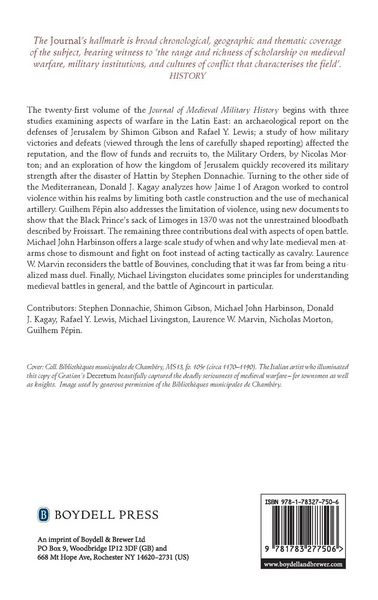
"The leading academic vehicle for scholarly publication in the field of medieval warfare." Medieval Warfare The twenty-first volume of the Journal of Medieval Military History begins with three studies examining aspects of warfare in the Latin East: an archaeological report on the defenses of Jerusalem by Shimon Gibson and Rafael Y. Lewis; a study of how military victories and defeats (viewed through the lens of carefully shaped reporting) affected the reputation, and the flow of funds and recruits to, the Military Orders, by Nicolas Morton; and an exploration of how the Kingdom of Jerusalem quickly recovered its military strength after the disaster of Hattin by Stephen Donnachie. Turning to the other side of the Mediterranean, Donald J. Kagay analyzes how Jaime I of Aragon worked to control violence within his realms by limiting both castle construction and the use of mechanical artillery. Guilhem Pépin also addresses the limitation of violence, using new documents to show that the Black Prince's sack of Limoges in 1370 was not the unrestrained bloodbath described by Froissart. The remaining three contributions deal with aspects of open battle. Michael John Harbinson offers a large-scale study of when and why late-medieval men-at-arms chose to dismount and fight on foot instead of acting tactically as cavalry. Laurence W. Marvin reconsiders the Battle of Bouvines, concluding that it was far from being a ritualized mass duel. Finally, Michael Livingston elucidates some principles for understanding medieval battles in general, and the battle of Agincourt in particular.
Noch keine Bewertungen vorhanden
Verfassen Sie die erste Bewertung zu diesem Artikel
Helfen Sie anderen Kundinnen und Kunden durch Ihre Meinung.
Kurze Frage zu unserer Seite
Vielen Dank für Ihr Feedback
Wir nutzen Ihr Feedback, um unsere Produktseiten zu verbessern. Bitte haben Sie Verständnis, dass wir Ihnen keine Rückmeldung geben können. Falls Sie Kontakt mit uns aufnehmen möchten, können Sie sich aber gerne an unseren Kund*innenservice wenden.
zum Kundenservice