Gutscheinbedingungen

**Gültig bis 14.09.2026 auf Spielzeug, Schreibwaren, Filme, Geschenke & Trends, Musik, tolino eReader & Zubehör, Hörbücher, nicht preisgebundene Bücher und Kalender in der Thalia App. Einzelne Artikel können ausgeschlossen sein. Aufgrund der Buchpreisbindung sind deutschsprachige Bücher und eBooks ausgenommen. Zusätzlich ausgenommen sind Abos & Flatrates, Games, Geschenkkarten/-boxen, Shelfies, Software, Zeitschriften sowie einzelne Artikel von tonies®. Pro Einkauf einmal einlösbar. Nur gültig mit im Onlineshop hinterlegter Bonuscard. Click & Collect nur bei Onlinevorabzahlung möglich. Keine Barauszahlung. Nicht kombinierbar mit anderen Aktionen und Gutscheinen. Gutschein wird auf max. 500€ Bestellwert angerechnet. Nicht gültig für Versandkosten und Services.

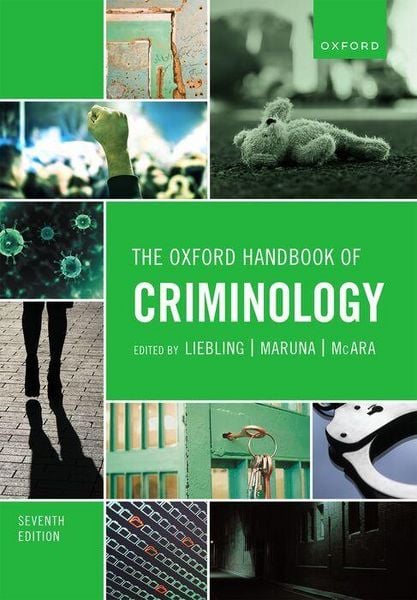
Produktbild: The Oxford Handbook of Criminology

The Oxford Handbook of Criminology

61,99 €

inkl. gesetzl. MwSt., Versandkostenfrei


Produktdetails

Einband

Taschenbuch

Erscheinungsdatum

21.09.2023

Verlag

Oxford University Press

Seitenzahl

991

Maße (L/B/H)

24,3/17,2/3,9 cm

Gewicht

1536 g

Farbe

Mint / Anthrazit

Auflage

7. Auflage

Sprache

Englisch

ISBN

978-0-19-886091-4

Produktdetails

Einband

Taschenbuch

Erscheinungsdatum

21.09.2023

Verlag

Oxford University Press

Seitenzahl

991

Maße (L/B/H)

24,3/17,2/3,9 cm

Gewicht

1536 g

Farbe

Mint / Anthrazit

Auflage

7. Auflage

Sprache

Englisch

ISBN

978-0-19-886091-4

Herstelleradresse

Libri GmbH
Europaallee 1
36244 Bad Hersfeld
DE

Email: gpsr@libri.de

Noch keine Bewertungen vorhanden

Verfassen Sie die erste Bewertung zu diesem Artikel

Helfen Sie anderen Kundinnen und Kunden durch Ihre Meinung.

Kundinnen und Kunden meinen

Bewertungen (0)

  • Produktbild: The Oxford Handbook of Criminology
    • 0: Alison Liebling, Shadd Maruna, and Lesley McAra: Introduction: Renewing our vision
    • Part I: Conceptions of Crime and Criminology
    • 1: Paul Rock: Sociological theories of crime
    • 2: Nicola Lacey and Lucia Zedner: Criminalization: historical, legal and criminological perspectives
    • 3: Manuel Eisner: Towards a global comparative criminology
    • 4: Susan McVie and Ben Matthews: The changing role of data in crime, criminal justice and criminology
    • 5: Darrick Jolliffe and Katherine M. Auty: Developmental and life-course criminology: an overview
    • 6: Beth Weaver, Hannah Graham, and Shadd Maruna: Turning over a new leaf: desistance research for a new generation
    • 7: Alistair Fraser and Dick Hobbs: Urban criminal collaborations
    • 8: Toby Seddon and Alex Stevens: Drug use, drug problems, and drug control: a political economy perspective
    • 9: Ailbhe O Loughlin and Jill Peay: Mental health, mental disabilities, and crime
    • 10: Mike Hough and Julian V. Roberts: Public opinion, crime, and criminal justice
    • 11: Chris Greer and Eugene McLaughlin: Crime news, trial by media, and scandal hunting
    • Part II: Critical Contemporary Issues
    • 12: Andy Aydin-Aitchison, Mirza Buljubasic, and Barbora Holá: Criminology and atrocity crimes
    • 13: Paolo Campana: Contagion and connections: applying network thinking to violence and organised crime
    • 14: Neil Chakraborti and Amy Clarke: Demystifying hate crime in an age of crises
    • 15: Coretta Phillips, Ben Bowling, and Alpa Parmar: Ethnicities, racism, crime, and criminal justice
    • 16: Adrian Grounds, Maria Ttofi, and Lidia Puigvert: Where is 'victimology' in an era of #MeToo?
    • 17: Michele Burman and Loraine Gelsthorpe: Feminist criminology: inequalities, powerlessness, and justice
    • 18: David Gadd: Domestic violence
    • 19: Jo Phoenix: Prostitution and sex work
    • 20: Belinda Winder and Nick Blagden: Understanding and rehabilitating men with sexual convictions: theory, intervention, and compassion
    • 21: Ben Collier and Alice Hutchings: Cybercrime: a social ecology
    • 22: Michael Levi and Nicholas Lord: White-collar and corporate crime  
    • 23: Victoria Canning, Paddy Hillyard, and Steve Tombs: Social harm and zemiology 
    • 24: Avi Brisman and Nigel South: Green criminology 
    • 25: Keith Hayward and Oliver Smith: Crime and consumer culture
    • Part III: Security, Policing, and Prevention: Visions of Justice
    • 26: Ian Loader, Richard Sparks, Ben Bradford, Ryan Casey, Evi Girling, and Gosia Polanska: Security and everyday life in uncertain times
    • 27: Adam Crawford, Susan Donkin, and Christine A. Weirich: Crime prevention as urban security
    • 28: Ben Bradford and Pete Fussey: Security and smart cities
    • 29: Trevor Jones, Tim Newburn, and Robert Reiner: Policing and the police
    • 30: Martin Innes and Michael Levi: Making and managing terrorism and counter-terrorism: the view from criminology
    • 31: Nicky Padfield and Cyrus Tata: Understanding penal decision-making: courts, sentencing and parole
    • 32: Lesley McAra: Youth justice in an age of uncertainty: principles, performance, and prospects
    • 33: Meredith Rossner: Restorative justice in the twenty-first century: making emotions mainstream
    • 34: Kieran McEvoy, Ron Dudai, and Cheryl Lawther: Punishment, victimhood, and social control: towards a criminology of transitional justice
    • Part IV: Punishment and the Penal State
    • 35: David Garland: The punishment-welfare relationship: history, sociology, and politics
    • 36: Katja Franko: Criminology, punishment, and the state in a globalized society
    • 37: Mary Bosworth: Border criminology and the changing nature of penal power
    • 38: Ben Crewe and Alison Liebling: Reconfiguring and reimagining penal power
    • 39: Gwen Robinson and Fergus McNeill: Punishment in the community: evolution, expansion, and moderation
    • 40: Yvonne Jewkes: Why prison architecture and design matter to our understanding of the limits of punishment and rehabilitation
    • 41: Joe Sim: 'Hounding power into a corner': prison abolitionism in England and Wales
    • 42: Rod Earle, Danica Darley, Bill Davies, David Honeywell, and Ed Schreeche-Powell: Convict criminology without guarantees: proposing hard labour for an unfinished criminology
    • 43: Alison Liebling, Fergus McNeill, and Bethany E. Schmidt: Criminological engagements