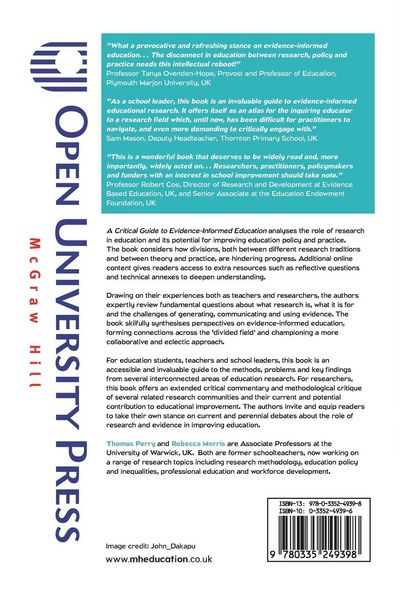
"What a provocative and refreshing stance on evidence-informed education! Evidence-informed education may currently be a divided field, but this must-read book offers hope that a reunion of existing approaches may be possible for a 'productive tension' where researchers, school leaders and teachers work together... The disconnect in education between research, policy and practice needs this intellectual reboot!"
Professor Tanya Ovenden-Hope, Provost and Professor of Education, Plymouth Marjon University, UK
"As a school leader, this book is an invaluable guide to evidence-informed educational research... It is a hopeful vision of a united evidence-informed education field in which practitioners, policymakers and researchers all play an active role as discerning creators and users of evidence."
Sam Mason, Deputy Headteacher, Thornton Primary School, UK
"This is a wonderful book that deserves to be widely read and, more importantly, widely acted on. It presents a robust and detailed critique of current orthodoxies in how we have tried to improve educational practice through the use of evidence. Researchers, practitioners, policymakers and funders with an interest in evidence and school improvement should take note."
Professor Robert Coe, Director of Research and Development at Evidence Based Education, UK, and Senior Associate at the Education Endowment Foundation, UK
A Critical Guide to Evidence-Informed Education analyses the role of research in education and its potential for improving education policy and practice. The book considers how divisions, both between different research traditions and between theory and practice, are hindering progress. Additional online content gives readers access to extra resources such as reflective questions and technical annexes to deepen understanding.
Drawing on their experiences both as teachers and researchers, the authors expertly review fundamental questions about what research is, what it is for and the challenges of generating, communicating and using evidence. The book skilfully synthesises perspectives on evidence-informed education, forming connections across the 'divided field' and championing a more collaborative and eclectic approach.
For education students, teachers, and school leaders, this book is an accessible and invaluable guide to the methods, problems, and key findings from several interconnected areas of education research. For researchers, this book offers an extended critical commentary and methodological critique of several related research communities and their current and potential contribution to educational improvement. The authors invite and equip readers to take their own stance on current and perennial debates about the role of research and evidence in improving education.
Thomas Perry is an Associate Professor at the University of Warwick. He is a former schoolteacher who now teaches about education research methods and advises and supervises researchers at all levels, including leading the Education Doctorate (EdD) programme at Warwick. His research and teaching are focused on research methodology and the role of research and evidence in improving education policy and practice.
Rebecca Morris is an Associate Professor at the University of Warwick. She is a former secondary English teacher and has previously worked at Durham University and University of Birmingham. Rebecca's research interests include education policy, teacher education and the teacher workforce, English and literacy, and widening participation. She is an editorial board member for the British Educational Research Journal and Educational Review.