Gutscheinbedingungen

**Gültig bis 06.07.2026 auf fremdsprachige Bücher online auf thalia.at, in der Thalia App ab einem Mindestbestellwert von 30€ und in allen Thalia Buchhandlungen in Österreich. In den Buchhandlungen nur gültig auf lagernde Ware. Einzelne Artikel können ausgeschlossen sein. Ausgenommen sind preisgebundene Artikel & eBooks. Pro Einkauf einmal einlösbar. Nur gültig gegen Vorlage oder im Onlineshop hinterlegter Bonuscard. Infos zur Einlösung in der Buchhandlung sind auf der Bonuscard-Vorteilspreisseite zu finden. Click & Collect nur bei Onlinevorabzahlung möglich. Keine Einlösung bei Scan & Go-Bezahlung. Keine Barauszahlung. Nicht kombinierbar mit anderen Aktionen und Gutscheinen. Gutschein wird auf max. 500€ Bestellwert angerechnet. Nicht gültig für Versandkosten und Services.

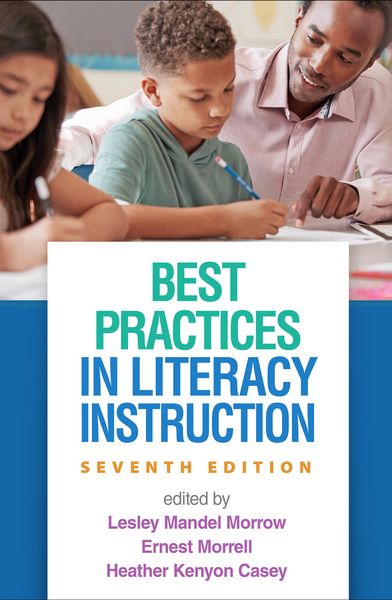
Produktbild: Best Practices in Literacy Instruction

Best Practices in Literacy Instruction

97,99 €

inkl. gesetzl. MwSt., Versandkostenfrei


Beschreibung

Produktdetails

Einband

Gebundene Ausgabe

Erscheinungsdatum

24.05.2023

Herausgeber

Lesley Mandel Morrow + weitere

Verlag

Taylor and Francis

Seitenzahl

496

Maße (L/B/H)

23,2/15,2/3,4 cm

Gewicht

862 g

Auflage

7th edition

Sprache

Englisch

ISBN

978-1-4625-5224-5

Beschreibung

Portrait

Lesley Mandel Morrow, PhD, is Distinguished Professor of Literacy and Director of the Center for Literacy Development at the Graduate School of Education at Rutgers, The State University of New Jersey. Her research deals with early literacy development and the organization and management of language arts programs and literacy-rich environments. Dr. Morrow has published more than 300 journal articles, chapters, and books. Her work has been recognized with awards including the Outstanding Teacher Educator in Reading Award and the William S. Gray Citation of Merit, both from the International Literacy Association (ILA), and the Oscar S. Causey Award for outstanding contributions to reading research from the Literacy Research Association. Dr. Morrow is past president of the ILA and is a member and past president of the Reading Hall of Fame.

Ernest Morrell, PhD, until his death in 2026, was Coyle Professor of Literacy Education at the University of Notre Dame, where he was also Director of the Center for Literacy Education and a faculty member in Africana Studies. He served for five years as Associate Dean of Humanities and Faculty Development in the College of Arts and Letters. A renowned scholar and educator, Dr. Morrell was an elected member of the American Academy of Arts and Sciences and the National Academy of Education, and an elected Fellow of the American Educational Research Association. His scholarly interests included literacy studies, critical media pedagogy, English education, postcolonial literatures, the African Diaspora, and youth popular culture. He was the recipient of honors including the 2025 James R. Squire Award from the National Council of Teachers of English and the 2026 President's Award from the University of Notre Dame, awarded posthumously. Dr. Morrell authored more than 100 articles and book chapters and authored or edited 17 scholarly books.

Heather Kenyon Casey, PhD, is Professor of Literacy Education at Rider University, where she teaches undergraduate and graduate courses in literacy, coordinates the graduate-level literacy concentration, and is Site Director of the National Writing Project. A former middle school language arts teacher and a certified reading specialist, Dr. Casey is past co-chair of the Adolescent Literacy Task Force and the Literacy Reform Task Force of the International Literacy Association (ILA). Her research focuses on the use of collaborative learning structures and new literacies to support adolescent literacy development and engagement. She has published numerous articles and book chapters in these areas and recently edited a series for the ILA, Literacy Practices That Adolescents Deserve. She has also led several grants in partnership with the National Writing Project focusing on building teacher leadership.

Produktdetails

Einband

Gebundene Ausgabe

Erscheinungsdatum

24.05.2023

Herausgeber

Verlag

Taylor and Francis

Seitenzahl

496

Maße (L/B/H)

23,2/15,2/3,4 cm

Gewicht

862 g

Auflage

7th edition

Sprache

Englisch

ISBN

978-1-4625-5224-5

Herstelleradresse

Libri GmbH
Europaallee 1
36244 Bad Hersfeld
DE

Email: gpsr@libri.de

Noch keine Bewertungen vorhanden

Verfassen Sie die erste Bewertung zu diesem Artikel

Helfen Sie anderen Kundinnen und Kunden durch Ihre Meinung.

Kundinnen und Kunden meinen

Bewertungen (0)

Weitere Artikel finden Sie in

Die Leseprobe wird geladen.
  • Produktbild: Best Practices in Literacy Instruction
  • Foreword, Gholnecsar (Gholdy) E. Muhammad
    I. Situating Best Practices: Comprehensive and Culturally, Responsive Literacy Instruction
    1. Current Issues and Best Practices in Literacy Instruction, P. David Pearson, Christina L. Madda, & Taffy E. Raphael
    2. Best Practices to Promote Social Justice and Equity in the Literacy Classroom, Ernest Morrell
    3. Best Practices for Motivating Students to Read, Ana Taboada Barber & John T. Guthrie
    II. Best Practices throughout the Grades
    4. Best Practices in Early Literacy, Lesley Mandel Morrow, Susan Dougherty, & Diane Tracey
    5. Best Practices for Literacy in the Intermediate and Middle Grades, Heather Kenyon Casey
    6. Best Practices for Literacy in High School, Douglas Fisher & Nancy Frey
    7. Best Practices for Integrating Children’s Literature into the Life of the Classroom, Kathy G. Short
    8. Best Practices for Organizing and Differentiating for Equitable Literacy Instruction, D. Ray Reutzel & Parker C. Fawson
    III. Evidence-Based Practices for Literacy Teaching and Learning
    9. Best Practices for Developing Phonological Awareness, Phonics, and Word Study to Support Fluent Reading, Donald R. Bear
    10. Best Practices in Fluency Instruction, Melanie Kuhn, Timothy Rasinski, & Chase Young
    11. Best Practices in Vocabulary Instruction, Kathy Ganske
    12. Best Practices for Developing Comprehension across Genres, Nell K. Duke & Nicole M. Martin
    13. Best Practices in Teaching Writers, Kelly Gallagher & Penny Kittle
    14. Best Practices in Reading Nonfiction: Understanding the Possibilities and Problems, Robert Probst & Kylene Beers
    15. Best Practices in Digital Literacy, Troy Hicks
    IV. Best Practices to Meet Targeted Needs
    16. Best Practices to Support the Literacy Development of Bilingual Learners, Ofelia García & Claudia Cervantes-Soon
    17. Best Practices to Change the Trajectory of Students Experiencing Reading Difficulties, Victoria J. Risko & Doris Walker-Dalhouse
    18. Best Practices to Support Achieving Yet “Invisible” Literacy Learners, Diane Lapp, Toni Faddis, & Alejandro Gonzalez Ojeda
    19. Best Practices in Literacy Assessment, Nancy Frey, Alejandro Gonzalez Ojeda, & Douglas Fisher
    V. Sustaining Best Practices: The Importance of Building Connections
    20. Best Practices Linking Professional Learning, Literacy Coaching, and Equity, Sharon Walpole, Faith Muirhead, & Jaime True Daley
    21. Best Practices for Home, School, and Community Partnerships: Collaborating for Social Justice and Equity, Patricia A. Edwards & Jacquelyn S. Sweeney
    Epilogue. Literacy Practicing: Repositioning Teachers as Cultural Workers and Ecopedagogues toward Creating Learning Cultures, Robert J. Tierney & P. David Pearson
    Afterword. Teaching Literacy in the Dystopia of Now: A Call to Action, Cornelius Minor
    Index