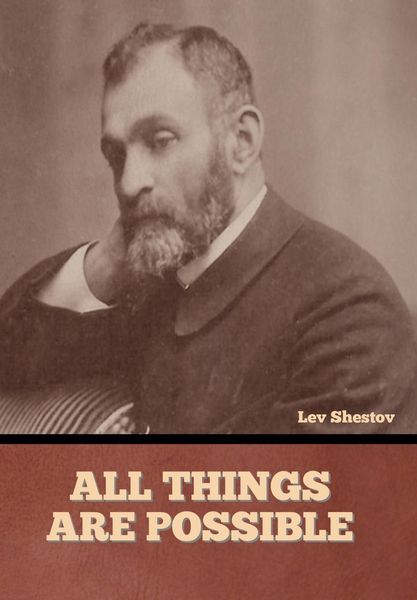

All Things are Possible
-
- Englisch ausgewählt
29,99 €
inkl. gesetzl. MwSt.,
- Kostenlose Lieferung ab 30 € Einkaufswert
- Versandkostenfrei für Bonuscard-Kund*innen
Beschreibung
Produktdetails
Einband
Gebundene Ausgabe
Erscheinungsdatum
09.01.2023
Verlag
Bibliotech PrSeitenzahl
138
Maße (L/B/H)
22,9/15,2/1,3 cm
Gewicht
340 g
Sprache
Englisch
EAN
9798888302750
Taking the words of Jesus that "With God, all things are possible", he [Shestov] extrapolates a philosophy of possibility or freedom as opposed to necessity or fate. For him, what it means to be human exists in the individual's struggle against the limitations and determinisms imposed by the misfortunes, sufferings, and ultimately end of his life. All that enriches the essential being of man and informs his most precious achievements is possible only in the denial that we could ever know what we are or what the 'the human condition' is. To 'know' something is to know all the results of all variables and products of all factors, like an algorithm in a machine.
He does not produce a systematic philosophy, of course, because his philosophy is a diatribe against humanity being understood as any kind of system. We exist in relation to systematic processes, but we are always more then a system. This possibility, by definition, is unknowable, therefore it faith alone that can affirm this possibility. For him faith in possibility is faith in God; for him, infinite human possibility is the essential meaning of "God". (Bill)
About the author:
Lev Isaakovich Shestov (31 January [O.S. 13 February] 1866 - 19 November 1938), born Yehuda Leib Shvartsman, was a Russian existentialist and religious philosopher. He is best known for his critiques of both philosophic rationalism and positivism. His work advocated a movement beyond reason and metaphysics, arguing that these are incapable of conclusively establishing truth about ultimate problems, including the nature of God or existence. Contemporary scholars have associated his work with the label "anti-philosophy."
Shestov wrote extensively on philosophers such as Nietzsche and Kierkegaard, as well as Russian writers such as Dostoyevsky, Tolstoy, and Chekhov. His published books include Apotheosis of Groundlessness (1905) and his magnum opus Athens and Jerusalem (1930-37). After emigrating to France in 1921, he befriended and influenced thinkers such as Edmund Husserl, Benjamin Fondane, Rachel Bespaloff, and Georges Bataille. He lived in Paris until his death in 1938. (wikipedia.org)
Noch keine Bewertungen vorhanden
Verfassen Sie die erste Bewertung zu diesem Artikel
Helfen Sie anderen Kundinnen und Kunden durch Ihre Meinung.
Kurze Frage zu unserer Seite
Vielen Dank für Ihr Feedback
Wir nutzen Ihr Feedback, um unsere Produktseiten zu verbessern. Bitte haben Sie Verständnis, dass wir Ihnen keine Rückmeldung geben können. Falls Sie Kontakt mit uns aufnehmen möchten, können Sie sich aber gerne an unseren Kund*innenservice wenden.
zum Kundenservice