• Produktbild: Insoluble Proteins
  • Produktbild: Insoluble Proteins
Band 2406 - 11%

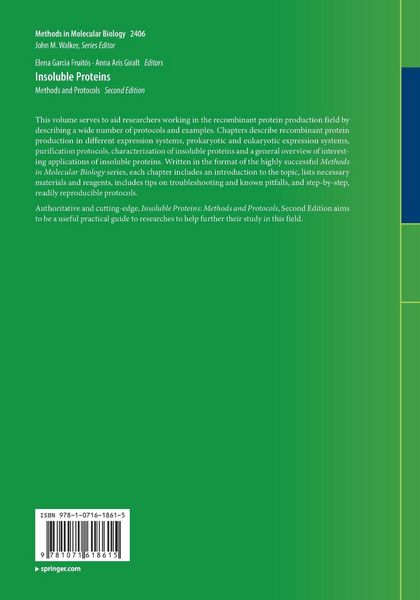
Insoluble Proteins Methods and Protocols

11% sparen

125,99 € UVP 142,99 €

inkl. gesetzl. MwSt., Versandkostenfrei


Beschreibung

Produktdetails

Einband

Taschenbuch

Erscheinungsdatum

29.01.2022

Abbildungen

XVI, 533 p. 98 illus., 60 illus. in color.

Herausgeber

Elena Garcia Fruitós + weitere

Verlag

Springer Us

Seitenzahl

533

Maße (L/B/H)

25,4/17,8/3 cm

Gewicht

1025 g

Auflage

Second Edition 2022

Sprache

Englisch

ISBN

978-1-07-161861-5

Beschreibung

Produktdetails

Einband

Taschenbuch

Erscheinungsdatum

29.01.2022

Abbildungen

XVI, 533 p. 98 illus., 60 illus. in color.

Herausgeber

Verlag

Springer Us

Seitenzahl

533

Maße (L/B/H)

25,4/17,8/3 cm

Gewicht

1025 g

Auflage

Second Edition 2022

Sprache

Englisch

ISBN

978-1-07-161861-5

Herstelleradresse

Libri GmbH
Europaallee 1
36244 Bad Hersfeld
DE

Email: gpsr@libri.de

Noch keine Bewertungen vorhanden

Verfassen Sie die erste Bewertung zu diesem Artikel

Helfen Sie anderen Kundinnen und Kunden durch Ihre Meinung.

Kundinnen und Kunden meinen

Bewertungen (0)

  • Produktbild: Insoluble Proteins
  • Produktbild: Insoluble Proteins

  • General Introduction: Recombinant protein production and purification of insoluble proteins.- Overcoming the solubility problem in
    E. coli
    : available approaches for recombinant protein production.- A3D 2.0 update for the prediction and optimization of protein solubility.- Tailoring codon usage to the underlying biology for protein expression optimization.- Protein Expression Optimization Strategies in
    E. coli
    :

    A Tailored Approach in Strain Selection and Parallelizing Expression Conditions.- A novel approach for production of aggregation prone proteins using the spidroin-derived NT* tag.- Cleavable Self-Aggregating Tags (cSAT) for Therapeutic Peptide Expression and Purification.- Use Intein Cleavable Polyhydroxyalkanoate Synthase Fusions to Improve Protein Solubility.- Introduction of a hexalysine (6K) tag can protect from N-terminal cleavage and increase yield of recombinant proteins expressed in the periplasm of
    E. coli.- 
    Two-tiered selection and screening strategy to increase functional enzyme production in
    Escherichia coli.- 
    Method for production of cysteine-rich proteins in 
    Lactococcus lactis
    expression system.- Heterologous protein production in
    Lactobacillus (plantarum)
    using pSIP vectors.- Soluble recombinant protein production in
    Pseudoaltermonas haloplanktis
    TAC125: the case study of the full-length human CDKL5 protein.- A protocol to enhance soluble protein expression in the cytoplasm of
    Bacillus subtilis.- 
    Applications of cell-free synthesized membrane protein precipitates.- High cell-density expression system: yeast cells in a phalanx efficiently produce a certain range of “difficult-to-express” secretory recombinant proteins.- Insect Cells-Baculovirus system for the production of difficult to express proteins: from expression screening for soluble constructs to protein quality control.- Transient gene expression in human Expi293 cells.- Recombinant Expression of Complex Proteins in Human Cells Lines.- Optimizing chaperone removal strategy from over-expressed recombinant proteins: GNE, a case study.- Intrinsically disordered proteins (IDP): purification under denaturing conditions.- Solubilization and Refolding of Inclusion Body Proteins.- Non-denaturing solubilization of Inclusion Bodies from Lactic Acid Bacteria.- Purification of Inclusion Bodies Produced in Bacteria and Yeast.- Eukaryotic aggresomes: protocols and tips for their production, purification and handling.- Characterization of the conformational properties of soluble and insoluble proteins by Fourier transform infrared spectroscopy.- Characterizing Soluble Protein Aggregates using Native Mass Spectrometry Coupled with Temperature-control Electrospray Ionization and Size-exclusion Chromatography.- Quality control of proteins solubilized from inclusion bodies.- Methods for the Characterizationof Protein Aggregates.- Insoluble Protein Applications: The Use of Bacterial Inclusion Bodies as Biocatalysts.- Methods for Processing Protein Aggregates into Surfaces.