KI-Beratung Beta

Gutscheinbedingungen

**Gültig bis 30.11.2026 auf Spielzeug, Schreibwaren, Filme, Geschenke & Trends, Musik, tolino eReader & Zubehör, Hörbücher und Hörbuch-Downloads, nicht preisgebundene Bücher und Kalender online auf thalia.at und in der Thalia App. Einzelne Artikel können ausgeschlossen sein. Aufgrund der Buchpreisbindung sind deutschsprachige Bücher und eBooks ausgenommen. Zusätzlich ausgenommen sind Abos & Flatrates, Games, Geschenkkarten/-boxen, Shelfies, Software, Zeitschriften sowie einzelne Artikel von tonies®. Pro Einkauf einmal einlösbar. Nur gültig mit im Onlineshop hinterlegter Bonuscard. Click & Collect nur bei Onlinevorabzahlung möglich. Keine Barauszahlung. Nicht kombinierbar mit anderen Aktionen und Gutscheinen. Gutschein wird auf max. 500€ Bestellwert angerechnet. Nicht gültig für Versandkosten und Services.

  • Produktbild: The Digital Twin of Humans
  • Produktbild: The Digital Twin of Humans
- 13%

The Digital Twin of Humans An Interdisciplinary Concept of Digital Working Environments in Industry 4.0

13% sparen

61,99 € UVP 71,49 €

inkl. gesetzl. MwSt., Versandkostenfrei


Beschreibung

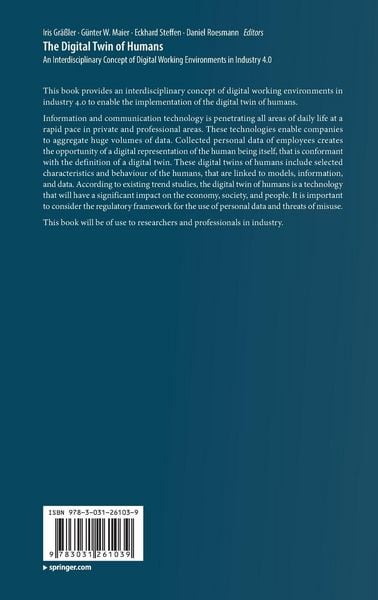
This book provides an interdisciplinary concept of digital working environments in industry 4.0 to enable the implementation of the digital twin of humans.

Information and communication technology is penetrating all areas of daily life at a rapid pace in private and professional areas. These technologies...

Beschreibung

This book provides an interdisciplinary concept of digital working environments in industry 4.0 to enable the implementation of the digital twin of humans.


Information and communication technology is penetrating all areas of daily life at a rapid pace in private and professional areas. These technologies enable companies to aggregate huge volumes of data. Collected personal data of employees creates the opportunity of a digital representation of the human being itself, that is conformant with the definition of a digital twin. These digital twins of humans include selected characteristics and behaviour of the humans, that are linked to models, information, and data. According to existing trend studies, the digital twin of humans is a technology that will have a significant impact on the economy, society, and people. It is important to consider the regulatory framework for the use of personal data and threats of misuse.


This book will be of use to researchers and professionals in industry.


Portrait


Prof. Dr.-Ing. Iris Gräßler is professor of Product Creation at the Heinz Nixdorf Institute of the Paderborn University. She is a member of the NRW research program “Design of flexible working environments - human-centered use of Cyber-Physical Systems in industry 4.0“. Prof. Gräßler's research focus lies on Model-Based Product Creation. On basis of models, cause effect relations are objectively explained and thus actively shaped. Main attention lies on Intelligent Technical Systems, i.e. adaptive configurable mechatronic systems and cyber-physical systems.
Günter W. Maier is professor of Work and Organizational Psychology at Bielefeld University. His research focuses on psychological processes of increasing digitalization of work (e.g., perceptions of AI decisions, XR-technologies in vocational trainings). He is vice chair of the NRW research program "Design of flexible working environments - human-centered use of Cyber-Physical Systems in industry 4.0” and he coordinates the topic area "Technology and Society" at the CoR-Lab at Bielefeld University, a leading transdisciplinary centre of excellence for applied research and industrial innovation transfer in the fields of cognition and robotics.
Prof. Dr. Eckhard Steffen is managing director of PACE (Paderborn Center for Advanced Studies) and head of the Working Group of Discrete Mathematics/Graph Theory at the Institute for Mathematics of the Paderborn University. He coordinates the NRW research program “Design of flexible working environments - human-centered use of Cyber-Physical Systems in industry 4.0“ and is a member of the NRW research program "Digital Future".
M. Sc. Daniel Roesmann is a research assistant at the chair for Product Creation at the Heinz Nixdorf Institute of the Paderborn University. He is member of the NRW research program “Design of flexible working environments - human-centered use of Cyber-Physical Systems in industry 4.0“. In his research he focuses on human centered system design and decision support system, in particular in flexible production and assembly systems.

Produktdetails

Einband

Gebundene Ausgabe

Erscheinungsdatum

17.05.2023

Abbildungen

X, 270 p. 45 illus., 31 illus. in color.

Herausgeber Iris Grässler + weitere

Produktdetails

Einband

Gebundene Ausgabe

Erscheinungsdatum

17.05.2023

Abbildungen

X, 270 p. 45 illus., 31 illus. in color.

Herausgeber
Verlag Springer
Seitenzahl

270

Maße (L/B/H)

24,1/16/2,1 cm

Gewicht

536 g

Sprache

Englisch

ISBN

978-3-031-26103-9

Herstelleradresse

Springer-Verlag KG
Sachsenplatz 4-6
1201 Wien
AT

Email: ProductSafety@springernature.com

Noch keine Bewertungen vorhanden

Verfassen Sie die erste Bewertung zu diesem Artikel

Helfen Sie anderen Kundinnen und Kunden durch Ihre Meinung.

Kundinnen und Kunden meinen

Bewertungen (0)

  • Produktbild: The Digital Twin of Humans
  • Produktbild: The Digital Twin of Humans
  • Part I Fundamentals.- The digital twin of human.- The role of digital twins in socio-technical systems.- Part II Planning of the digital and networked work.- Enhancing the risk management for digitalization projects in the context of social technical systems.- Procedural justice and automated decision making: seven rules to design fair decision making systems.- External crowd working.- Part III Implementation of the digital twin of humans.- Intelligent assistance systems: Assistive strategies and their effects.- Work Autonomy and Adaptive Digital Assistance in Flexible Working Environments.- Individual assembly guidance.- Human factors in assembly systems of the future.- Part IV The effects of the digital twin of humans.- The digital twin of humans as a perceived threat: Negative effects on relationships with colleagues and superiors at work?.- Signed graphs in social network analysis.- How will genetic and biographic data interact to shape our lives?.- How does the digital transformation affect skills and training? A task-based approach.