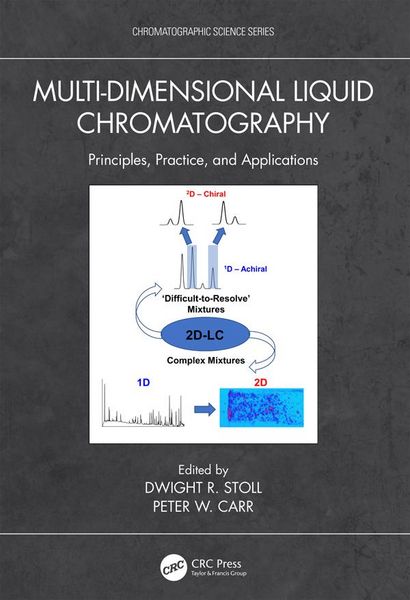
Multi-Dimensional Liquid Chromatography Principles, Practice, and Applications
-
- Hardcover
- Taschenbuch
- eBook ausgewählt
-
Form:Einzelkauf Download
-
Sprache:Englisch
-
eBook Format:PDF
- PDF 70,50 € ausgewählt
- ePUB 69,90 €
70,50 €
inkl. gesetzl. MwSt.Beschreibung
Produktdetails
Format
Kopierschutz
Ja
Family Sharing
Nein
Text-to-Speech
Nein
Erscheinungsdatum
30.12.2022
Herausgeber
Dwight R. Stoll + weitereVerlag
Taylor & Francis eBooksSeitenzahl
400 (Printausgabe)
Auflage
1. Auflage
Sprache
Englisch
EAN
9781000817331
Two-dimensional liquid chromatography (2D-LC) is finding increasingly wide application principally due to the analysis of mixtures of moderate to high complexity. Many industries are developing increasingly complex products that are challenging the separation capabilities of state-of-the-art 1D-LC and need new analytical methodologies with substantially more resolving power, and 2D-LC meets that need.
This text, organized by two leaders in the field, establishes a sound fundamental basis for the principles of the technique, followed by a discussion of important practical considerations. The book begins with an introduction to multi-dimensional separations and a discussion of the history and development of the technique over the past 40 years, followed by several chapters that provide a theoretical basis for development of 2D-LC methods, including foundational concepts regarding separation complementarity, under-sampling, and dynamics of liquid chromatography separations. Instrumentation for 2D-LC is discussed extensively, including practical aspects such as interface selection and setup. Building on this foundation, two separate chapters are focused on method development for non-comprehensive and comprehensive separations, followed by a chapter dedicated to data analysis. Finally, applications of 2D-LC in several fields ranging from pharmaceutical analysis to polymer science are summarized.
The book is an important resource for both students and practitioners who are already using 2D-LC or are interested in getting started in the field.
Key Features:
- Demonstrates the conditions under which a 2D-LC method should be considered as an alternative to a 1D-LC method
- Establishes a sound fundamental basis of the principles of the technique, followed by guidelines for method optimization
- Provides a single source for technical knowledge advances and practical guidance described in recent literature
- Assists with the initial decision to develop a 2D-LC method
- Guides the reader in developing a high-quality method that meets the needs of their application
Noch keine Bewertungen vorhanden
Verfassen Sie die erste Bewertung zu diesem Artikel
Helfen Sie anderen Kundinnen und Kunden durch Ihre Meinung.
Kurze Frage zu unserer Seite
Vielen Dank für Ihr Feedback
Wir nutzen Ihr Feedback, um unsere Produktseiten zu verbessern. Bitte haben Sie Verständnis, dass wir Ihnen keine Rückmeldung geben können. Falls Sie Kontakt mit uns aufnehmen möchten, können Sie sich aber gerne an unseren Kund*innenservice wenden.
zum Kundenservice