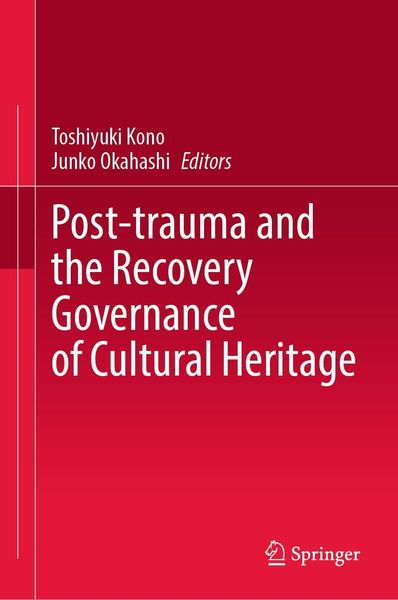
Post-trauma and the Recovery Governance of Cultural Heritage
-
- Hardcover
- Taschenbuch
- eBook ausgewählt
-
Form:Einzelkauf Download
-
Sprache:Englisch
142,99 €
inkl. gesetzl. MwSt.Beschreibung
Produktdetails
Format
Kopierschutz
Nein
Family Sharing
Nein
Text-to-Speech
Nein
Erscheinungsdatum
02.12.2022
Herausgeber
Toshiyuki Kono + weitereVerlag
Springer Nature SingaporeSeitenzahl
281 (Printausgabe)
Dateigröße
8268 KB
Sprache
Englisch
EAN
9789811960413
This book successfully represents the indispensable interdisciplinarity of viewpoints by its authors combining legal perspectives with architectural and anthropological approaches. With the observation and analysis presented here, this book is the first to demonstrate research-based governance solutions for cultural heritage within the process of recovering from traumatic events. Its opening statement is that universal international standards are not effective enough for the specific situations of disaster-struck places.
A major objective of this monograph is to allow its readers to go through a learning experience, from plural cases where reconstruction of cultural heritage became central to rebuilding a post-disaster society. This book introduces Japan as the most disaster-prone country, with a long history of confronting and overcoming the power of nature, resulting in its unique solutions for cultural heritage resilience and sustainability. But how do leadership and decision making become efficient in times of recovery? Bearing in mind what may be lacking in Japanese practices, this work also presents comparable governance models from other countries which indicate alternative solutions.
While a traumatic event may occur within one night, the process of recovery could last for decades. Such disasters also tend to recur. In order that directly affected communities can sustain resilience throughout the long recovery period, and that equally severe social trauma will not be repeated, a continuous, well-maintained governance response is required, whether grounded in local knowledge or national policy frameworks. At the heart of this book is the matter of the reconstruction process involving networks of small and large communities. Each of those has a role that becomes operational through linkages of contacts, the interchange of knowledge and skills, and above all through the sharing of common goals.
Noch keine Bewertungen vorhanden
Verfassen Sie die erste Bewertung zu diesem Artikel
Helfen Sie anderen Kundinnen und Kunden durch Ihre Meinung.
Kurze Frage zu unserer Seite
Vielen Dank für Ihr Feedback
Wir nutzen Ihr Feedback, um unsere Produktseiten zu verbessern. Bitte haben Sie Verständnis, dass wir Ihnen keine Rückmeldung geben können. Falls Sie Kontakt mit uns aufnehmen möchten, können Sie sich aber gerne an unseren Kund*innenservice wenden.
zum Kundenservice