KI-Beratung Beta

  • Produktbild: Academic Style Proofreading
  • Produktbild: Academic Style Proofreading
Band 54

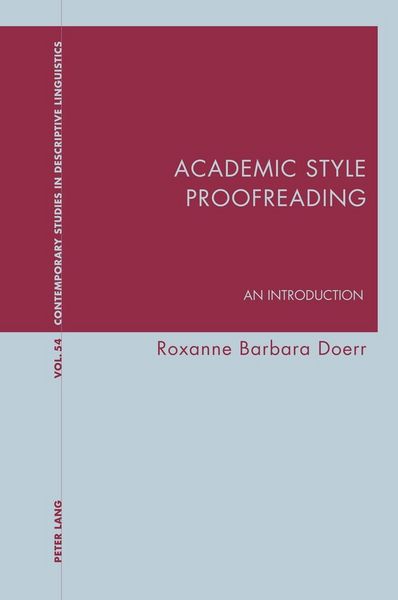
Academic Style Proofreading An Introduction

61,20 €

inkl. gesetzl. MwSt., Versandkostenfrei


Beschreibung

«The contribution of Dr Doerr’s book is beyond measure. Her research relies on highly sophisticated methodology with invaluable practical applications in academic style editing for scholars who are non-native speakers of English. Academic Style Proofreading stands to become vital for readers from across...

Beschreibung

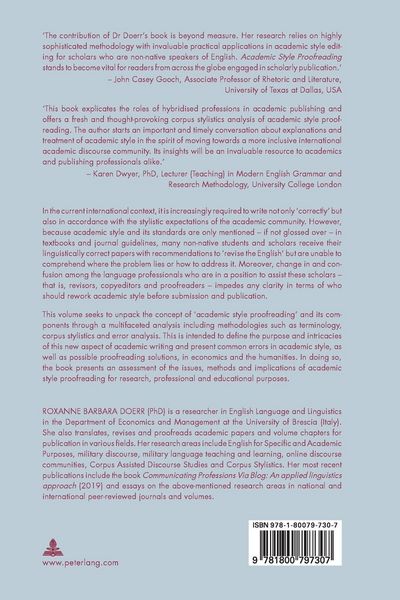
«The contribution of Dr Doerr’s book is beyond measure. Her research relies on highly sophisticated methodology with invaluable practical applications in academic style editing for scholars who are non-native speakers of English. Academic Style Proofreading stands to become vital for readers from across the globe engaged in scholarly publication.»(John Casey Gooch, Associate Professor of Rhetoric and Literature, University of Texas at Dallas, USA)«This book explicates the roles of hybridised professions in academic publishing and offers a fresh and thought-provoking corpus stylistics analysis of academic style proofreading. The author starts an important and timely conversation about explanations and treatment of academic style in the spirit of moving towards a more inclusive international academic discourse community. Its insights will be an invaluable resource to academics and publishing professionals alike.»(Karen Dwyer, PhD, Lecturer (Teaching) in Modern English Grammar and Research Methodology, University College London)In the current international context, it is increasingly required to write not only «correctly» but also in accordance with the stylistic expectations of the academic community. However, because academic style and its standards are only mentioned – if not glossed over – in textbooks and journal guidelines, many non-native students and scholars receive their linguistically correct papers with recommendations to «revise the English» but are unable to comprehend where the problem lies or how to address it. Moreover, change in and confusion among the language professionals who are in a position to assist these scholars – that is, revisors, copyeditors and proofreaders – impedes any clarity in terms of who should rework academic style before submission and publication.This volume seeks to unpack the concept of «academic style proofreading» and its components through a multifaceted analysis including methodologies such as terminology, corpus stylistics and error analysis. This is intended to define the purpose and intricacies of this new aspect of academic writing and present common errors in academic style, as well as possible proofreading solutions, in economics and the humanities. In doing so, the book presents an assessment of the issues, methods and implications of academic style proofreading for research, professional and educational purposes.

Produktdetails

Einband

Taschenbuch

Erscheinungsdatum

27.01.2023

Abbildungen

12

Herausgeber Graeme Davis + weitere

Produktdetails

Einband

Taschenbuch

Erscheinungsdatum

27.01.2023

Abbildungen

12

Herausgeber
Verlag Peter Lang Ltd. International Academic Publishers
Seitenzahl

244

Maße (L/B/H)

22,9/15,2/1,5 cm

Gewicht

380 g

Auflage

1

Sprache

Englisch

ISBN

978-1-80079-730-7

EU-Ansprechpartner

Kolibri 360 GmbH
Ettore-Bugatti-Straße 6-14
51149 Köln
DE
produktsicherheit@kolibri360.de

Herstelleradresse

Peter Lang
Avenue du Théâtre 7
1005 Lausanne
CH
orders@peterlang.com

Noch keine Bewertungen vorhanden

Verfassen Sie die erste Bewertung zu diesem Artikel

Helfen Sie anderen Kundinnen und Kunden durch Ihre Meinung.

Kundinnen und Kunden meinen

Bewertungen (0)

Die Leseprobe wird geladen.
  • Produktbild: Academic Style Proofreading
  • Produktbild: Academic Style Proofreading

  • Contents: Introduction – Proofreading: Shifting definitions, demands and profiles – Publishing in academia is a matter of ‘style’ – Style and stylistics in academic English and proofreading – Methodology, dataset and areas of interest – Qualitative analysis and main findings – Concluding remarks and considerations.