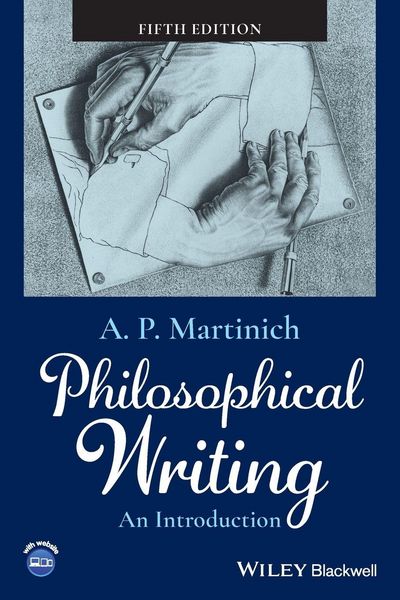
Philosophical Writing An Introduction
-
- Englisch ausgewählt
29,99 €
UVP
34,20 €
inkl. gesetzl. MwSt.,
- Kostenlose Lieferung ab 30 € Einkaufswert
- Versandkostenfrei für Bonuscard-Kund*innen
Beschreibung
Produktdetails
Einband
Taschenbuch
Erscheinungsdatum
23.08.2024
Verlag
John Wiley & SonsSeitenzahl
290
Maße (L/B/H)
22,8/15,2/1,8 cm
Gewicht
436 g
Auflage
5. Auflage
Sprache
Englisch
ISBN
978-1-394-19339-4
Tracing the evolution of a good philosophical essay from the draft stage to completion, the book's eleven chapters are purpose-built to serve the needs of a wide range of students, with levels ranging from elementary to moderately advanced. Philosophical Writing includes numerous essay examples, techniques for outlining and composing, guidance on evaluating philosophical essays, useful appendices, a glossary, a full-featured companion website, and more.
Now in its fifth edition, Philosophical Writing is fully updated with enhanced language and improved explanations throughout. Two entirely new chapters delve into the intricacies of belief networks and explore the properties of sound interpretations, supported by a wealth of new exercises and discussion questions.
Written with clarity and humor by a leading analytic philosopher, Philosophical Writing:
* Helps students organize their beliefs, assess their interpretations, and critically evaluate the ideas of others
* Explains the basic concepts of logic and rhetoric, the structure of a philosophical essay, and the criterion of good philosophical writing
* Describes key tactics for analytic writing, such as definitions, analysis, counterexamples, and dialectical reasoning
* Discusses the concepts of author and audience as they apply to a student's philosophical writing
* Offers advice on common problems that students encounter when writing a philosophical essay
Philosophical Writing: An Introduction, Fifth Edition, remains an ideal textbook for lower- and upper-division courses in philosophy, particularly introductory philosophy classes, as well as courses with significant writing components that cover logic, rhetoric, and analysis.
Noch keine Bewertungen vorhanden
Verfassen Sie die erste Bewertung zu diesem Artikel
Helfen Sie anderen Kundinnen und Kunden durch Ihre Meinung.
Kurze Frage zu unserer Seite
Vielen Dank für Ihr Feedback
Wir nutzen Ihr Feedback, um unsere Produktseiten zu verbessern. Bitte haben Sie Verständnis, dass wir Ihnen keine Rückmeldung geben können. Falls Sie Kontakt mit uns aufnehmen möchten, können Sie sich aber gerne an unseren Kund*innenservice wenden.
zum Kundenservice