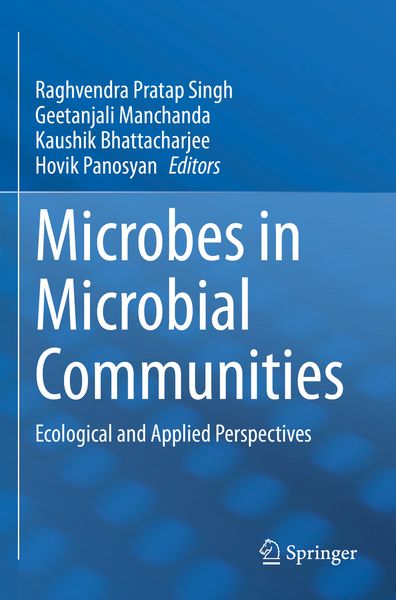
Microbes in Microbial Communities Ecological and Applied Perspectives
-
- Hardcover
- Taschenbuch ausgewählt
- eBook
-
Sprache:Englisch
142,99 €
UVP
164,99 €
inkl. gesetzl. MwSt.,
Beschreibung
Produktdetails
Einband
Taschenbuch
Erscheinungsdatum
17.12.2022
Abbildungen
XIII, 370 p. 1 illus.
Herausgeber
Raghvendra Pratap Singh + weitereVerlag
Springer SingaporeSeitenzahl
370
Maße (L/B/H)
23,5/15,5/2,1 cm
Gewicht
581 g
Auflage
22001 Auflage 1st ed. 2021
Sprache
Englisch
ISBN
978-981-16-5619-4
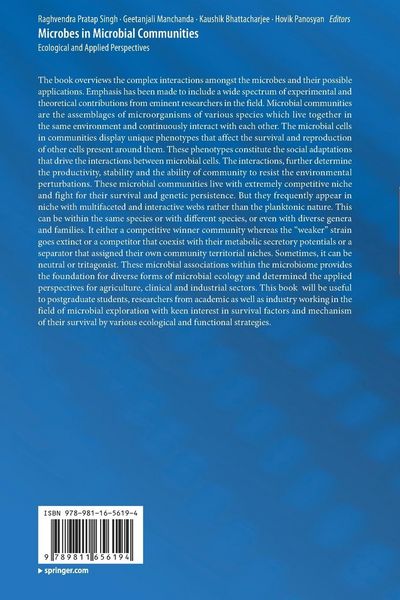
The book overviews the complex interactions amongst the microbes and their possible applications. Emphasis has been made to include a wide spectrum of experimental and theoretical contributions from eminent researchers in the field. Microbial communities are the assemblages of microorganisms of various species which live together in the same environment and continuously interact with each other. The microbial cells in communities display unique phenotypes that affect the survival and reproduction of other cells present around them. These phenotypes constitute the social adaptations that drive the interactions between microbial cells. The interactions, further determine the productivity, stability and the ability of community to resist the environmental perturbations. These microbial communities live with extremely competitive niche and fight for their survival and genetic persistence. But they frequently appear in niche with multifaceted and interactive webs rather than the planktonic nature. This can be within the same species or with different species, or even with diverse genera and families. It either a competitive winner community whereas the “weaker” strain goes extinct or a competitor that coexist with their metabolic secretory potentials or a separator that assigned their own community territorial niches. Sometimes, it can be neutral or tritagonist. These microbial associations within the microbiome provides the foundation for diverse forms of microbial ecology and determined the applied perspectives for agriculture, clinical and industrial sectors. This book will be useful to postgraduate students, researchers from academic as well as industry working in the field of microbial exploration with keen interest in survival factors and mechanism of their survival by various ecological and functional strategies.
Noch keine Bewertungen vorhanden
Verfassen Sie die erste Bewertung zu diesem Artikel
Helfen Sie anderen Kundinnen und Kunden durch Ihre Meinung.
Kurze Frage zu unserer Seite
Vielen Dank für Ihr Feedback
Wir nutzen Ihr Feedback, um unsere Produktseiten zu verbessern. Bitte haben Sie Verständnis, dass wir Ihnen keine Rückmeldung geben können. Falls Sie Kontakt mit uns aufnehmen möchten, können Sie sich aber gerne an unseren Kund*innenservice wenden.
zum Kundenservice