KI-Beratung Beta

  • Produktbild: Routledge Companion to Global Cyber-Security Strategy
  • Produktbild: Routledge Companion to Global Cyber-Security Strategy

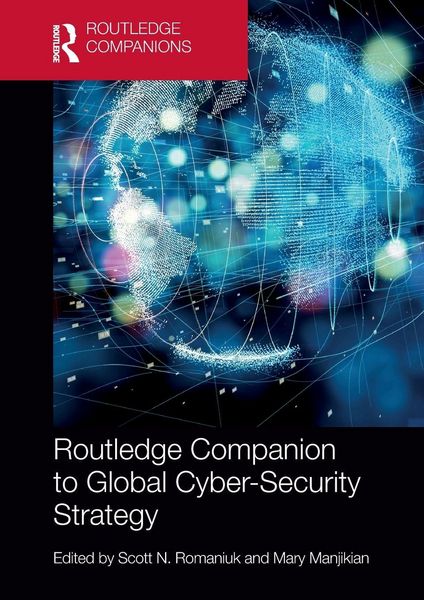
Routledge Companion to Global Cyber-Security Strategy

64,99 €

inkl. gesetzl. MwSt., Versandkostenfrei


Beschreibung

This companion provides the most comprehensive and up-to-date comparative overview of the cyber-security strategies and doctrines of the major states and actors in Europe, North America, South America, Africa, and Asia.

The volume offers an introduction to each nation's cyber-security strategy and policy,...

Beschreibung

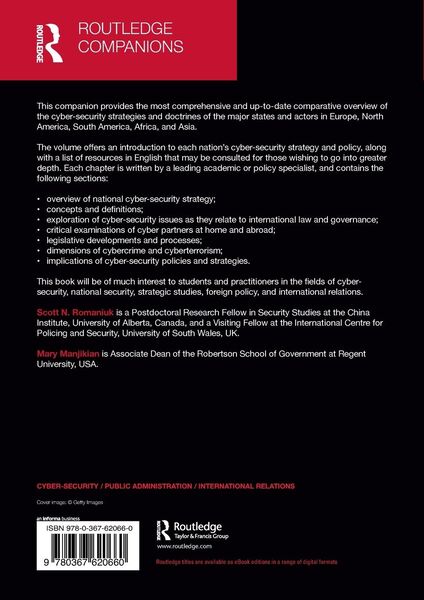
This companion provides the most comprehensive and up-to-date comparative overview of the cyber-security strategies and doctrines of the major states and actors in Europe, North America, South America, Africa, and Asia.

The volume offers an introduction to each nation's cyber-security strategy and policy, along with a list of resources in English that may be consulted for those wishing to go into greater depth. Each chapter is written by a leading academic or policy specialist, and contains the following sections:

  • overview of national cyber-security strategy;
  • concepts and definitions;
  • exploration of cyber-security issues as they relate to international law and governance;
  • critical examinations of cyber partners at home and abroad;
  • legislative developments and processes;
  • dimensions of cybercrime and cyberterrorism;
  • implications of cyber-security policies and strategies.

This book will be of much interest to students and practitioners in the fields of cyber-security, national security, strategic studies, foreign policy, and international relations.

Rezension

'To create this omnibus collection, Romaniuk (Univ. of Alberta) and Manjikian (Regent Univ.) gathered the most comprehensive possible set of essays on national cybersecurity policies. Each of the 51 chapters provides an up-to-date summary and analysis of a single country's cybersecurity situation and strategies. Hostile-state actors, online terrorists, organized criminal groups, black hat hackers, and other bad actors all must be countered through sophisticated advance planning. Defenders are generally at a significant disadvantage against their nimbler attackers. Policies vary according to how each nation defines and prioritizes the potential threats. An authoritarian government, for example, will be far more concerned with controlling politically sensitive information that might undermine the power of the ruling regime than a more democratic nation. A maritime country is likely to prioritize different defenses than one that is landlocked. Countries that were once parts of the former Soviet Union fear hybrid warfare attacks that might be launched from Russia. Although the individual essays provide fine summaries of the unique laws, political forces, and social dynamics obtaining in each nation discussed, the book as a whole would have been greatly enhanced by expanding the editors' nine-page introduction to further integrate the themes drawn from these diverse contributions.

Summing Up: Recommended. Upper-division undergraduates. Graduate students, faculty, and professionals.'

--T. H. Koenig, Northeastern University, Choice, December 2022

Produktdetails

Einband

Taschenbuch

Erscheinungsdatum

09.01.2023

Abbildungen

18 SW-Abb., 2 SW-Fotos, 16 SW-Zeichn., 18 Tabellen

Herausgeber Scott N. Romaniuk + weitere

Produktdetails

Einband

Taschenbuch

Erscheinungsdatum

09.01.2023

Abbildungen

18 SW-Abb., 2 SW-Fotos, 16 SW-Zeichn., 18 Tabellen

Herausgeber
Verlag Taylor & Francis
Seitenzahl

658

Maße (L/B/H)

24,6/17,4/3,5 cm

Gewicht

1152 g

Sprache

Englisch

ISBN

978-0-367-62066-0

Herstelleradresse

Libri GmbH
Europaallee 1
36244 Bad Hersfeld
DE

Email: gpsr@libri.de

Noch keine Bewertungen vorhanden

Verfassen Sie die erste Bewertung zu diesem Artikel

Helfen Sie anderen Kundinnen und Kunden durch Ihre Meinung.

Kundinnen und Kunden meinen

Bewertungen (0)

Die Leseprobe wird geladen.
  • Produktbild: Routledge Companion to Global Cyber-Security Strategy
  • Produktbild: Routledge Companion to Global Cyber-Security Strategy
  • Foreword: Global cybersecurity in the 21st century; Introduction: cybersecurity strategy and policy in a comparative context (Mary Manjikian and Scott N. Romaniuk); Part I: Europe; 1 Securing the kingdom's cyberspace: cybersecurity and cyber intelligence in Spain (Rubén Arcos); 2 Albania's cybersecurity pivot: between western architectures and great power competition (Alexander Fotescu and Mihai Chihaia); 3 Armenian national policy in cyber space: toward a global cyber security architecture (Ruben Elamiryan); 4 Czech Republic: a new cyber security leader in Central Europe (Lucie Kadlecová and Michaela Semecká); 5 Cybersecurity in the French Republic (Amber Darwish and Scott N. Romaniuk); 6 Germany's cybersecurity strategy: confronting future challenges (Scott N. Romaniuk and Michael Claus); 7 Cybersecurity of Poland: legal and organizational framework (Dominika Dziwisz); 8 Hungary: from the groundworks to an evolving cyber security landscape (Annamária Beláz and Dániel Berzsenyi); 9 Romanian cybersecurity efforts: a work in progress (Oana-Elena Brânda); 10 Italy's cybersecurity architecture and critical infrastructure (Tommaso De Zan, Giampiero Giacomello, and Luigi Martino); 11 Dutch cyber security strategy (Joost Bunk and Max Smeets); 12 Norwegian cybersecurity: a small-state approach to building international cyber cooperation (Lars Gjesvik); 13 Seeking a new order for global cybersecurity: the Russian approach to cyber-sovereignty (Ilona Stadnik); 14 Slovakia: the Tatra Tiger without teeth (Aaron T. Walter); 15 Slovenia: a fragmented cyber security (Laris Gaiser); 16 In the line of Russian aggression: Ukraine, hybrid warfare, and cyber security defense (Olya Zaporozhets and Oleksiy Syvak); 17 United Kingdom: pragmatism and adaptability in the cyber realm (Tim Stevens); 18 European Union: policy, cohesion, and supranational experiences with cybersecurity (Christopher Whyte); 19 Estonia: from the "Bronze Night" to cybersecurity pioneers (Nick Robinson and Alex Hardy); 20 NATO's evolving cyber security policy and strategy (Scott N. Romaniuk, Alexander Fotescu, and Mihai Chihaia); Part II: Asia and Australia; 21 Japan's challenges, capabilities, and preparedness in cyberspace (Tobias Burgers, Scott N. Romaniuk, and Cherry H. Y. Wong); 22 An effective shield? Analyzing South Korea's cybersecurity strategy (Yangmo Ku); 23 In the line of fire: Taiwan's legal, political, and technological cybersecurity posture (Tobias Burgers, Moritz Hellmann and Scott N. Romaniuk); 24 Serving the people: China's cybersecurity policy and its implications (Yu-Cheng Chen, Tony Tai-Ting Liu, and Scott N. Romaniuk); 25 Cybersecurity in a one-party state: policies and implications for Vietnam's economy and online freedom (Phan Le); 26 The Philippines' cybersecurity strategy: strengthening partnerships to enhance cybersecurity capability (Amparo Pamela, H. Fabe, and Ella Zarcilla-Genecela); 27 Malaysia: balancing national development, national security, and cybersecurity policy (Ahmad El-Muhammady); 28 Cyber governance and data protection in India: a critical legal analysis (Debarati Halder and K. Jaishankar); 29 Cyber security: a national priority for Bangladesh (Md. Shariful Islam); 30 Managing a digital revolution: cyber security capacity building in Myanmar (Niels Nagelhus Schia and Lars Gjesvik); 31 Australia's cyber securit