KI-Beratung Beta

Gutscheinbedingungen

**Gültig bis 30.11.2026 auf Spielzeug, Schreibwaren, Filme, Geschenke & Trends, Musik, tolino eReader & Zubehör, Hörbücher und Hörbuch-Downloads, nicht preisgebundene Bücher und Kalender online auf thalia.at und in der Thalia App. Einzelne Artikel können ausgeschlossen sein. Aufgrund der Buchpreisbindung sind deutschsprachige Bücher und eBooks ausgenommen. Zusätzlich ausgenommen sind Abos & Flatrates, Games, Geschenkkarten/-boxen, Shelfies, Software, Zeitschriften sowie einzelne Artikel von tonies®. Pro Einkauf einmal einlösbar. Nur gültig mit im Onlineshop hinterlegter Bonuscard. Click & Collect nur bei Onlinevorabzahlung möglich. Keine Barauszahlung. Nicht kombinierbar mit anderen Aktionen und Gutscheinen. Gutschein wird auf max. 500€ Bestellwert angerechnet. Nicht gültig für Versandkosten und Services.

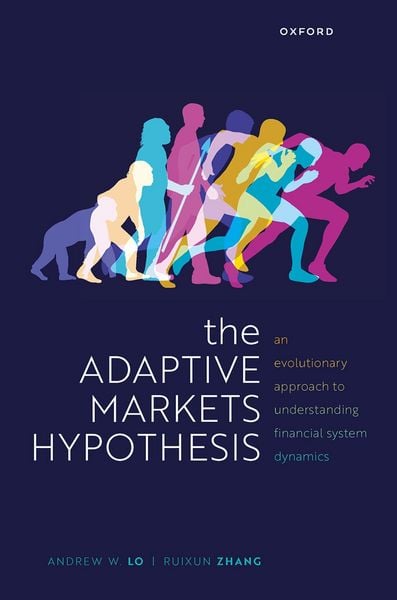
Produktbild: The Adaptive Markets Hypothesis

The Adaptive Markets Hypothesis An Evolutionary Approach to Understanding Financial System Dynamics

35,99 €

inkl. gesetzl. MwSt., Versandkostenfrei


Beschreibung

The Adaptive Markets Hypothesis (AMH) presents a formal and systematic exposition of a new narrative about financial markets that reconciles rational investor behaviour with periods of temporary financial insanity. In this narrative, intelligent but fallible investors learn from and adapt to randomly...

Beschreibung

The Adaptive Markets Hypothesis (AMH) presents a formal and systematic exposition of a new narrative about financial markets that reconciles rational investor behaviour with periods of temporary financial insanity. In this narrative, intelligent but fallible investors learn from and adapt to randomly shifting environments. Financial markets may not always be efficient, but they are highly competitive, innovative, and adaptive, varying in their degree of efficiency as investor populations and the financial landscape change over time. Andrew Lo and Ruixun Zhang develop the mathematical foundations of the AMH--a simple yet surprisingly powerful set of evolutionary models of behaviour--and then apply these foundations to show how the most fundamental economic behaviours that we take for granted can arise solely through natural selection. Drawing on recent advances in cognitive neuroscience and artificial intelligence, the book also explores how our brain affects economic and financial decision making. The AMH can be applied in many contexts, ranging from designing trading strategies, to managing risk and understanding financial crises, to formulating macroprudential policies to promote financial stability. This volume is a must read for anyone who has ever been puzzled and concerned by the behaviour of financial markets and the implications for their personal wealth, and seeks to learn how best to respond to such behaviour.

Produktdetails

Einband

Gebundene Ausgabe

Erscheinungsdatum

22.02.2024

Verlag Oxford University Press
Seitenzahl

765

Produktdetails

Einband

Gebundene Ausgabe

Erscheinungsdatum

22.02.2024

Verlag Oxford University Press
Seitenzahl

765

Maße (L/B/H)

23,7/16,4/4 cm

Gewicht

1348 g

Farbe

Dunkellila

Sprache

Englisch

ISBN

978-0-19-968114-3

Herstelleradresse

Libri GmbH
Europaallee 1
36244 Bad Hersfeld
DE

Email: gpsr@libri.de

Noch keine Bewertungen vorhanden

Verfassen Sie die erste Bewertung zu diesem Artikel

Helfen Sie anderen Kundinnen und Kunden durch Ihre Meinung.

Kundinnen und Kunden meinen

Bewertungen (0)

Die Leseprobe wird geladen.
  • Produktbild: The Adaptive Markets Hypothesis
    • 1: Introduction and Roadmap
    • 2: The Origin of Behaviour
    • 3: Mutation
    • 4: Group Selection
    • 5: Probability Matching
    • 6: Risk Aversion
    • 7: Cooperation
    • 8: Bounded Rationality and Intelligence
    • 9: Learning to be Bayesian
    • 10: The Madness of Mobs
    • 11: Fear, Greed, and Financial Crises
    • 12: The Psychophysiology of Trading
    • 13: What Makes a Good Day Trader?
    • 14: A Computational View of Market Efficiency
    • 15: Maximizing Relative vs. Absolute Wealth
    • 16: Hedge Funds: The Galápagos Islands of Finance
    • 17: What Happened to the Quants in August 2007?
    • 18: Co-Evolution of Financial Markets and Technology
    • 19: The Role of Culture in Finance
    • 20: Regulation and Adaptive Markets