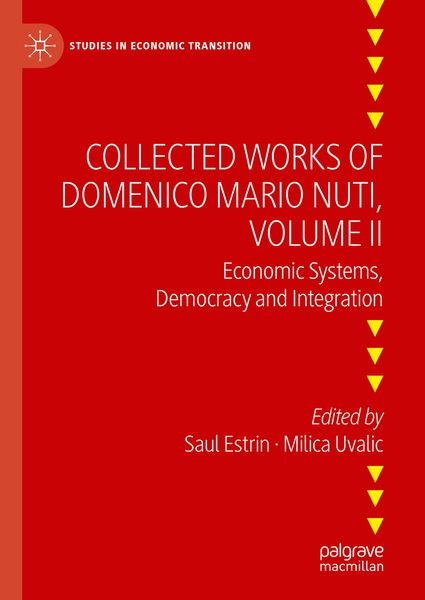
Produktbild: Collected Works of Domenico Mario Nuti, Volume II
- 15%

Collected Works of Domenico Mario Nuti, Volume II Economic Systems, Democracy and Integration

15% sparen

166,99 € UVP 197,99 €

inkl. gesetzl. MwSt., Versandkostenfrei


Beschreibung

Produktdetails

Einband

Gebundene Ausgabe

Erscheinungsdatum

11.08.2023

Herausgeber

Saul Estrin + weitere

Verlag

Springer

Seitenzahl

697

Maße (L/B/H)

21,6/15,3/4,3 cm

Gewicht

1023 g

Auflage

2023

Sprache

Englisch

ISBN

978-3-031-23166-7

Beschreibung

Portrait

Domenico Mario Nuti was Professor of Economics at La Sapienza University in Rome and the European University Institute in Florence.  He also held positions at the University of Cambridge, University of Birmingham, and the London Business School.

Saul Estrin is Emeritus Professor of Managerial Economics and Strategy at LSE.

Milica Uvalic is Professor of Economics at the University of Perugia.

Produktdetails

Einband

Gebundene Ausgabe

Erscheinungsdatum

11.08.2023

Herausgeber

Verlag

Springer

Seitenzahl

697

Maße (L/B/H)

21,6/15,3/4,3 cm

Gewicht

1023 g

Auflage

2023

Sprache

Englisch

ISBN

978-3-031-23166-7

Herstelleradresse

Springer-Verlag GmbH
Tiergartenstr. 17
69121 Heidelberg
DE

Email: ProductSafety@springernature.com

Noch keine Bewertungen vorhanden

Verfassen Sie die erste Bewertung zu diesem Artikel

Helfen Sie anderen Kundinnen und Kunden durch Ihre Meinung.

Kundinnen und Kunden meinen

Bewertungen (0)

  • Produktbild: Collected Works of Domenico Mario Nuti, Volume II
  • Chapter 1. An introduction to the Collected Works of Domenico Mario Nuti ,  Saul Estrin and Milica Uvalic.- Part I. Evolution of economic systems.- Chapter 2. Capitalism, socialism and steady growth.- Chapter 3. The degree of monopoly in the Kaldor-Mirrlees growth model.- Chapter 4. V. K. Dmitriev: Economic Essays on Value, Competition and Utility.- Chapter 5. Kalecki and Keynes revisited: Two original approaches to demand-determined income – and much more besides.- Chapter 6. Full indexation and less-than-full wage indexation”.- Chapter 7. Post-communist mutations.- Chapter 8. Comparative economics after the transition.- Chapter 9. Kornai: shortage versus surplus economies.- Chapter 10. The Chinese alternative.- Chapter 11. Alternative pension systems: Generalities and reform issues in transition economies.- Chapter 12. A flat tax is for a flat Earth.- Chapter 13. The rise and fall of socialism.- PART II.Economic democracy.- Chapter 14. Codetermination, profit-sharing and full employment.- Chapter 15. On traditional cooperatives and James Meade's labour-capital discriminating partnerships.- Chapter 16. Profit-sharing and employment: claims and overclaims.- Chapter 17. Employee ownership in Polish privatizations.- Chapter 18. Employeeism: corporate governance and employee share ownership in transition economies.- Chapter 19. Employee participation in enterprise control and returns: patterns, gaps and discontinuities.- PART III. East-West integration and globalization.- Chapter 20. The case for Western aid to Central Eastern Europe.- Chapter 21. The impact of systemic transition on the European Community.- Chapter 22. Symposium on  Exchange rate regimes in transition economies. The euroization debate.  Introduction.- Chapter 23. Costs and benefits of unilateral euroization in central eastern Europe.- Chapter 24. Globalization today: incomplete, distorted and unfair.- Chapter 25. The impact of the global crisis on transition economies.- Chapter 26. The European Social Model: Is there a Third Way?.- Chapter 27. Seismic faults in the European Union.